









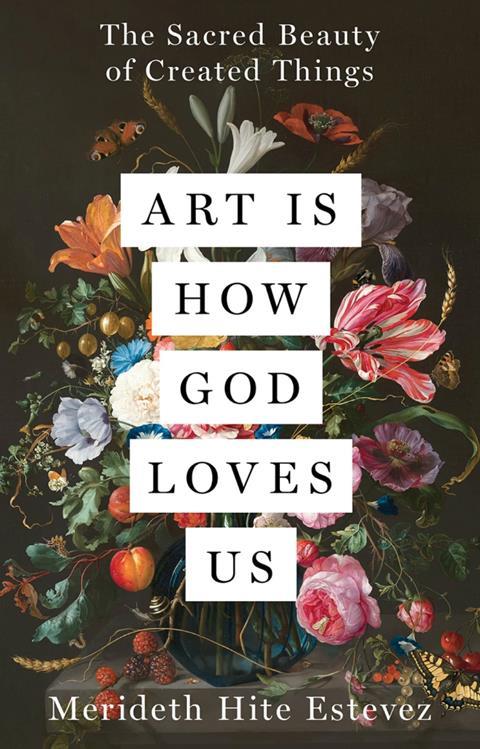
In Art Is How God Loves Us, Merideth Hite Estevez offers a warm invitation to encounter God through beauty and creativity. Though some readers may long for firmer theological grounding, her vision of art as a pathway to grace is compelling, says our reviewer

Art is not simply something human beings make; it is one of the ways God continues to reach toward us in a bruised and distracted world.
Merideth Hite Estevez’s Art Is How God Loves Us (Broadleaf Books) is a warm, generous, and deeply personal invitation to see art not as decoration, luxury, or specialist territory, but as one of the places where divine love becomes perceptible. From the opening pages, Estevez makes clear that this is not a book about mastering aesthetics or learning the right critical vocabulary. It is a book about tenderness and spiritual receptivity.
The book’s central line is: “Art is how God loves us.” That line, borrowed from Estevez’s reading of Makoto Fujimura’s thought that God creates “out of love, not necessity,” becomes the interpretive key for everything that follows. Art is presented here as a spiritual gateway, a site where Ultimate Reality as she often calls God or Spirit can break through our shame, perfectionism, exhaustion and emotional numbness. Estevez wants readers to recover a sense of wonder before music, painting, sculpture, poetry and the beauty of created things, not merely as enriching experiences but as hints of the Really Real.
Estevez repeatedly contends that art can help us see ourselves differently – not as projects to perfect, but as works in progress already held in divine regard. One particularly strong passage speaks of God as “the God who sees,” drawing on Hagar’s naming of El Roi, and imagines human beings as beloved works of art to which God continually returns. It is a beautiful and pastorally sensitive image, especially for readers whose creativity has become entangled with performance anxiety, comparison, or shame.
The structure of the book is also carefully considered. It unfolds in three parts – “Spark,” “Shadow,” and “Source” – with interludes and a concluding “Creative Creed.” The movement is intentional: from awakening to artistic and spiritual attention, through darkness and surrender, and finally toward freedom, abundance, and a more integrated life. Estevez explores works of both sacred and secular art, and she explicitly includes underrepresented voices alongside more familiar Western “masters.” She also aims to give readers tools for engaging art through what she calls “Ars Nova,” a way of seeing and hearing that slows us down and opens us to God’s presence.
Estevez writes with real warmth and accessibility. She is clearly well read, musically trained, and spiritually serious, but she never writes as though art belongs only to the cultured few. In fact, one of her recurring concerns is to lower the drawbridge for intimidated readers. She wants those who feel unsure around art to enter without embarrassment. Again and again, she reassures the reader that attention matters more than expertise. That instinct makes the book hospitable and pastorally useful.
There is also a generous ecumenical and even interfaith breadth to the work. Estevez refers approvingly to Thomas Keating’s “Eight Points of Agreement,” especially the claim that Ultimate Reality may be encountered not only through religious practice but also through nature, art, relationships and service. She writes as a Christian and names God and Spirit quite openly, but there is a spaciousness in her approach that will likely appeal to a broad spiritual readership.
That said, the book is not without weaknesses. At times, its prose can become slightly overripe, with a steady stream of lyrical abstractions – beauty, wonder, reality, belovedness, tenderness, transcendence – that occasionally blur together. The cumulative effect is often moving, but some readers may wish for a little more restraint or sharper theological definition. There are moments when the book feels more like a long spiritual encouragement than a tightly argued work.
Relatedly, readers looking for a more rigorous theology of art may come away unsatisfied. Estevez offers rich reflection, personal testimony, and evocative language, but less sustained critical engagement with harder questions. What exactly distinguishes spiritual experience through art from aesthetic intensity alone? How do we discern between revelation and projection? Can all art be spoken of so positively, or are there limits? The book gestures toward these questions, but does not dwell on them for long.
Even so, Art Is How God Loves Us succeeds in what it most wants to do. It opens a door. It invites readers to become more attentive, more porous, more willing to be surprised by grace through created beauty. In a world of constant noise, speed and self-protection, that is no small gift.
Estevez’s central message is one many readers will need to hear: that beauty is not demanding our perfection but inviting our presence. Art is not simply for experts, nor only for artists, but for anyone willing to remain tender enough to notice. This is a thoughtful, luminous book that will resonate especially with spiritually hungry readers, artists recovering joy, and anyone trying to find God again through beauty rather than argument.






















No comments yet