






Blair Linne’s Made To Tremble offers a nuanced and biblical perspective on anxiety, says our reviewer in this rare five star review

Made To Tremble: How Anxiety Became the Best Thing That Ever Happened to My Faith (B&H) by Blair Linne is a refreshingly nuanced reflection on anxiety, shaped by biblical insight, spiritual wisdom and personal experience. One of the pioneers of Christian spoken word poetry in the US, Linne bravely shares her own struggles with anxiety and the journey of dismantling harmful beliefs she held before a major car crash introduced her to a new and deeper level of anxiety.
The 41-year-old recounts how the crash, caused by hitting a deer, triggered a series of panic attacks. The way she describes these episodes feels reminiscent of the kind of anxiety someone experiencing PTSD might recognise.
Made To Tremble is a necessary read for the Church, which, despite good intentions, often takes a rigid approach to anxiety. The well-known words of Philippians 4:6–7: “be anxious for nothing” – are frequently cited to support a one-size-fits-all response, rather than a more careful, contextual reading of scripture.
Linne admits that she once held a similar view, assuming that all anxiety automatically fell under what she calls “sinful fear”. However, the circumstances following her crash led her to a more nuanced understanding. The mother of three thoughtfully distinguishes between sinful fear that manifests as anxiety and fear that is more accurately understood as a physiological response, rather than something inherently sinful.
The book is rich with scriptural reflections that explore the different dimensions of anxiety. Describing sinful fear, Linne writes: “The problem is not that we experience fear in our life, since we have established that it can be quite natural. The problem, then, is when we replace fear for our life when it keeps us from the One who is our Life by drawing our attention to our fear as though it sits on the throne rather than our Holy God.”
She also examines the Greek words used for anxiety in scripture, explaining their meanings and how they function within their biblical context. This definition resonated with me. As someone who has experienced low-level anxiety and panic attacks, I’ve found there is often a clear difference in intensity – panic attacks can feel like an overwhelming physiological response. Yet there are also aspects of anxiety that can become sinful when we choose to feed them.
I have experienced this “sinful fear” in the form of constant worrying and the desire to control every outcome. Demanding control is, in many ways, a lack of faith in God’s sovereignty over my life. Over time, I have found that meditating on God’s word and learning to surrender what is beyond my control to him has brought a greater sense of peace than before.
Elsewhere, Linne explains that overcoming anxiety is not about adopting stoicism, but about leaning into God’s strength in our weakness. She suggests that some forms of anxiety may function as a “thorn in the flesh” (2 Corinthians 12:7–9) – something we may or may not always experience. In this latter case, it shows how the thorn of anxiety can actually strengthen your faith as it causes you to be more dependent on God. This is a perspective that is often not considered in church contexts - that anxiety is a form of suffering that God can use to draw us nearer to him. I have experienced this in my own life. For example, in moments of feeling anxious, I’ve invited God in the process to help me remain present and try to focus on the things I can be grateful for in the midst of the anxiety. In moments like this, I have found God to be a tangible comforter and helper through his Holy Spirit. Like a friend who is right next to me in the midst of the suffering. In either case, the invitation is the same: to rely not on our own strength, but on God’s.
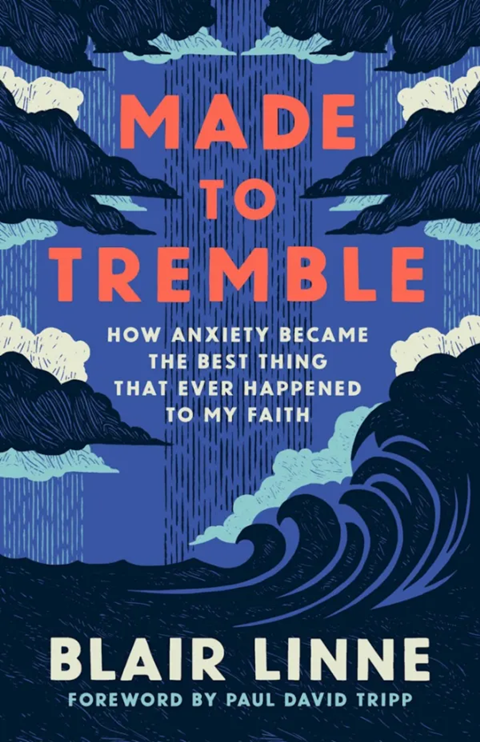
Linne’s book left me feeling seen and relieved, especially as a Christian. It is a valuable read for anyone who has experienced anxiety or who knows someone who does, encouraging us to lean on God in the midst of our afflictions.
At the same time, it gently challenges Christians to embrace common-grace support – such as medication or breathing exercises – as gifts God can use to help us navigate anxiety.
The book is a thoughtful and comprehensive approach to anxiety experiences, considering the many ways people experience it. This quote is evidence of that: “Even if we have experienced anxiety ourselves, it doesn’t mean that our friends are mimicking our affliction. We cannot put a one-size-fits-all Band-Aid upon all our anxieties…”
Linne’s poetic flair appears throughout the book in short sections of poetry. One of my favourite moments is where she lists exhortations drawn from scripture, intended to remind readers experiencing anxiety of God’s sovereignty and nearness in the midst of an anxious episode. Whether the feeling of anxiety fades or lingers, the reminder that we have access to God in the midst of it is a profound kindness – far better than facing it without him.
Linne also equips readers with practical tools alongside theological insight. She shares resources that have helped her navigate anxiety, including breathwork (not the New Age kind) and suggested responses people can use when supporting someone experiencing anxiety.
This book is a valuable read for Christians who experience anxiety. It offers helpful tools for distinguishing between sinful fear and anxiety, while providing practical guidance for navigating anxiety attacks. It would also benefit those who have not experienced anxiety themselves, helping them better understand and support brothers and sisters in the faith – and beyond – who have.




















No comments yet