












The Missing Messiah challenges readers to consider whether their view of Jesus has been shaped more by culture than by scripture. Clear and practical, it offers a compelling call to discipleship, though some critiques feel overly broad, says our reviewer

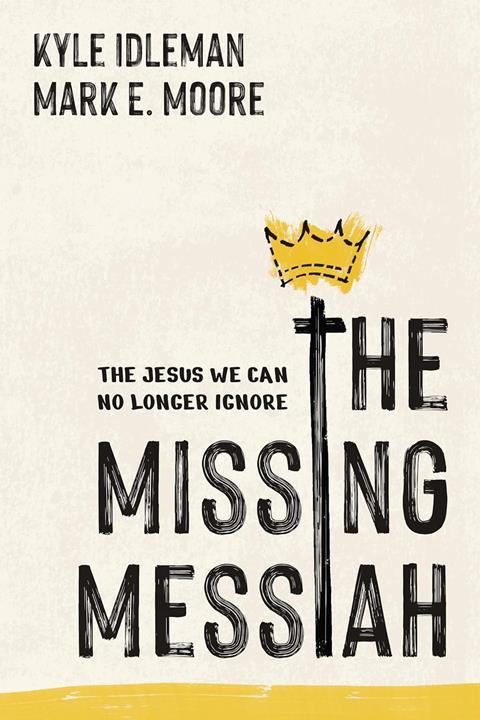
The Missing Messiah: The Jesus We Can No Longer Ignore (Tyndale Elevate) by Kyle Idleman and Mark E. Moore is a contemporary evangelical work that seeks to recover what the authors perceive as a diminished and culturally distorted understanding of Jesus. Written in a pastoral and accessible style, the book functions both as theological corrective and as a discipleship manual, urging readers to rediscover Jesus not merely as a comforting figure but as Messiah and King.
At its core, the book asks two simple questions: ‘What if your Jesus is shaped more by culture than by scripture?’, and ‘If Jesus walked into the room right now, would you recognise him?’ Idleman and Moore argue that modern, Western Christianity has reshaped Jesus into a figure of convenience: a ‘life coach,’ ‘therapist,’ ‘political ally,’ or even a ‘genie’ fulfilling personal desires. The result, they suggest, is not only theological error but leads to spiritual impoverishment.
Modern, western Christianity has reshaped Jesus into a figure of convenience
The book’s strength lies in the clarity and consistency of this central thesis. Rather than offering a diffuse or overly technical Christology, the authors pursue a focused argument: that cultural domestication has concealed the biblical Jesus, and that authentic discipleship requires a reorientation toward the scriptural portrait of Christ. This gives the work both a strong story line and holds it together from a theological perspective, allowing it to function effectively as both critique and exhortation.
In practical terms, the book combines biblical discussion, pastoral reflection, and practical application, drawing heavily on messianic prophecy and Gospel narratives, attempting to “trace the prophecies around the Messiah through scripture”, and thereby reconstructing a fuller Christological vision . In this respect, Moore’s background as a professor of New Testament theology is evident, though the work remains intentionally non-academic. The tone is accessible, avoiding technical language so as to make it pastorally appealing.
Equally notable is the book’s emphasis on the distinction between ‘transactional’ and ‘transformational’ faith. The former describes an approach in which Jesus is valued primarily for the benefits he provides; the latter entails a comprehensive reordering of life under Christ’s leadership. Taken together, they form an interpretive lens, shaping both the book’s critique of contemporary Christianity and its vision for renewal. The authors’ insistence that Jesus must be encountered as King marks the work as deeply concerned with discipleship rather than mere belief.
Nevertheless, The Missing Messiah is not without limitations. One potential weakness is its tendency towards generalisation, with the authors sometimes underplaying the complexity of contemporary Christian practice. For example, the identification of Jesus as a therapist or political ally is not explored in sufficient depth to account for reasonable connections between faith, psychology, and public life.
Another limitation is the book’s polemical edge, which may alienate some readers. The limited critical depth and the insistence that many modern Christians have ‘missed’ the Messiah might even feel offensive to some readers.
One of the book’s most compelling features is its integration of diagnosis and prescription. Each chapter not only critiques a particular distortion of the ‘true’ Jesus but also offers solid steps toward deeper discipleship. This practical emphasis encourages readers to “move from a transactional relationship with Jesus to a deep and intimate one” and ensures that the book functions as more than a theoretical exercise. It is designed to be read devotionally as well as reflectively.
The Missing Messiah is a focused, pastorally driven work that addresses a genuine concern within contemporary Christianity; that is, the tendency to reshape Jesus according to cultural expectations. Its strengths lie in its clarity, accessibility, and practical application, while its weaknesses stem from occasional overgeneralisation and limited theological nuance. For its intended audience – supposedly churchgoers, small groups, and readers seeking a renewed vision of discipleship – it might prove to be useful, being both challenging and edifying. For more academically inclined readers, and despite its lightweight approach in this respect, it may serve less as a definitive treatment of Christology and more as a reminder of the persistent tension between cultural accommodation and theological faithfulness.


























No comments yet