






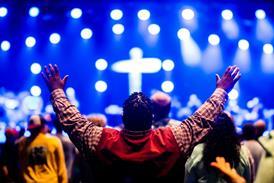





A new report from Christian thinktank Theos looks at the faith of 30 young people who have become Christians since Covid-19. Freya Laidlow-Peterson says their stories of slow conversion offer an alternative insight into the loud debates that have surrounded the so-called ‘Quiet Revival’

The word ‘revival’ first came into regular use with the rise of the evangelical movement, and the subsequent mass conversions of the 18th and 19th centuries. In the UK, this was largely driven by the Methodists, while the USA witnessed several ‘Great Awakenings’, with numerous new denominations emerging as a result. In all instances, revival has long been traditionally associated with fervour and emotional outpouring.
By contrast, the latest Christian revival to make headlines has been the so-called “Quiet Revival”, a phrase coined by The Bible Society’s now-withdrawn research report.
In February 2024, a YouGov survey claimed that church attendance had significantly increased in the younger generation and, even after the survey’s optimistic conclusion was adjusted earlier this year, the conversation has not abated.
Nor, it seems, has the hope that some kind of religious reawakening really is taking place. The revival itself may be quiet, but the response to it has been anything but.
The quiet journey to Jesus
Although excitement about the prospect of revival is understandable, it is perhaps the word ‘quiet’ that we should be paying most attention to. It has been noted that many young people coming to faith appear to be drawn to Catholic and Orthodox churches, with their more traditional forms of liturgy.
Their conversion to Christianity tends to be less about an intense spiritual awakening and more a gradual exploration of faith, something that a new report from Christian thinktank Theos has also observed.
In Understanding Young Adult Journeys to Faith in the Church of England Theos interviewed 30 young converts, seeking to understand the paths that led them to church. It is clear that deep reflection went into each of their decisions to become a Christian.
When we become overly preoccupied by relevancy, the temptation is to explain revival in overly temporal terms
This is something that the dialogue surrounding the so-called ‘Quiet Revival’ has sometimes glossed over. It is said that young people are hungry for meaning, but it is still the more material aspects of church that are often cited as explanations for an uptick in attendance - the turmoil that young adults have contended with in recent years; the technological weariness, the isolation and news of wars - as though church was predominantly just a way for them to seek solace from wider societal instability.
There is a tendency to speak of young church-goers as though they are a cultural phenomenon, swept up by a passing bandwagon, the result of the modern circumstances that we find ourselves in, rather than individuals on their own personal, quiet journeys towards faith.
Unchangeable God
Perhaps because the Church has so often been told it needs to be ‘relevant,’ there is now some perplexity as to why young people would turn to more traditional churches – which causes us to look for ‘relevant’ reasons why this might be.
But it was never relevancy that brought young people to church. Rather, it is the same desire to seek God that has driven humans throughout history, regardless of whether a broader religious revival is occurring. When we become overly preoccupied by relevancy, the temptation is to explain revival in overly temporal terms. But it is, above all, the eternal nature of God that draws people in.
The last few years have certainly been turbulent, but it is important to remember that there have always been societal ups and downs, and that the Church is more than just a refuge from the problems of the modern world.
There is a tendency to speak of young church-goers as though they are a cultural phenomenon, swept up by a passing bandwagon
Previous revivals may have emphasised visible expressions of the Spirit, but the quietness of this revival is not a reason to see it in more materially explicable terms, or to speak of church as though it were primarily a social institution.
What we’re witnessing is something less definable in terms of numbers or visible display. Instead, it is more akin to an increased openness to religious discourse and ideas; an openness that can, in turn, beget a desire to learn more about the history and profundity of Christianity.
The talk of a revival is hopeful and exciting for the Church, but we should be careful not to speak of young churchgoers as though they are just a product of their particular moment in time. We should also be wary of putting too much emphasis on statistics and externalities instead of the deeper reasons that people come to faith. The Church can indeed provide solace and community to a modern, secular world that lacks these things, but it also provides so much more than that - and does so no matter the fluctuations of wider society.





















No comments yet