








Separation of Church and Hate is a merciless take down of right-wing readings of the Bible, says our reviewer

“I’m here because two people broke a promise to God,” Fugelsang tells us in the introduction. His mother and father were a nun and a priest who fell in love and realised that God had a different calling for their lives. Consequently, young John was raised in a way that made him: “too liberal to ever fit in with Christians and far too Christian to ever blend with liberals”. For those of us in the more progressive wing of Christianity, this is an experience we know all too well.
“I’ve come to view Jesus the way I’ve come to view Elvis,” he tells us in the epigraph: “I love the guy, but some of the fan clubs terrify me.” In this short line, Fugelsang makes it clear: his problem isn’t with Jesus, but rather with the people who purport to represent him.
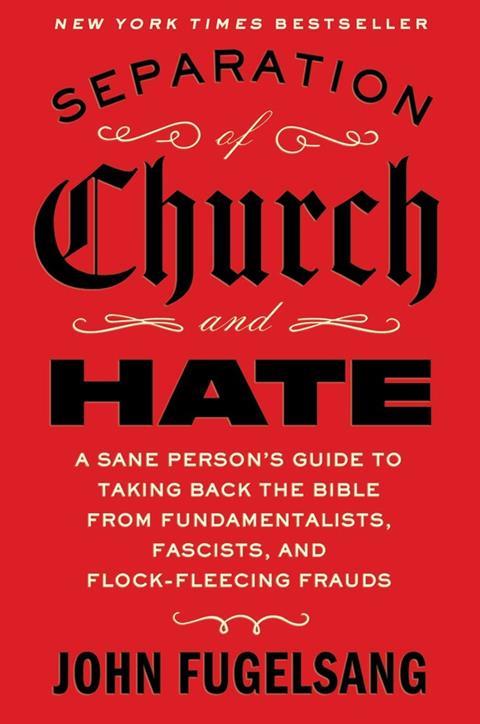
Separation of Church and Hate: A Sane Person’s Guide to Taking Back the Bible from Fundamentalists, Fascists, and Flock-Fleecing Frauds (Avid Reader Press) is a thoroughly enjoyable read, and not just for alliteration lovers. Fugelsang is incredibly quotable, and whether you agree with him or not, you won’t be able to stifle a giggle at his turns of phrase. This is a man who has learned his trade not in the stodgy politeness of academia, but in the cutthroat world of the stand-up comic. This is underscored by a quick glance at the people who have endorsed the book. Rather than having quotes from Christian authors and academics, Fugelsang fills his back page with supporters from the world of music, entertainment and politics. People more likely to play alongside Springsteen than appear on a spirituality podcast. It sends a message that this book is designed more for the people in the pews than those in the pulpit, and it is a welcome change of tone.
As well as humour and relatability, Fugelsang inspires trust in the way he positions himself. “When I cite specific scripture, I strongly encourage you to doubt me” he says. Fugelsang invites discussion and debate rather than framing himself as an unquestionable expert, which he expands on when discussing the New Testament’s most prolific epistolist.
His second chapter is titled “Paul, Jesus’ PR Man, Who is Not Jesus”. In it, he attacks the tradition of putting Paul’s words on a par with, and in many cases, above the direct words of Jesus. He points out that when Paul says: “All Scripture is God-breathed” (2 Timothy 3:16) he was referring to the Hebrew scriptures, not referring to himself. Paul’s letters would not become official Christian scripture for another 300 years, pointing out the peculiarity of a form of commentary becoming part of the original text. “It’s like saying Roger Ebert’s review of The Godfather is now officially part of The Godfather’s script”.
Though more combative in tone, this book covers a lot of the same ground as Zach W Lambert’s Better Ways to Read the Bible (Baker Publishing Group). It also has a broader scope, arguably too broad, as it at times feels like Fugelsang is just getting into a thorny, complex topic when he’s already moving onto the next one. In this sense, it’s better to think of this book as a jumping off point; something to point you in the right direction for topics that you want to research further.
Fugelsang mercilessly attacks the way the Bible has been used to attack women, racial minorities and the LGBT community. Some of the chapters focus on the blatant evils of gun culture, the death penalty and privatised health care, which may give many readers the feeling of ‘reading over the shoulder’ of Fugelsang’s intended American audience. One stand-out chapter is when Fugelsang points out that abortion is not specifically prohibited in the Bible. Many readers have been led to believe that this is because abortion simply did not exist in Jesus’ time. But in the ancient world, induced miscarriage was a common practice, so common that the book of Numbers even has instructions for it! (Numbers 5:11–31 – the test for an unfaithful wife). If this was a practice that was common in first century Israel, then Jesus’ silence on the topic becomes conspicuous. Particularly if it is truly the cornerstone of a Christian faith. Whether you agree with that point or not, Separation of Church and Hate makes it clear that the topic demands further research.
Fugelsang’s acerbic wit is perfectly calibrated to counter that of the American fundamentalist Christian.
This book is not designed to be read from a broad range of political and theological perspectives. Instead, this book is designed to equip the progressive Christ-followers in their discussions with their socially conservative relatives around the family dinner table. “You may find yourself unable to escape a particular person like this in your life,” Fugelsang tells us: “But there are two things to remember: much of the time these people don’t really know the Bible all that well. And they’re 100% counting on you not knowing the Bible all that well”.
























1 Reader's comment