










Eternity charmingly invites Christians to ask what romantic relationships look like in the afterlife — but, Giles Gough warns, some Christians may find the answers this fantasy film gives deeply unsettling
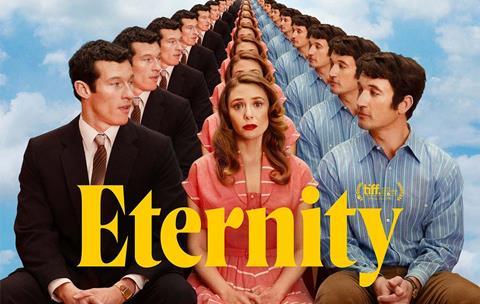
One of the best things about the fantasy genre is that it can ask the questions we can’t hope to in the real world. Eternity speculates about an afterlife where souls have just one week to decide where to spend the rest of their afterlives. When Joan (Elizabeth Olsen) dies, she is forced to choose between the man she spent her life with (Miles Teller) and her first love (Callum Turner), who died young and has waited decades for her to arrive.
The film opens on Larry and Joan, an argumentative elderly couple, attending a family party. Joan has terminal cancer, which the couple have hidden from their family, but it’s Larry who dies first, choking on a pretzel at the party.
Will we be married in heaven?
After his death, Larry finds himself arriving at ‘The Hub’, an in-between space where Anna, his ‘Afterlife Coordinator’, explains that he must choose where he wants to spend his eternity. Each eternity has a unique appeal, but the decision to enter one is final, and trying to leave results in immediately being sent to the ‘Void’, which is the closest thing to hell they have. Anna explains that Larry can wait at the Hub for his wife while considering which eternity he will choose.
Just a week later, Joan eventually dies and reunites with Larry at the Hub, where she also is reunited with Luke, which forces her to choose who she wants to spend eternity with. Joan is encouraged by her Afterlife Coordinator, Ryan, to choose Luke, who has become popular at the Hub due to waiting for Joan for 67 years – whilst Larry, who is staunchly unromantic, struggles to ‘re-audition’ for his role as Joan’s husband.
In this way the film poses the question, ‘will we still be married in heaven?’ and if so, what obligations might we still have to each other.
Christians have consistently taught that death ends the marriage covenant on this side of eternity - meaning a widower is free to marry again if they wish. But the thought that ‘til death do us part’ means we won’t be married in heaven can be hard to grasp. Nevertheless, it appears to be what Jesus taught in Luke 20: “In the resurrection, people will neither marry nor be given in marriage. Instead, they will be like the angels in heaven.”
NT Wright in his article for Premier Christianity last year reflected on how the New Testament offers little speculation about what the age to come will actually be like. But he pointed to Matthew 22 to conclude that “In the new age, we will no longer be mortal. There will be no more death and, therefore, no need for reproduction. We’ll have no need for marriage as we know it”.
An impossible choice
As an independent studio, A24 has a good track record of producing films with fascinating concepts. Eternity is no exception. One central idea in the movie is that after death, our bodies revert back to the moment in life when we were happiest. It’s why they have so many 10-year-old boys, Anna tells Larry, and practically no teenagers.
This results in some wonderful central performances, as both Teller and Olsen are effectively playing people in their late eighties, thrust back into bodies that look like they’re in their mid-thirties. It does lead to a delightful little scene where the two realise they can do squats again!
In addition to this, ‘The Hub’ is jam-packed with visual gags where they advertise the different eternities: Pearly Gates World, Yacht World, Irish Countryside (Famine Free), even Weimar Germany (with 100% no Nazis!)
The dialogue does provide some great laughs and the leads are charismatic, but there’s something deeply unsettling about this film. Being able to choose your own eternity sounds like a great idea. But the rule about being forced to stay in the world of your choice is entirely arbitrary, and cruel. Any place, no matter how big, will eventually feel like a cage when you know you’re not allowed to leave.
On top of that, the ‘The Hub’ where recently departed souls have to choose where to spend the rest of their afterlife is decidedly drab, with a distinctly 1970s hotel aesthetic going on. It’s a place where there are no answers to life’s big questions and hierarchy has followed us into the next world.
The living quarters for the recently deceased are much nicer than the boxy, windowless single room apartments of the people that choose to work there. In addition to that, the afterlife seems to feel entirely artificial, devoid of all wonder and majesty, like it’s been put together on a budget, which feels oddly disheartening. Much more The Truman Show than The Shack in the way it’s presented.
Perhaps for a general audience this might not be so much of an issue, but for those of us hoping for something more when we die, it’s an awkward setting to enjoy a romcom.
For the most part Eternity is deeply charming, but for much of the runtime, the film writes itself into a corner that it struggles to get out of. While it does eventually draw itself to a satisfying conclusion, it certainly takes its time getting there.

























No comments yet