





The TV adaptation of Margaret Atwood’s The Testaments follows two teenage girls navigating Gilead’s brutal regime. Giles Gough says this show comes with a timely call for Christians to distance themselves from any ideology that resembles this dystopian theocracy
Margaret Atwood’s 1985 seminal work The Handmaid’s Tale is a dystopian speculative novel where, due to a world-wide fertility crisis, women who are still fertile have their rights stripped away and are forced to bear children for a brutal authoritarian regime in what used to be America.
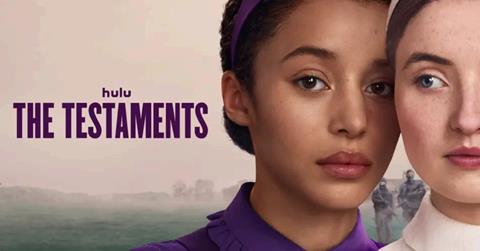
Set several years after the events of The Handmaid’s Tale, Atwood’s 2019 follow up The Testaments follows young teens Agnes and Daisy as they navigate an elite preparatory school for future wives. The pair develop a bond that could not just disrupt their lives, but the whole tyrannical system that keeps them in captivity.
Adaption challenges
When the Handmaid’s TV adaptation was released in 2017, the first season covered much of the original novel, but the show went on to run for six seasons in total, dramatically expanding Gilead and the geopolitical world it inhabits. When a book series and its TV version are being created concurrently, this can create something of a challenge in terms of adaptation. However, based on the three episodes we’ve seen of newly released The Testaments, the creative team are more than up to the task.
While Gilead is still the awful place it was in The Handmaid‘s Tale, this show feels less shocking than its parent show. That could be because of the slightly more genteel setting of a preparatory school, where young pre-pubescent girls are prepared for the role of being a commander’s wife. It could also be that fans of The Handmaid‘s Tale have had nearly 10 years to get used to the levels of performative cruelty on display, and there’s still plenty of it.
Performances
Chase Infiniti (most recently seen in the Oscar winning One Battle After Another) plays Agnes - a ‘plum’, a young girl who is enrolled at the Aunt Lydia School. She still has a doll house, where all the women in the household; wives, daughters and marthas are duplicated in doll form. Only the ‘handmaid’ doll is missing from the set, showing how the Handmaids Program was only ever meant to be a stop gap.
Raising a generation of young teenage girls who have been completely indoctrinated into the Gilead regime is the masterplan and Agnes is one of those girls. But Agnes is beginning to have doubts, and as she has not been taught to read, and her outside influences are strictly controlled, she does not yet have the language to describe the fears that she is facing.
Agnes is tasked with watching over Daisy. Daisy is a ‘pearl-girl’, a convert who has come from outside Gilead’s borders and needs to be taught the strict routines that women of Gilead are forced to adhere to.
Ann Dowd returns as Aunt Lydia (her performance in the show was said to be part of Atwood’s inspiration for writing the sequel). The Lydia we see here is likely to be a much more nuanced character, not just the matronly tyrant we’ve seen before.
A challenge to the church
One key aspect that has remained consistent throughout Handmaid’s and The Testaments is that the name ‘Jesus’ never gets invoked by the Gilead regime. This may be because Atwood was never picking a fight with Christ, but rather the people who use Christianity as a convenient prop for oppression.
As she stated in 2018: “I believe that much of the Church’s behaviour and doctrine during its two-millennia-long existence as a social and political organisation would have been abhorrent to the person after whom it is named.”
For many, God can often be a much more nebulous concept, much more easy to apply and invoke His name when doing horrendous things. It is much harder to justify prejudice and oppression in Christ’s name when there are a wealth of examples of his doing the opposite. This makes the desire of US pastor and Christian Nationalist Doug Wilson to remove the vote from women all the more galling.
This is addressed directly in Daisy’s voiceover: “There were signs of what was coming, candidates running for office had said things openly, about women, about gays, but they still were elected. People thought they were speaking in hyperbole. Now women can’t have jobs, or phones, or read books. And gay people? Well you know what happened to them”.
For Christians, this show comes with something of a challenge: to put as much clear blue water between ourselves and any group that remotely resembles the Gilead regime.
Jesus advocated for women, trusted women and empowered women, as well as other oppressed groups. It is long past time for the church to loudly do the same.























No comments yet