











He may be one of Britain’s most celebrated hymnwriters, but Isaac Watts misread scripture when he confused the promises God made to the children of Israel with those made to modern day nation states. It’s a conversation that’s never been more relevant, says Daniel Johnson
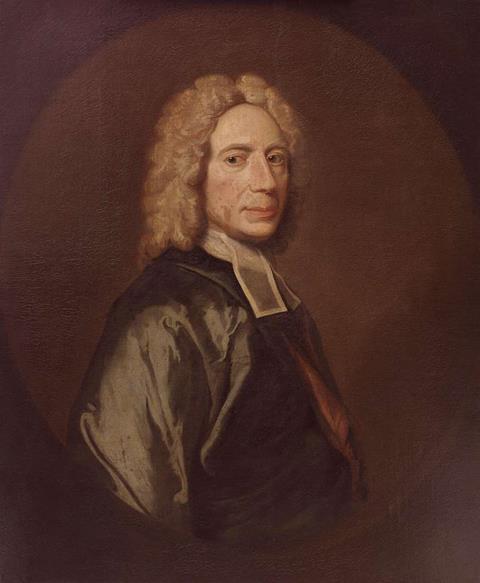
As the author of classic hymns that include ‘When I survey the wondrous cross’ and ‘Joy to the world’, Isaac Watts is one of the most celebrated hymnwriters of all time.
Aged just 20, he published his first hymn on 5 November 1707. The first line begins: “Shout to the Lord and let our joys / Through the whole nation run / Ye British skies resound the noise/ Beyond the rising sun”.
Later verses talk about God’s “envious foes” who have “dark designs” and “cursed hands”. These enemies of God are described as being “the busy sons of hell”.
The hymn ends: “For mighty grace defends our land / From their malicious power / Rise England, and with cheerful songs / Almighty grace adore”.
In case you think this was simply the poor early efforts of a young man caught up in nationalistic pride, he composed another hymn a year later – also written on 5 November.
The promises given to Abraham are ours in Christ, not ours in Britain
Here a picture emerges, because the hymn’s title reads: ‘An hymn of praise to the God of England for three great salvations; from the Spanish Invasion, the gunpowder plot, and from Popery and slavery by King William’.
We’ll return to this shortly.
In 1719, 45-year-old Watts published a collection of songs that he considered to be his greatest work: The Psalms of David, Imitated in the Language of the New Testament.
In the King James Bible, which Watts used, Psalm 67:1 begins: “God be merciful unto us, and bless us; and cause his face to shine upon us”. Watts’ version differs: “Shine, mighty God, on Britain shine / With beams of heavenly grace / Reveal thy power through all our coasts / And show thy smiling face”.
A chosen isle
He speaks of Britain as being “the favourite land” and writes that God “will crown his chosen isle with fruitfulness and peace”. His version of Psalm 75 is dedicated to “the Glorious Revolution by King William, or the Happy Ascension of King George to the Throne”. Psalm 147 is subtitled: ‘A Song for Great Britain’.
I’ve spent a decade studying Watts, so I’m familiar with the moments in his writings when he still makes me raise my eyebrows. For example, when he says that if David were alive in Watts’ day, he would have written his psalms the way Watts did. Or when he says that he purposely avoids writing hymns or psalms that cover controversial subjects (!).
The reason Watts can write these words, and claim to be faithfully interpreting the meaning of scripture in his songs, is because of the events of 5 November. This was the day that – in the view of Watts and many others at the time – God protected Britain from the gunpowder plot in 1605.
It was also the day William of Orange arrived in England in 1688. In the popular imagination at the time, these events proved God was preserving Britain’s unique Protestant identity. The logic went that, if the gunpowder plot had succeeded, or William of Orange had never arrived, Britain would be a Catholic nation, and would thus lose the blessing of the true gospel. So, the logic continued, if Britain had in fact been preserved by God, Britain must indeed be special – just look at France and Spain, who hadn’t known such divine favour.
Watts took this view of God’s electing grace to its final conclusion – namely, that Britain was enjoying many of the same blessings that Israel had known in the Old Testament. That is why he unashamedly went to the Psalms and swapped out Israel for Britain. In doing so, he perpetuates a view that puts Britain at the heart of God’s salvation plan for the rest of the world.
What it means to be British
As I write this, debates are raging about what it means for Britain to find, retain or maybe reinvent a national identity. For some, Britain has always been a Christian nation. In this view, the fact that the supposed ‘glory days’ of the British Empire were also the high points of colonial tyranny and slave trading are just inconvenient details, best ignored.
For others, to be British must also bring with it the badge of being a Christian. Two passports for the price of one.
For yet others, Britain is a multi-cultural, multi-faith society in which Christians are called to live lives of justice and mercy, salt and light, as aliens and strangers. From the responses to other Premier Christianity articles on this subject I know that views among readers are varied.
What I do know is that Watts is totally wrong in his interpretation of scripture. No, he wasn’t a Christian nationalist – that’s anachronistic, because it’s a modern term. But Watts is a fountainhead for the river of Christian nationalism. He held a view which conflated an early modern nation state with God’s ancient covenant to the children of Abraham.
For some, Britain has always been a Christian nation. Colonial tyranny and slave trading are just inconvenient details, best ignored
This is, simply and bluntly, to misread scripture. The promises given to Abraham are ours in Christ, not ours in Britain. To mingle the gospel and nationhood is to dilute both. It’s akin to eating tuna-flavoured chocolate. I like seafood, and I like chocolate. They aren’t meant to go together.
There are no promises in scripture to modern nations. The entire movement of the New Testament is that the kingdom of Christ is not of this world. For all his genius, Isaac Watts failed to grasp this. He used his national identity to inform his view of Christ, the gospel and providence.
If you try reading a map, but you’ve got your starting point wrong, you’ll just keep getting lost. So, as Christians seek to faithfully understand our place in an ever-changing world, we can’t make the mistake that Watts does. Our starting point has to be Christ, not our country.
We can pray for, hope for and support our country, while also acknowledging and grieving for her sins past and present. But we must not seek living water in broken cisterns. The promises of God in Christ are never mediated to us through the land we were born in. They are ours in Christ alone.

























3 Readers' comments