










The Borussia Dortmund striker’s goalscoring celebrations have stirred debate about faith, inclusion and freedom of conscience in football. But beyond the controversy lies an extraordinary story of how Christianity has moved from the margins to the heart of the professional game, says Christians in Sport’s Graham Daniels
When I played professional football, scoring a goal was generally followed by a raised fist, an embrace from your teammates and a return to the halfway line.
How things have changed.
Cristiano Ronaldo’s spectacular leap, Cole Palmer’s shivering routine and Kylian Mbappé’s folded arms are instantly recognisable. In the age of social media, scoring a goal provides an opportunity to communicate something about who you are.
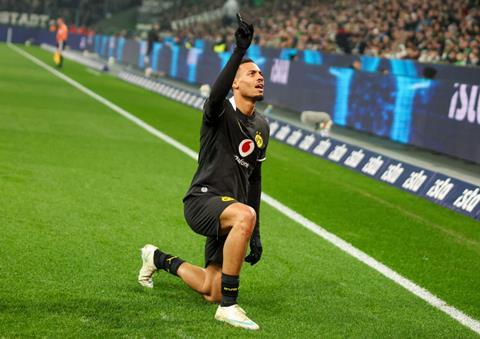
Borussia Dortmund’s Felix Nmecha offers an interesting contrast. In recent goalscoring celebrations, the German striker mimed removing a crown from his head and laying it down. The gesture echoes Revelation 4, where the elders lay their crowns before God’s throne. In a culture increasingly concerned with personal branding, here is a footballer seeking to give glory to someone else.
The celebration is associated with ‘The King’s Return’, an evangelistic initiative linked to Ballers in God, a Christian football network whose work I greatly admire. German broadcaster ARD highlighted an online counselling service linked from the campaign’s website which reportedly advocated traditional Christian teaching on sexual relationships. This led to Dortmund’s supporter’s representatives questioning whether the campaign was compatible with the club’s commitment to diversity and inclusion.
Ballers in God reaffirmed its commitment to pointing people towards Jesus while demonstrating love and respect for everyone. Nmecha explained that his intention was to honour Jesus, rejecting intolerance, discrimination and hatred.
“My celebration is not intended to promote myself or any organisation,” Nmecha wrote in a social media post. “Rather, it is about laying my ‘crown’ before the soon coming King and pointing to Jesus, my hope and strength. My message has never been about promoting intolerance, discrimination, or hate in any form.
“As Christians, our message is one of love and respect for everyone, regardless of where they come from, what they believe, or what their worldview may be.”
Beyond the controversy, however, lies a story that Christians have every reason to celebrate.
When I was playing for Cambridge United in the early 1980s, I was one of four Christians in professional football. How different the landscape looks today.
Research by Christians in Sport surveyed 134 clubs across the top six tiers of men’s football in England and Wales. Three-quarters have Christian first-team players and 40 per cent regularly host Bible studies and prayer meetings.
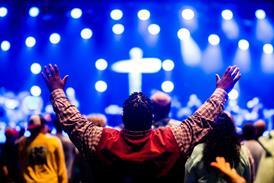
After decades of praying for Christianity to emerge from the margins of professional football, it is deeply encouraging to see it much closer to the heart of the game. We have much to thank God for and a wonderful opportunity to serve him faithfully.
Can football accommodate genuine difference?
In 2024, as part of Stonewall’s Rainbow Laces campaign to promote LGBT inclusion, Premier League captains were encouraged to wear rainbow-coloured armbands. Crystal Palace captain Marc Guéhi wore one, adding the words “I love Jesus” and, subsequently, “Jesus loves you”. Ipswich captain Sam Morsy declined to wear one because of his Muslim convictions.
Football should oppose discrimination unequivocally. But asking players to respect everyone is not necessarily the same as asking them to endorse every belief or campaign.
Christians who hold to historic biblical teaching understand marriage to be the union of a man and a woman. This flows from a much bigger conviction: Jesus Christ is Lord of every aspect of our lives, including our sexuality. The Bible also affirms that every human being, irrespective of their sexuality, is made in God’s image and must therefore be treated with dignity and respect.
Jesus warned his disciples to expect opposition but also showed them how it could become an opportunity
As a football club director, I believe we must protect both human dignity and freedom of conscience. It was encouraging, therefore, to see German national coach Jürgen Klopp and Dortmund president Hans-Joachim Watzke (himself a practicing Catholic) speak positively about Nmecha. Klopp later confirmed that Nmecha would no longer perform the celebration when playing for his country.
Watzke did not go so far, but after scoring an 80th minute winner in Dortmund’s game against Borussia Monchengladbach recently, Nmecha celebrated his goal by signing “Jesus loves you” towards the crowd. Afterwards, he told Sky Sports: “I wanted to show people today whether they are for me or against me, Jesus loves them.”
Felix Nmecha heute bewusst ohne "umstrittenen Kronenjubel", ordnet die Sportschau ein. #OerrBlog https://t.co/qAhSZe1dpX
— ÖRR Blog. (@OERRBlog) November 21, 2026
At Liverpool, Klopp brought together Christians such as Alisson Becker and Roberto Firmino alongside Muslim teammmates Mohamed Salah and Sadio Mané. He also welcomed the courage of Australian footballer Josh Cavallo when he publicly came out as gay in 2021.
I want to see a culture in which a gay footballer need not fear revealing his sexuality and a Christian footballer need not fear revealing his faith. The real test of tolerance is not whether we all agree, but whether we can live and play together respectfully when we don’t.
Witnessing in a world of difference
When Jesus sent his disciples out in Matthew 10, he told them to be as shrewd as snakes and as innocent as doves. There may be wisdom in reconsidering how we express our faith publicly without compromising what we believe.
Jesus warned his disciples to expect opposition but also showed them how opposition could become an opportunity for witness. Christians must not manufacture opposition or mistake every criticism for persecution. Neither should our desire for public approval silence our witness.
In an industry where personal worth appears dependent upon performance, the gospel offers something radically different: an identity secured through the death and resurrection of Jesus Christ, received by grace rather than earned through achievement.
That is good news for the goalscorer, the injured player, the rejected academy youngster and the manager who has just lost his job. When Jesus looked upon the crowds in Matthew 9:36-38, he saw people who were harassed and helpless, like sheep without a shepherd. He saw a harvest.
As Christians become increasingly visible in professional football, our greatest opportunity is not simply to show that we belong in the game, but to introduce others to Jesus. And that is something that is always worth celebrating.