










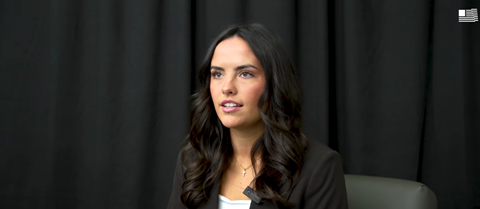
A University of Oklahoma student has made international headlines after she wrote a Psychology essay which said it was “demonic” to argue there are more than two genders. Samantha Fulnecky’s work was deemed “offensive” by her instructor who failed her, and said the student should have cited “empirical evidence” rather than only quoting scripture. Fulnecky pushed back by claiming her religious freedom was under threat. The University has since stated the assignment will not be factored into her final grade following mass public backlash. Here, Christian and academic Krish Kandiah pens an open letter to Fulnecky, and urges her to remember four key principles when discussing the Christian faith in public
Dear Miss Fulnecky,
As a fellow Christian, I read the recent paper you wrote for the University of Oklahoma, and the ensuing media coverage, with interest.
I want to first commend you for your conviction, courage and confidence in writing an essay for your Psychology class from your Christian perspective. Despite disagreeing with many of your views, I do recognise how brave it is to bring your faith into your academic work.
As a Christian academic, I encourage students at public universities to be open about their faith. Too many in Western academic circles assume faith belongs only in the private sphere—that the public world of education is for facts, not faith. Yet the two cannot be separated. Christianity is rooted in historic events and evidence; it has shaped civilizations, inspired scientific discovery, and provided the moral framework for much of what we value today. It is good therefore that you are prepared to bring your convictions to the table.
It can’t have been easy for you to face the public spotlight at such an early stage in your academic journey and I am truly sorry for the abusive backlash you have experienced because of what you wrote. As a Christian, I believe everyone deserves love and compassion. No one should experience the dehumanising vitriol you have faced in the wake of your sudden media exposure. I appreciate that in your interview with Fox News you expressed love for the Teaching Assistant who failed your paper. That is an important witness. We need more of that graciousness in our world today.
I have experienced occasional hate-filled comments and online trolling, particularly when I have expressed opinions about controversial topics in the public square. I have learned some important lessons along the way. Perhaps they will also help you in the future if you choose to continue to speak out in the public arena.
Firstly, may I encourage you to remember the Principle of Accountability. In his letter to a younger Christian the apostle Paul instructed Timothy to: “Do your best to present yourself to God as one approved, a worker who does not need to be ashamed and who correctly handles the word of truth.” (2 Timothy 2:15)
Paul presents this as a personal challenge, making clear that there are appropriate and inappropriate ways to use scripture. Handling the Bible correctly requires training, discipline, and care, so that we can reveal its truths accurately, show their context and relevance, remain faithful to its values, and allow them to shape not only the points we make but the manner in which we make them. While we seek to commend our message to others, it is God’s approval we seek above all else. We are accountable first of all to him.
Having read your essay, I believe you have the potential to grow significantly in your ability to handle scripture well. I strongly encourage you to seek a mentor who can guide you in this area, so that your future work reflects both clarity and faithfulness to God’s Word.
Secondly, may I encourage you to apply the Principle of Reciprocity—evaluating your own approach by imagining how you would judge it if someone else did it. If, for example, your class had been set the task of critically engaging with a section of John Calvin’s Institutes, and a Muslim student had written an essay claiming that Calvin was apostate and demonic, based not on Calvin’s actual writings but on his own convictions, how would you expect that work to be assessed? You would likely support a teaching assistant’s right to fail that student—they had not answered the question that was set.
Applying that principle would have helped you refine your essay, focussing less on your personal views, and responding more carefully to the material set in the assignment.
I fully support freedom of speech so long as it does not target a group based on identity, which is hate speech, and as appropriate - for example on social media. But in an academic essay, the primary responsibility, whatever your faith convictions or personal opinions, is to meet the rubric and respond thoughtfully to the question.
Thirdly, I recommend you consider the Principle of Translatability. By this I simply mean trying your best to express your ideas in a way that people who do not share our beliefs can still understand, interact with, and evaluate. It doesn’t mean watering down your faith, hiding scripture, or pretending to believe something you don’t. Rather, it means learning to express our Christian convictions in a way that builds a bridge for those who have differing opinions.
I recommend you express your ideas in a way that people who do not share our beliefs can still understand
It is highly likely that in the future you will write other essays for those who do not share your beliefs. They may not have read the Bible at all, let alone trust it as an authoritative source. When you refer to your Christian faith, try to translate it: show why your beliefs are relevant, explain how Christian theology relates, and show Christianity in the generous and life-affirming way Jesus modelled.
To be clear, I am not saying you should remove scripture from your work. I am saying that simply quoting the Bible—without explanation, context, or engagement with scholarly sources—makes it impossible for someone outside the faith to see your argument as academically grounded, or, even more importantly, as part of a worldview that invites a closer look.
Fourthly, I would like to put forward the Principle of Humility. You mentioned in an interview, “I don’t understand how my opinion can be offensive.” I appreciate your sincerity, and I would like to believe you when you say you meant no harm. However, many people - including many Christians - did find your opinion offensive - not so much because of your personal faith, but more because of your language and tone. They felt that you failed to show respect to transgender people, and to those who don’t fit or don’t embrace traditional gender identities or traditional gender-role definitions.
Rather than dismissing those with different views, experiences or choices as “demonic”, or “not biblical whatsoever”, let’s remember that Christians believe that everyone is made in the image of God. Jesus went out of his way to reach out to those who were considered untouchable by their society. He spent time with minoritised and unpopular groups of people. His harshest reprimand was reserved for judgmental religious leaders and, on one occasion, his close disciple Peter, for suggesting he deny the cross. To everyone else, he showed radical respect and generous hospitality.
When the Bible calls us to follow Jesus’ example, it reminds us most often to be humble. Rather than assuming we are the authority on every issue, humility invites us to listen, to learn, and to recognise that God is at work in people whose journeys look nothing like our own. It challenges us to choose compassion over condemnation.
Finally, many of the viewpoints espoused in your paper remind me of too many sermons and popular mainstream sentiments I have heard recently. Unlike academic essays, preachers and are not subject to accountability by an expert assessor. This means that those of us who preach too often include unfounded opinions or unkind judgments about groups of people who are not in the room. Your exposure reminds preachers to think twice before using lazy derogatory arguments, and instead to model kind and gracious ways of handling the Bible. It reminds all of us that when listening to sermons or podcasts - even by those we respect - we have a responsibility to discern what is true, kind and loving, and apply that not only to our lives, but to the way we communicate with those around us.
I have tried my best to balance truth and grace in this letter to you, and I hope some of my words have been helpful as you consider ways to integrate faith with scholarship in the future. May God give you wisdom, courage, and compassion as you continue your studies and navigate this unexpected attention.

























4 Readers' comments