








Tributes have hailed him as a civil rights titan. But the most important word before Jesse Jackson’s name was “Rev”, says Chine McDonald. His life embodied a tradition in which preaching and political protest were never meant to be separate
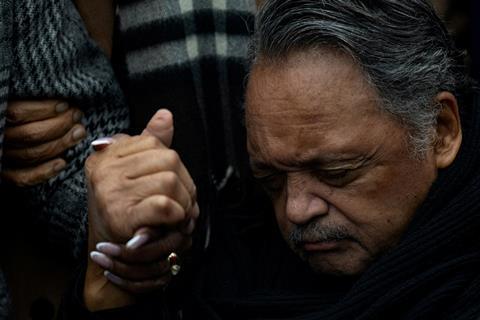
Since the death of civil rights campaigner Jesse Jackson, he has been called a “giant among men”, a “titan”, and an “icon”. But to many, one of the most distinctive things about him was that he was called: “Rev”.
The “Reverend” title for him was an important one. Like Rev Dr Martin Luther King, Rev Al Sharpton, and others of that iconic group of civil rights campaigners, Rev Jesse Jackson was both a pastor and a politician. These giants of political rhetoric, imagination and prophetic voice stood within the Black church tradition that birthed the modern civil rights movement. With the rousing oratory they honed from the pulpits, they delivered sermons as political strategies, and their political strategies as sermons. Their compelling, powerful and moving use of language made people feel something rather than left them cold. Scripture underpinned their social policy, they saw justice as an integral part of the Christian vision of the world turned right way up.
Many of Rev Jackson’s enslaved ancestors would have gathered together to sing songs of freedom and read the Bible nestled under trees in hush harbours away from the gaze of their white ‘owners’. Here the negro spirituals were born as they read of how God saw them, of how their freedom was possible, even while they were in chains. They read in the pages of scripture a liberating vision of human flourishing.
Decades later, their descendants, including Rev Jackson and his counterparts, did not just keep this vision to themselves behind closed doors in their churches. While they were more free than their parents and grandparents had been, they were still far from equal, and subjected to violence and oppression because of their race. These stirring sermons and readings of scripture propelled them beyond contemplation towards action.
As Barack Obama said earlier this week: “For more than 60 years, Reverend Jackson helped lead some of the most significant movements for change in human history. From organising boycotts and sit–ins, to registering millions of voters, to advocating for freedom and democracy around the world, he was relentless in his belief that we are all children of God, deserving of dignity and respect.”
Reverend Jackson helped lead some of the most significant movements for change in human history
This belief in the inherent dignity and worth of every human person can be described as the theological concept of imago Dei, that draws on an understanding from Genesis 1 of humans being made in God’s image, and other passages such as Paul’s reference to us as “God’s offspring” in Acts 17:29. He didn’t always cite the Bible references, but the scripture infused his words and his actions. The imago Dei can be a hard concept to grasp, but Rev Jesse Jackson communicated it in a way that people could understand. Most notably for me in his appearance on Sesame Street in 1971. Yes, Sesame Street. I happened to re-watch this moving scene a few weeks ago in which he leads a multi–racial group of children in declaring: “I am somebody.” This declaration is a Christian view of the human person – that each of us is imbued with dignity and worth, no matter who we are, no matter our background – in a way that a five–year–old can understand.
I’m sure those children will never have forgotten that moment. He was the kind of person that you would never forget meeting. An old school aura of greatness, courage and moral leadership that we seem to be in short supply of in our day. I have watched as black British Christians from across generations have shared their Rev Jesse Jackson moments. He visited the UK several times and each time made sure to connect with black Britons.
My own moment with him came in 2009, when I was a 25–year–old local newspaper reporter, and was invited to attend a press conference in Reading when Rev Jackson was visiting. Just a few months before, I had stayed up all night to watch Obama elected as the first black US president and wept as the cameras showed Rev Jackson himself weeping in the crowd gathered at Grant Park in Chicago, as he witnessed what had seemed unthinkable decades before. So I confess to having been somewhat starstruck when I met him in the flesh.
As a young black woman who had studied theology, and had read about him my whole life, it was a special moment. After the press conference, he invited all of the black and brown journalists and reporters to gather round him to take a photo. In an industry in which many of us felt ‘other’, he made us feel seen. But he did that for so many others, too, no matter their race.
On Al Jazeera, I was asked why I thought Rev Jackson was able to mount a political campaign that very nearly got him to the White House long before Barack Obama. I answered that perhaps one of the ways in which he appealed beyond the black community is that he was an advocate for justice and equality for all who were marginalised. “Our flag is red, white and blue,” he once said. “But our nation is a rainbow – red, yellow, brown, black and white – and we’re all precious in God’s sight.” His Rainbow PUSH Coalition arose out of a 1996 merger between his PUSH (People United to Save Humanity) – started in 1971 following the assassination of Dr Martin Luther King, which Jackson witnessed – and the Rainbow Coalition. The latter movement had its origins in civil rights era campaigns such as the Black Panther Party’s multi–racial anti–poverty coalition, led by Fred Hampton in Chicago. These Rainbow Coalitions brought together the white, black, Hispanic and Asian communities to work together at a grassroots level for educational programmes, food provision, voting rights and more. It is this work that – while clearly being part of the Black community and much beloved by it – enabled Jackson to widen his appeal in a diverse and polarised America.
Today, progressives and conservatives alike can be suspicious of the mixing of politics and religion – whether it’s concern around the ways religion can be weaponised to exclude and harm, or eye–rolling at the latest ‘woke bishop’ (as it were) commenting on issues such as immigration policy.
But religion and politics can’t help but mix. Christian theology has over centuries offered views and visions of what human society can and should be, and how we live together well in light of that. Perhaps Rev Jesse Jackson’s life will serve as an example to critics of the ways in which politics and religion can work well together, for the good of all; how it’s possible to seamlessly interweave the two unselfconsciously. When politics loses the language of hope and justice – words that are heard in churches every Sunday, when it becomes purely and deliberately secular in tone, could it be that we lose some of its humanity?
Perhaps what Jackson’s generation can teach us about the relationship between faith, activism and public life – particularly at a time of democratic fragility and deepening inequality, is that maybe they shouldn’t be seen as entirely separate spheres. Because maybe they never have been.
This article was first published on the Theos website

























1 Reader's comment