








The Anglican bishop of Goma in the DRC, explains how the Church is at the forefront of practical aid, tackling misinformation and providing pastoral care amid the Ebola outbreak
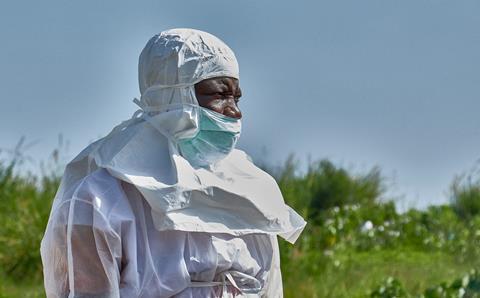
On 15 May, the government of the Democratic Republic of the Congo (DRC) declared the country’s 17th Ebola outbreak in 50 years. Its epicentre is in the north, in Ituri province. As I write this, the situation is escalating with terrifying speed: there are already more than 1,000 suspected cases and 200 suspected deaths.
The virus is moving. There are now 15 confirmed cases in Uganda, and at least one right here in Goma, the largest city in the east, where I am based. Yet, reliable information is incredibly hard to come by.
From where I stand, this outbreak feels fundamentally different from the ones before it, and we are fighting a multi-front war against biological mutations, geopolitical standoffs and a devastating wall of community mistrust.
Fear and misinformation
Detection was dangerously slow at the beginning. This is partly because our diagnostic tests are not as effective for this specific outbreak, and the symptoms differ from the previous Zaire strain in 2018–2020. For this particular mutation, the Bundibugyo strain, there is currently no approved treatment and no cure. A vaccine is a few months away at best.
To make matters worse, we are trying to contain a deadly virus in a fractured healthcare landscape. Recent US aid cuts have decimated our regional health monitoring systems and 10 million people in this region live under the control of M23 rebel authorities.
Because of the ongoing military and political standoff between the Congolese government and the M23, both Goma and Bukavu airports remain completely closed. This is severely hampering our ability to fly in critical medical supplies.
But the physical borders and closed airports are only half the problem. We are facing huge scepticism among much of the population as to whether Ebola even exists, driven by a deep, historic mistrust of medical centers.
When people fall ill, relatives are highly suspicious of what happens to patients behind the closed doors of an isolation ward. They fiercely oppose the strict, clinical restrictions placed on traditional burials. Out of grief and anger, families will often try to storm the treatment centres and forcefully retrieve patients, as well as the bodies of those who have died, so they can give them traditional funeral rites.
This anger is dangerous. During the last outbreak in 2018, there were nearly 500 violent attacks against health facilities, and 25 frontline medical staff were killed. In this current outbreak, two Ebola treatment centres have already been set on fire.
Why the Church must step in
In this atmosphere of fear and violence, the Church finds itself on the frontline of the Ebola response.
The Anglican Church in DRC runs a huge number of health centres across the country. The church is at the heart of every single village and community. Crucially, we are one of the very few institutions left trusted by the population to tell the truth.
During the last crisis, the Church successfully challenged misinformation by working across different denominations, bringing senior church leaders, community figures and journalists to get accurate messaging out over the airwaves. We replaced messages of terror with messages of hope, and we were key in helping communities safely adapt their religious practices - particularly traditional burials.
But the secret to saving lives is always the same: we must mobilise early.
Here in Goma, we have already circulated a formal pastoral letter to our parishes. This outlines the symptoms of the Bundibugyo strain and urges best practices regarding handwashing, physical touching and swift medical referrals. The next step is to purchase temperature guns for all our schools and churches.
Today, I am holding an emergency meeting for all our clergy, evangelists, schoolteachers and staff. Looking ahead, my goal is to raise funding to invite every priest in the diocese to Goma, so we can equip and strengthen them to lead the frontline response in their remote villages.
A plea to the global Christian community
It is exactly in these practical areas - messaging, leadership training and purchasing basic tools like temperature guns - that we urgently need international financial support. It will be crucial to whether we contain this or watch it spill across borders.
If you are able to give, please do so. But above all, I ask for your prayers.
- Pray for a quick mobilisation of resources to test, isolate, and treat patients
- Pray for the physical safety of our frontline health workers
- Pray for effective community awareness, and that crippling political and rebel tensions will not hamper the medical response
- Pray for the quickest possible scientific development of an effective treatment and vaccine
- Pray that our churches would continue to be trusted, unwavering voices of hope in the darkness.
The Anglican Health and Community network are working in partnership with the Anglican Alliance and other agencies to support the Anglican Church of Congo. Donate to the Diocese of Goma
















No comments yet