












What do AI social media reels depicting Jesus as a miracle-performing superhero have in common with sermons full of Christianese jargon? George Pitcher says they both point to the Church’s biggest problem: a failure to communicate the gospel well
At the end of Cool Hand Luke, a 1967 movie with Paul Newman in the title role, Luke has escaped his chain gang (again) and is holed up in a wooden church at night. He kneels, prays for help and is greeted by silence. Armed police draw up outside.
His prisoner friend Dragline turns up. Luke chuckles and raises his eyes to heaven: “That your answer, old man?”
Dragline tells him all he has to do is “give up”. Luke walks to the window and shouts a line that his warden had delivered after a beating: “What we got here is a failure to communicate.” He’s shot in the neck and dies shortly after.
There’s always been something messianic about this movie: Strength in weakness, speaking truth to power, self-sacrifice and that Gethsemane ending. But it’s Luke’s final words that stay with you. What we have here – what we always have here – is a failure to communicate.
It’s the Church’s greatest failure, which may sound controversial. But all the Church’s terrible failures, its abuse of innocents, its persecutions and wars, its derelictions of charitable duty, all stem from our failure authentically to communicate the gospel. And when we fail to do that, we get shot.
Jesus, according to the algorithm
This line of thought occurs as a consequence of two massive failures of communication that are far from new, but have become apparent lately, at least to me. One is quite simple and the other a little complex, because it’s about complicated language.
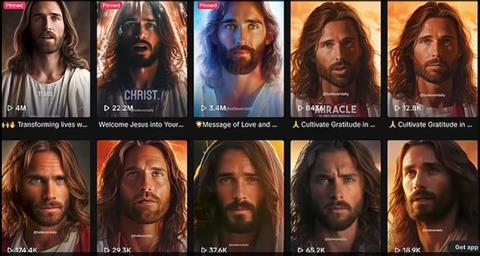
Take the simple one first. On social media such as Facebook and Instagram, I’ve lately noticed a truly weird form of evangelising in the form of reels (short, repetitive videos) that depict a very white and very handsome Jesus of Nazareth, wandering through our contemporary world performing miracles.
All the Church’s terrible failures all stem from our failure authentically to communicate the gospel.
You’re unlikely to find anything canonical here. He resurrects dead puppies; he rewards people who have performed little acts of kindness with suitcases of dollar-bills or gold; he restores missing limbs to the disabled because they helped a beggar. He’ll sit on a railway track stroking a bunny rabbit while an enormous horned demon bears down on him in a train, which he disintegrates to dust with a raised hand.
In many ways they’re worth a laugh, because they’re satirical, though I don’t think that’s the intention. And that’s because they’re not just simple, they can be dark. The bad young man who kicks away a homeless person’s cup has an enormous tree fall on his limo. I know, it makes me smile too.
What’s less smiley is the sexily-attired young woman weeping at the gates of heaven before the Christ and begging for mercy for her sinful life. He angrily despatches her to burn in hell. Hello? Who’s writing this stuff?
Not gospel witnesses evidently. And, without wanting to sound unduly snobbish, not theologians either. In the Eighties, the then Bishop of Durham, David Jenkins, got himself into wholly undeserved trouble for saying in an interview that the Resurrection was “not just a conjuring trick with bones.” Today, we might want to echo that by saying that the risen Christ isn’t a street magician.
The power of plain language
My second point about dreadful gospel communication is related, in that so long as we keep using complex religious jargon we can expect these populist videos to prosper.
Recent research from the snappily-named journal Personality and Individual Differences found that corporate executives that spoke fashionable nonsense are useless at their jobs. They “activate stakeholder engagement” rather than talk to their customers, or “socialise their learnings” rather than send an email.
We religious folk do something similar. We’ll speak of gifts of grace, or the redemptive spirit, or the priesthood of all believers, revelation of the kingdom or being in communion with all members of the body of Christ. We may know what we mean (or more probably may not), but it’s just corporate jargon to outsiders, whom we might humbly observe are the people it’s meant to be for.
One communicational weakness generates the other. If we talk of eschatology or the Parousia, we can hardly be surprised if some simple souls reduce Christology to a superhero walking the streets of an American city giving war veterans their legs back.
The language is powerful enough without jargon or comic reels. The human capacity for unconditional love and forgiveness has a source to be celebrated and is the most powerful strength at the world’s disposal. There’s a voyage of discovery for the human race in that and I, for one, want to be part of that.
I don’t think that’s a terribly complicated statement. Nor do I think that it conjures up magic tricks. Healing people is about everyday miracles, not magic. There’s enough to talk about in plain language, without resorting to verbosity or sleight of hand.

























1 Reader's comment