





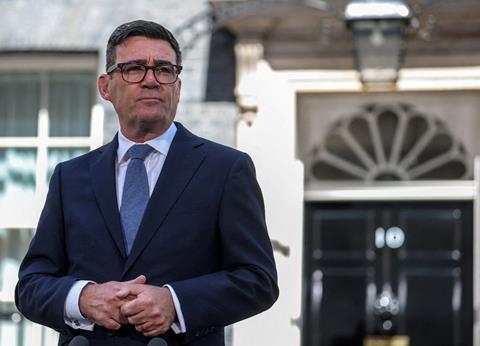
As Andy Burnham enters Downing Street, Tommy Sharpe urges the new prime minister to restore the UK’s overseas aid budget. It is the Christian thing to do, he says
Thirty years ago, over after-service biscuits and cups of tea, church groups across the UK began to unite behind a simple phrase.
‘Jubilee 2000’, founded on the principles in the Levitical Jubilee laws, was a movement to cancel the burdensome debts of the world’s poorest countries. What had started as a spark of inspiration between two friends quickly became a national movement. The Archbishop of Canterbury endorsed the movement and its policy proposals gained traction with Gordon Brown and Tony Blair. It even exerted influence on the United States congress.
Seed of faith to tree of fruits
Jubilee 2000, a contributing movement to the Make Poverty History campaign, was a living example of Jesus’ parable of the mustard seed. God grew a small seed into a huge tree in whose branches birds could perch.
Twenty years on, Justin Welby said that the campaign was “perhaps the churches’ finest hour in dethroning Mammon” and that “sustained support from Christians and others across the world led to the cancellation of more than $100 billion (£74.7bn) of debt owed by 35 of the poorest countries.”
This campaign found itself in a long tradition of Christians fighting against poverty, advocating for peace, working for the empowerment of women and girls, and contributing to healthcare for the sick.
Right from the start, the early Church was well-known for their generosity and their willingness to carry out humanitarian work in disaster regions – like staying behind in villages hit by the plague to care for the dying. More recently, many major international charities have been founded because of the Christian call to love our neighbours as ourselves – for example, Christian Aid, CAFOD, the Salvation army, World Vision, Open Doors and International Justice Mission.
The Lancet medical journal estimates that they international development cuts will cause 22 million avoidable deaths by 2030
Generations of Christians have engaged in this work for deeply theological reasons, not as a result of progressive liberalism. In caring for the world’s most vulnerable, Christians have chosen to make real sacrifices in order to recognise the image of God in, and the inherent dignity and value this gives to, oppressed and vulnerable people with whom the church may have limited connection. This work is celebrated as an act of worship by Jesus in Matthew 25 when he says “whatever you did for the least of these, you did for me”.
A return to loving our neigbours
Over recent years, the world has begun to retreat in its support for “the least of these”. Nationalistic, isolationist political agendas and media frenzies about the efficiency of spending – despite the spending of development departments being some of the most scrutinised spending in government – have led to deep cuts to international development agencies like the Department for International Development, which has seen its funding fall from 0.7% of GDP to 0.3% over recent years, and the dismantling of USAID.
While the international development system does need to evolve from paternalistic programming to empowering local in-country partners (and in many places has begun to do so), the wholesale withdrawal by countries such as the UK and the USA has had a devastating impact and has left many of the world’s most vulnerable in desperate situations. The Lancet medical journal has attempted to quantify the human toll of international development cuts, estimating that they will cause 22 million avoidable deaths by 2030, including 5.4 million children under five. Each of these individuals is made in God’s image and has inherent dignity and value.
Andy Burnham is facing this reality as he enters number 10 Downing Street.
He can respond in one of two ways. He can continue to pursue an isolationist foreign policy agenda that pulls Britain away from co-operation with the rest of the world. As well as harming the world’s most vulnerable, this will make the UK less safe, damage our international standing, and fuel major international issues like climate change and the refugee crisis.
Alternatively, he has a chance to recall his Catholic upbringing and do the Christian thing, the thing that recognises that every human has inherent dignity and value, by prioritising international development. To do this, Burnham could chart a path back to the UK’s previous commitment of spending 0.7% of GDP on international development – whilst ensuring agencies are held to account on delivering high quality programmes through local partners.
Doing the Chrisitan thing will require Burnham making a convincing case to the country on the value of international development. If he succeeds, he could, like the two friends who started Jubilee 2000 all those years ago, plant a mustard seed that changes the direction of our increasingly fractious world.






















1 Reader's comment