










Henry Nowak died pleading for help while police focused on allegations that he had made a racist remark. Jamie Bambrick contends that his death exposes the dangers of recent policies of race which have impacted both the Church and wider culture. He’s calling on Christians to return to the biblical principle of equal justice for all
Imagine the scene. Police receive a call that an 18-year-old Indian man has racially insulted a family of white people. Officers arrive to find the Indian man pale as a ghost and barely conscious. The first thing they are told as they walk up to the man is that his mouth keeps filling with blood. Other witnesses have called the police saying that there has been a stabbing. The Indian man pleads for an ambulance, saying, “I can’t breathe. I’ve been stabbed.” Officers laugh it off, saying, “I don’t think you have, mate.”
When one officer suggests checking him anyway, a white family member insists there is no wound. The policewoman replies, “I know” (because of course he’s the offender here), “but we have to check.” They briefly lift his shirt up to his bellybutton and no further, performing no proper check, before roughly throwing the man to the ground, proceeding to arrest him for the alleged racist remark and cuffing him.
As they do so, he drowns in his own blood and dies. Meanwhile, the police are searching his phone to find evidence of anti-white racism.
Why? Because their training demanded they prioritise the white accusers over a non-white victim in any racial dispute.
Later, it emerges the white stabber’s family colluded: they not only failed to call for an ambulance, but called the police to hide their tracks, concealing the fact that the young man was in any way injured. The mother of the family removed the murder weapon to hide it. On body camera footage, the brother urged the killer to fabricate a self-defence story.
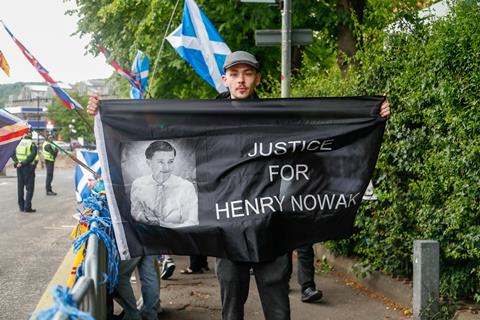
Reverse the races, and this story matches the final hour of 18-year-old Henry Nowak. On 3 December 2025 in Southampton, Henry, a white British university student walking home after a night out, was stabbed five times by 23-year-old Vickrum Digwa, a Sikh man carrying a 21cm knife. Digwa falsely claimed Henry had racially abused him and assaulted him.
Police from Hampshire & Isle of Wight Constabulary, primed by years of “anti-racist” training that treats accusations of racism as uniquely heinous, handcuffed the dying teenager on the ground. Henry repeatedly told them, “I’ve been stabbed,” and “I can’t breathe.” Officers dismissed him, and he died at the scene.
Despite calls from many on the Left that this should not be politicised—something I note they never said about the death of George Floyd—the fact remains that this was not merely a random act of violence, but a politically precipitated murder. For decades now, white people have been accused of bearing “white privilege”, of having “unconscious bias”, and we have been told that the “systemically racist” systems of our country are the primary cause of any and all suffering endured by ethnic minorities.
As such, there have been endless initiatives to prioritise the wellbeing of ethnic minorities over and against white people. The Race Action Plan of the police force in question here lays bare this mindset. Officers are trained repeatedly to focus particularly on ethnic minorities and to reduce disproportionality between arrest rates for minorities and whites, regardless of well-known per-capita crime rate disparities.
The Police Anti-Racism Commitment, produced by the National Police Chiefs’ Council (NPCC), explicitly rejects treating everyone “the same” or being “colour blind” in the interest of “producing equality of policing outcomes”.
Henry Nowak’s death is the predictable fruit of a broader cultural capture. Masquerading as “anti-racism” and “Equality, Diversity and Inclusion”, anti-white racism has become endemic in British institutions.
Examples abound. White working-class boys lag behind every other demographic in education, yet receive no targeted “closing the gap” programmes akin to those for ethnic minorities. Grooming gang scandals across the nation saw authorities hesitate to act against predominantly Pakistani perpetrators for fear of “racism” labels, abandoning thousands of mostly white girls to be violently and brutally raped in explicitly racially motivated attacks. In employment, unconscious bias training and diversity drives often disadvantage white candidates, particularly men, in the public sector.
Henry Nowak’s death crystallises this inversion: an accusation of a white person’s racism was weighed more heavily than visible evidence of that white person having been stabbed.
Sadly, Britain’s church establishment has wholeheartedly endorsed this moral lunacy.
In the Church of England, quotas are set for at least 30% “BAME” candidates for church leadership programmes—well above the national percentage of ethnic minorities, thereby demanding whites be underrepresented in church leadership. The Evangelical Alliance welcomed phrases such as “microaggressions”, “unconscious bias”, “critical race theory”, “systemic racism”, and “decolonisation” entering Christian vocabulary, despite the fact that none of them are found in the Bible and indeed represent ideas wholly unbiblical in origin.
Scripture repeatedly condemns favouritism based on ethnicity or social status
Ben Lindsay, widely recognised as one of the go-to figures for anti-racism seminars in UK Christianity, indicated in his book that reparations from white people to black people were preferable, though not practical, despite biblical warning to the contrary.
Scripture repeatedly condemns favouritism based on ethnicity or social status. James 2:1–9 says that, “If you show partiality, you are committing sin and are convicted by the law as transgressors.” This includes partiality against white people.
George Floyd’s death prompted national days of reflection, sermons, and policy pushes by churches across the country. Will any of these same institutions reflect on Henry Nowak’s death, caused by a false accusation of racism and a systemically anti-white police force? I doubt it.
Krish Kandiah came out accusing Nigel Farage of “stoking division”, as opposed to the racist policies that clearly influenced the police’s actions in this scenario. Paul Woodman’s article, though doubtless well-intentioned, directed the discussion towards “rising living costs” and “social, economic, and cultural pressures”, as though they were even remotely related to the case at hand.
This is not mere cultural accommodation. It is theological error. “Anti-racist” policies that treat white Britons as inherently privileged or suspect, while framing ethnic minorities as perpetual victims requiring special protection, invert the principle of biblical equality. They replace the imago Dei with identity hierarchies.
The Church, called to be salt and light, has instead baptised secular critical race ideologies that divide rather than unite. By prioritising racial equity metrics over impartial justice, it has sinned against God and against the white British population.
The British Church must repent. Affirmative action in hiring, race-based training that pathologises “whiteness”, and victimhood narratives that ignore anti-white prejudice must be renounced as unbiblical. Leaders should publicly confess how alignment with cultural fashions has distorted the gospel of reconciliation.
Henry Nowak was not given dignity in death. He died pleading for help while officers, shaped by race-conscious doctrine, treated him as the perpetrator. If the Church continues down this path, embracing partiality under the guise of justice, it will not only fail the nation, it will answer to the impartial Judge.
Repentance is urgent. White lives matter too, because all lives are made in God’s image.