












There are many Bible translations available, so how do we choose the one that is right for us? Dr Jason Myers explains how we got from ancient Greek to modern English, and what we need to know when thinking about the version of scripture that we read
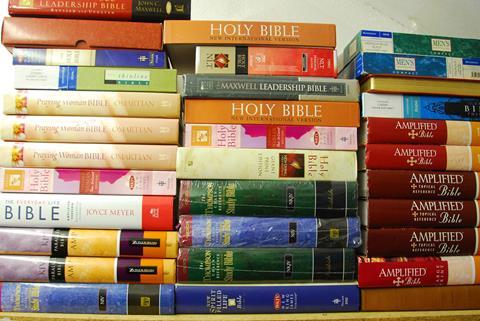
Open almost any Bible app or walk into a Christian bookstore, and you will encounter a bewildering array of Bibles to choose from. There’s the New International Version (NIV), New Revised Standard Version (NRSV), English Standard Version (ESV), New American Standard Bible (NASB), New King James Version (NKJV), Common English Version (CEV), The Message - and many more.
Each claims to communicate the Bible faithfully, yet they do not always use the same words - or even appear to say precisely the same thing.
So, why are there so many translations? Which one should we use? And how did ancient Hebrew and Greek texts become the English Bible that we read today?
Answering these questions requires us to recognise that the journey from the biblical authors to our English Bibles involved several important stages. The books of the New Testament were originally written in Greek, but the original, handwritten paper or papyrus copies no longer survive. Floods, fires, and the general trajectory of the natural world towards degradation and decay over thousands of years have unfortunately taken their toll. But, what we do possess instead are thousands of manuscripts, copied over many centuries.
Made by hand
The early Church wanted to have the texts of scripture to read together, so they made copies. For example, Paul sends a letter to the church in Rome, but what if another community wanted to read it too? Hopefully, someone had a friend who was good at copying - known as a scribe - who would make the paper, draw up the ink, and begin the laborious process of copying the text of Romans letter by letter. And this is just for one copy!
Scribes copied these texts line by line. They generally worked with remarkable care but, of course, mistakes could be made. A scribe might confuse similar letters, repeat a word, omit a phrase, or accidentally skip from one line to another. Occasionally, a scribe might clarify a difficult expression or harmonise one Gospel’s wording with another. This process happened for centuries. So, what we have today are some nearly complete Bibles, such as the fourth-century Codex Sinaiticus and Codex Vaticanus. Others are small fragments containing only part of a page.
Diversity does not automatically guarantee accuracy, nor does uniformity prove that a decision is wrong
Some people might become nervous when they first learn that New Testament manuscripts contain differences. This is not a problem unique to the Bible. It is true of every work from antiquity, from Homer’s Odyssey to Plato’s Republic. Before the invention of the printing press, preserving a book meant copying it by hand. However, it’s also important to know that, even though the Bible went through this copying process like every other ancient text, today it can be rigorously checked.
This process is known as textual criticism. This discipline compares surviving manuscripts to determine the earliest recoverable form of a text. Scholars consider external evidence, including the number, age, geographical distribution, and quality of the manuscripts supporting a particular reading. They also examine internal evidence: Which reading best explains how the others arose? Is one more consistent with the author’s vocabulary and style? Did a scribe accidentally omit words or simplify a difficult sentence?
So, the abundance of manuscripts is an advantage. It allows scholars to compare many witnesses, identify where differences occurred and evaluate the available readings. The result is the carefully reconstructed critical text of the original manuscripts used by most modern translation committees.
More than words
Translating Greek and Hebrew texts written thousands of years ago is a complex process and one that has to be done for every generation and every culture as language evolves. However, this is not a matter of simply replacing each ancient word with a corresponding English word. Languages simply do not work that way.
Every language has its own vocabulary, grammar, word order, idioms and cultural assumptions. A strictly word-for-word translation of an expression such as “a frog in your throat” would make little sense to someone unfamiliar with the English idiom, for example.
The question becomes how would we translate “a frog in your throat” into another language that does not have this idiom? We might substitute words in order to convey the meaning of what was said and help our new reader understand what was being communicated.
Bible translations therefore operate along a spectrum. At one end are translations that emphasise the form of the original language. These attempt, as much as possible, to preserve Greek or Hebrew vocabulary, sentence structure and grammatical patterns. The NASB, NRSV, and ESV tend to lean in this direction.
The variety of English Bibles need not undermine our confidence in scripture
Form-driven translations can help readers see repeated words, literary patterns and features of the original text. They may also preserve ambiguities found in the Greek or Hebrew. At the same time, they can sound awkward in English, especially when reproducing long and complex sentences.
Look at Ephesians 1:3-14. In Greek, these twelve verses constitute one elaborate sentence of roughly 200 words. In modern English this is a classic “run-on” sentence, but not so in the ancient Greek in which Paul wrote. Bad English, but good Greek! Most English translations divide this long Greek sentence into several shorter ones so that readers can follow the argument. The wording may become less formally equivalent, but the meaning becomes considerably clearer.
At the other end are meaning-driven translations. These prioritise the meaning of a passage in natural, understandable English. Translators may divide one long Greek sentence into several English sentences, rearrange the word order, or translate the same Greek word differently according to its context. The NIV and CEV tend lean more strongly in this direction.
These versions are often easier to read, but their clarity requires translators to make interpretive decisions for us. A meaning-driven translation may resolve an ambiguity that the original text leaves open or obscure the repeated use of an important Greek term.
Consider the Greek word sarx, often translated as ‘flesh’. Depending on the context, it can refer to the physical body, ordinary human existence, human mortality, or humanity oriented away from God.
Translating sarx with the same English word each time allows readers to trace Paul’s vocabulary, but it may also produce misunderstandings. Translating it differently in each passage may communicate Paul’s intended meaning more clearly, but readers can no longer see that the same Greek term stands behind the various English expressions. Take a look at the following examples:
| Passage | NRSV | NIV | Meaning |
|---|---|---|---|
| Phil 1:22 | “If I am to live in the flesh, that means fruitful labor for me.” | “If I am to go on living in the body, this will mean fruitful labor for me.” | The human body (morally neutral) |
| 1 Cor 15:50 | “Flesh and blood cannot inherit the kingdom of God.” | “Flesh and blood cannot inherit the kingdom of God.” | Mortal human nature in contrast to God’s immortal nature |
| Gal 5:17 | “What the flesh desires is opposed to the Spirit …” | “The sinful nature desires what is contrary to the Spirit …” | Unrenewed human nature (morally corrupt) |
Neither approach eliminates interpretation. Every translation is interpretation.
Finally, we always need new translations because the English language is always changing. Although one could make their way through the King James Version of 1611 today, it would not be without difficulty for most people because this is no longer the vernacular that we now speak. The King James Bible was a remarkable gift in the 1600s. However, because language is always changing, so too must translations to achieve the goal of translation: which is for people to be able to read and understand what they are reading.
In more recent times, several new translations have emerged. One of the most popular is Eugene Peterson’s The Message. As a pastor, Peterson set out to translate the Old and New Testament into a more modern vernacular that people in his church could understand. Sadly, The Message has suffered a great deal of misunderstanding and is sometimes looked down on by scholars.
Contrary to some misinformation, Peterson translated from Greek and Hebrew and had a consultation of recognised Old and New Testament scholars who reviewed his work to ensure accuracy. The popularity of his translation shows the desire of many to read a text that speaks into their own experiences.
In the last few years, newer translations of the New Testament have appeared from scholars including NT Wright (The New Testament for Everyone) and Scot McKnight (The Second Testament).
Who is doing the translating?
Translation is not only shaped by a stated philosophy (form versus meaning). It is also shaped by the people at the table, their experiences, backgrounds and cultures. So, what do we know about the people who translate the Bibles we read today? Let’s take the ESV and the NIV as examples.
The current ESV Translation Oversight Committee consists entirely of men, largely drawn from conservative evangelical institutions, with particularly strong representation from Reformed seminaries and churches. The committee displays relatively little diversity in gender or theological perspective.
This presents some potential hazards. When translators share many of the same theological assumptions, they may be less likely to recognise where those assumptions influence their decisions. This becomes especially important when translating disputed passages concerning gender, ministry, church leadership or other theologically contested subjects. If the translators already think the same about an issue, they will likely favour translations that support their views.
By contrast, the NIV Committee on Bible Translation includes both women and men, represents several countries, and draws its members from a broader range of evangelical denominations and theological institutions. Its members include Baptists, Presbyterians, Anglicans, Christian Reformed scholars, and scholars affiliated with other evangelical traditions.
Be very wary of anyone advocating one translation only
The NIV also requires at least 70 percent of its translation committee to approve any change to the text. This means that no narrow group or simple majority can easily impose its preferred interpretation. A proposed change must persuade scholars across the committee’s denominational, theological, cultural and gender diversity.
Diversity does not automatically guarantee accuracy, of course, nor does uniformity prove that a decision is wrong. Nevertheless, a diverse committee operating with a high threshold for consensus creates an important system of checks and balances. It encourages translators to test their interpretations against perspectives different from their own. This can produce greater clarity while reducing the risk that the assumptions of one theological community will quietly determine the translation.
Consider Romans 16:7, where Paul greets Andronicus and Junia and says they are eisin episēmoi en tois apostolois (“of note among the apostles”). The main issue for translators is the little preposition en and whether it should be translated as ‘to’ the apostles or ‘among’ the apostles.
The ESV describes them as “well known to the apostles,” while the NIV says they were “outstanding among the apostles.” The difference matters enormously. Was Junia simply respected by the apostles, or was she herself recognised as an apostle?
There is overwhelming evidence from elsewhere in the scriptures (and other contemporary Greek texts) that the preposition should be translated as ‘in’ or ‘among’, thus making Junia a first century female apostle – the highest level of leadership in the early Church. (For more on this debate see Junia is Not Alone by Scot McKnight.)
Greek grammar, historical evidence, and assumptions about women’s leadership all enter this discussion. Translators cannot avoid making a decision, and that decision shapes what English readers encounter and therefore believe.
Which translation should I choose?
So, how should we choose which translation to read? Is one really much better than another?
First of all, it’s important to recognise that there is no perfect English Bible. By which I mean, every single one is a translation of the original and has been through the process of interpretation by a committee or individual.
The best translation therefore depends partly on what we are trying to accomplish. A meaning-driven translation may be especially useful when reading biblical narratives or large sections of scripture. A more form-driven translation may help when studying the detailed progression of an argument in Romans or tracing the repetition of a particular term.
The wisest approach is not to insist that everyone use one translation. In fact, be very wary of anyone advocating one translation only! Instead, we should read multiple translations and pay particular attention to places where they differ. Those differences often alert us to an ambiguity, textual question or interpretive decision that deserves closer study.
The variety of English Bibles need not undermine our confidence in scripture; in fact it is a gift that can deepen our understanding. At WTC, we often recommend that students use the NIV or NRSV. The more neutral translation process and readability make these great options for the study of scripture and formation.
But, at the end of the day, the best translation is the one that actually helps you read the Bible! We want to be caught up in the story of scripture, to love reading the Bible, and to be sent out to proclaim Jesus’s kingdom. Translations are one key part of that process.





















2 Readers' comments