










Churches often encourage adoption, but rarely understand what it really involves. Reflecting on a recent Sunday morning, Lisa Mainwaring highlights how some well-meaning language can be harmful to adoptive families and what they truly need from their church communities
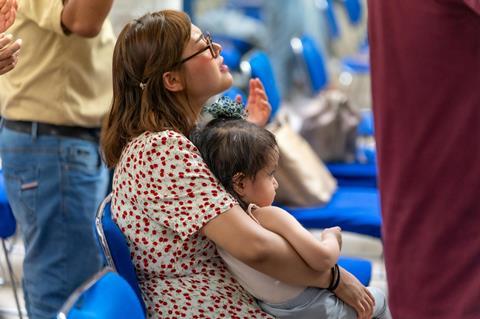
It’s coffee after church on Sunday.
I’m holding a paper cup and keeping one eye on my children, who are circling the room with a glint in their eyes, laughing a little too loud, moving a little too fast.
An older woman smiles warmly.
“They’re so lovely. I can’t imagine why their parents could give them up.”
I look down at the coffee in my hands and feel the familiar calculation begin. How much truth fits here? Modern adoption is different. Children are usually taken into care because of neglect or abuse, often after long periods of instability. There’s no version of this that can be said lightly, and no version that won’t invite more questions.
I try to smile and say, “They didn’t give them up.”
I regret it immediately.
“Oh. What happened?”
Around us, people are chatting about their Sunday plans. I’m running on empty, aware of the way my children are tipping closer to the edge. I don’t have the energy to translate their lives into something digestible.
“That’s their story to tell when they’re older, if they want to,” I quip.
Just as I’m about to leave, the children’s pastor and the vicar join us, so I stay a moment longer to be polite. Someone adds, kindly, “At least they won’t remember what happened to them.”
I feel the familiar tightness in my chest. I don’t correct them. I don’t explain that trauma doesn’t need conscious memory to leave a mark. I simply nod, already planning our exit.
Walking away, I realise this is the moment I keep circling back to. Not because anyone has been unkind, but because there isn’t a shared understanding of what many adopters are carrying while trying to show up to church.
When theology meets real life
For many Christian families, adoption doesn’t begin in isolation. It is encouraged, explicitly or implicitly, in church settings that speak passionately about caring for vulnerable children.
Adoptive parents need the church to be a place where we can breathe and be spiritually replenished
For many of us, it also includes infertility, loss, and unanswered prayer. Stories like Abraham and Sarah, often held up as hopeful, can be complicated and painful rather than comforting.
And yet, while I stood there with a cup cooling in my hand, I was struck by how little understanding there is of what modern adoption actually involves. Without lived experience in church leadership, there’s often very little sense of how trauma and attachment difficulties, rooted in a child’s earliest experiences, play out day-after-day at home.
Most churches are kind and welcoming. But many church leaders haven’t been equipped to understand what it means to parent children shaped by Adverse Childhood Experiences (ACEs), and there’s little pastoral curiosity either.
Parenting adopted children is different
Around 80% of adopted children in the UK have experienced abuse, neglect or violence before being adopted. For many, those early experiences are linked to developmental trauma, shaping how they experience the world.
It isn’t only about what happened to them. It’s also about what didn’t happen. A baby’s brain develops through repeated experiences of being soothed when distressed, having needs noticed and met, and learning that adults are reliable and the world is predictable. When those experiences are missing or inconsistent, because of neglect, abuse, repeated separations, chaotic caregiving, or even stress and fear in utero, the brain adapts for survival rather than connection.
That early adaptation doesn’t simply switch off because a child is now safe. Many children are emotionally much younger than their chronological age and still need the kind of reassurance and co-regulation we usually associate with much younger children. Sleep can be fragile. Big emotions can arrive quickly and linger. Even good days can feel unsafe, so a child may sabotage birthdays, holidays, or calm moments, not out of defiance or ingratitude, but self-protection.
Parenting that calmly, day after day, takes a huge amount of energy.
There’s a saying that a parent is only as happy as their saddest child, and that feels painfully true much of the time.
For children shaped by trauma, feeling safe with people has to come before joining in. Without that, church becomes another place they’re trying to manage and mask, rather than a place where they can settle.
What can churches do differently?
To support our children well, we, the parents, need oxygen first. We need the church to be a place where we can breathe and be spiritually replenished, not just another place where we’re managing and coping.
If you’re a church leader reading this and thinking, I honestly didn’t realise, please know this. This is not criticism. We just want you to understand that we need.
Around 80% of adopted children in the UK have experienced abuse, neglect or violence before being adopted.
And most of the time, we’re too busy firefighting. Managing crises as they arise. Playing whack-a-mole with behaviour, sleep, school, and services. Spending an inordinate amount of time advocating for our children to get therapy, filling forms, attending meetings, and trying to hold everything together. In all honesty, there’s very little space left to explain ourselves, or to think strategically about what support might look like.
What helps most isn’t expertise or perfect answers. It’s consistency. Understanding. Support that stays when things get messy. The kind of practical, alongside-you support Jesus modelled.
Adoption isn’t a moment. It’s a long, demanding journey. And the church can be a place that walks it with families, kindly and faithfully.
Voices from adoptive families
Over the past week, I’ve spoken to a number of families across the UK who are Christians and have adopted, fostered, or cared for children through kinship and special guardianship. They live in different places, attend different churches, and have children of different ages.
But as I listened, a clear pattern began to emerge. The details vary, but the themes repeat. What follows are their words, shared anonymously, in their own voices.
When support starts, then disappears:
“One of the hardest things is when help is offered, becomes part of your week, and then suddenly stops.”
“For a while it can feel like a lifeline. And then it’s gone, without explanation.”
“For children who have already learned that adults don’t always stay, that kind of inconsistency can be deeply unsettling. It can actually be easier to cope with no help at all than to adjust to support that disappears.”
“Many people genuinely want to help, but walking alongside families over the long term is hard. And when that support falls away, parents are left quietly carrying the cost.”
Sarah, 48, Cornwall
The absence of pastoral curiosity:
“What I’ve struggled with most isn’t unkindness, it’s the absence of pastoral curiosity. No one has ever really asked, ‘What is family life actually like for you?’ or ‘What’s hard right now, and how could we support you?’”
“Our church is kind, and our children are included, but there’s never been that sense of someone from leadership coming alongside us to understand what adoption means day to day. And because that understanding isn’t there, you end up explaining the same things over and over again, quietly, on your own.”
Angela, 49, Northern Ireland
When language never changes:
“With fostering, every time a new baby comes, we have the same conversations. ‘Isn’t it awful the parents didn’t want them?’ And every time I have to explain that they are wanted and loved, but their parents can’t keep them safe.”
“You start to wonder when people are going to get it. The language never changes, and neither does the assumption.”
Angela, 49, Northern Ireland
Church as an exposing space:
“Church can feel really exposing for adopted children. It’s busy, it’s loud, people are friendly and curious, and that can be overwhelming for children who need safety and predictability.”
“What I’ve found hardest is that curiosity often comes with an expectation that you’ll share your child’s story. People ask questions without realising they’re asking about trauma. As a parent, you’re constantly holding boundaries, protecting your child, and managing the environment at the same time.”
“I wish churches were better at setting those boundaries themselves, so parents didn’t always have to.”
Ludovica, 40s, Teddington
When things are at breaking point:
“When things got really bad at home, I told our vicar what was happening. Broken windows. Police involvement. A ten-year-old completely out of control.”
“He was kind in the moment. We had a cup of tea. And then it was never mentioned again.”
“It felt like something enormous had happened in my life, and everyone decided to pretend it hadn’t. That was one of the hardest things to carry.”
Katie, 54, Kent
When leadership experience makes a difference:
“I think experiences vary hugely depending on whether there is lived experience of adoption within church leadership. Where there is, supportive structures can be built quietly over time, often without the wider congregation being aware because of privacy.”
“In that context, occasional unhelpful comments don’t really affect week-to-week life.”
“A few years ago, when there was too much change in the children’s team and no trusted adult to attach to, our daughter struggled badly. Once consistency and trusted relationships were rebuilt, things improved.”
John, 48, Wimbledon
Dreading Sundays:
“I’ve come to dread Sundays. If church were anything else, I wouldn’t even attempt it on my own with our children. It doesn’t work, and we know that.”
“Church has always mattered deeply to me. It’s been the highlight of my week my whole life, and I want that for our children. But the reality of getting through the door, sitting down, managing behaviour, and holding everything together is overwhelming.”
“People are kind, they try to help. And still, I dread going.”
Hannah, minister’s wife, 45, London
What actually helps:
“What has helped us most hasn’t been courses or one-size-fits-all solutions, but stories and relationships. People who are willing to really listen, to get alongside us, and to get their hands dirty in the way Jesus did.”
“A few people who genuinely want to understand and help make all the difference.”
Sarah, 48, Cornwall





















2 Readers' comments