











Michel-Yves Bolloré and Olivier Bonnassies’ bestseller argues that belief in God is not blind faith but a rational conclusion. Endorsed by Nobel Prize winners and Oxford professors, this ambitious work uses cosmology, physics and philosophy to challenge materialism. But can science truly prove God’s existence?
Does God exist? For Premier Christianity readers, the answer is a confident yes. But for countless sincere seekers, this age-old question remains as pressing as ever.
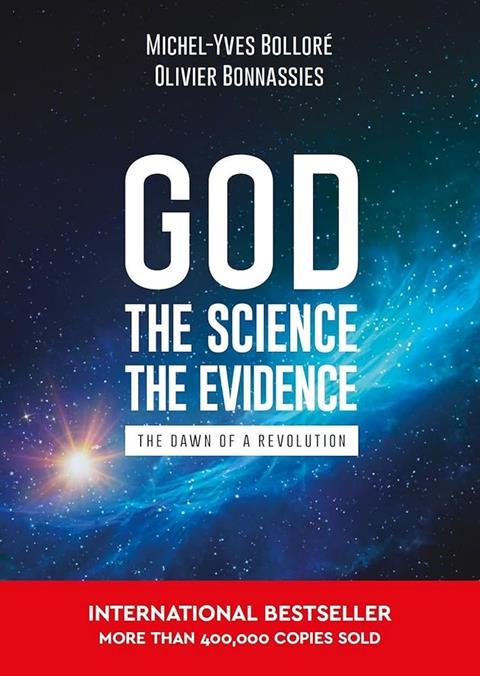
In God, the Science, the Evidence (Abrams), French co-authors Michel-Yves Bolloré and Olivier Bonnassies take nearly 600 pages to argue that belief in God is no longer a matter of blind faith, but a conclusion grounded in scientific discovery. Drawing on developments in cosmology, physics, and philosophy, they contend that belief in a creator is both rational and supported by compelling evidence.
Before appearing in English, this book had already become a European bestseller, selling hundreds of thousands of copies in France and elsewhere. This English translation now comes with endorsements from major scientists and thinkers across physics, philosophy, and theology. Oxford professors Andrew Briggs and John Lennox, as well as Robert Wilson (winner of the Nobel Prize in Physics), are just a few of the names to commend the work. These endorsements certainly build credibility, involving respected scientists and Nobel laureates, acting like an imprimatur that sets it apart from other books.
At its core, the book argues against the dominant materialist narrative, where all reality is explained solely through matter and physical laws, asserting that this worldview is increasingly untenable. Instead, Bolloré and Bonnassies claim that developments in cosmology, thermodynamics, quantum mechanics, and the fine‑tuning of the universe make a stronger case for a creator hypothesis than for mere chance or impersonal physical processes. Throughout, they challenge the assumption that science and faith are antithetical. Instead they propose that science can provide indirect support for belief in God’s existence. Towards the end of the book, questions around perceived “errors” in the Bible, Jesus, and other theological matters are explored, although these feel more like add-ons than central arguments.
One of the book’s strengths is its broad survey of scientific concepts. Readers are taken from the classical challenges to religion posed by figures such as Darwin and Freud through to contemporary ideas in physics and cosmology that the authors argue have undermined strict materialism. The narrative includes familiar scientific milestones: the Big Bang theory, the expansion of the universe, heat death, and the exquisitely low probability of life emerging by chance – as well as the fine‑tuning problem, which points to the precise calibration of physical constants necessary for life. Through these examples, Bolloré and Bonnassies invite readers to consider whether the universe’s remarkable properties are better explained by a mind‑like cause rather than blind processes.
This book, however, is not without its limitations. For readers expecting a conventional Christian apologetic rooted in theology or scripture, God, the Science, the Evidence may feel more like an extended philosophical and scientific reflection. The title’s promise of “evidence” may also set expectations that are difficult to fulfil, especially for those versed in the philosophy of science, where the term “proof” carries a very different meaning than it does in everyday discourse. Bolloré himself acknowledges that science cannot prove God’s existence in the strictest sense, but can only weigh evidence for or against competing explanations.
Another challenge arises in the book’s appeal to authority. While endorsements from scientists add gravitas, appeal to authority is not itself evidence of truth. Some critics have pointed out that the arguments presented are familiar, echoing classic fine‑tuning and cosmological arguments, and may not satisfy those who believe scientific explanations do not, in principle, address metaphysical questions.
Perhaps the subtitle “the dawn of a revolution” is hyperbolic. This book will certainly help many, but we need to be careful not to frame belief in God solely as the result of intellectual reasoning. After all, religious experience does not constitute “proof” in any empirical sense. Throughout Church history, from Augustine to Wesley, spiritual encounters – albeit subjective – were the driving force of faith. Faith, then, is not only (or even primarily) about logical deduction or empirical evidence; it is about encounter, relationship, and transformation. Christianity, at its heart, is not just a belief in the existence of a deity, but a response to a God who reveals, speaks, and draws near. Of course, we are to love the Lord with our “minds,” but let this never be at the expense of the “heart.”
Despite these criticisms, this book belongs on your bookshelf. It is ambitious in scope, covering centuries of scientific and philosophical thought. It is accessible in tone, avoiding highly technical jargon that might alienate; and it is thought‑provoking, challenging readers to reconsider long‑held assumptions about the relationship between science and religion. For Christians who have felt marginalised by secular portrayals of science, Bolloré and Bonnassies offer an encouraging narrative: that scientific discovery and belief in God are not mutually exclusive.
God, the Science, the Evidence (Abrams) by Michel-Yves Bollore, Olivier Bonnassies is out now.


























No comments yet