












Nine years after the Grenfell Tower disaster, another west London fire killed three men in Rev Jamie Sewell’s parish. The tragedy caused him to reflect on what Christian community and being a good Samaritan really looks like
Last week marked the ninth anniversary of the Grenfell Tower disater. Across our city, people gathered to remember the 72 lives lost in the fire. We remembered the stories, the families and the questions that still linger.
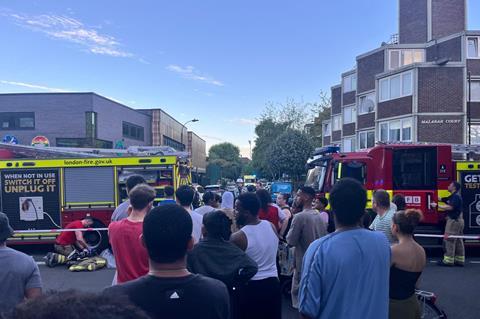
Less than a week later, on Saturday 20 June, I stood outside another fire. I had stepped outside my vicarage and noticed smoke drifting across the street. I followed it to it’s source, about 50 meters from my house, and was met by flames pouring from a boarded-up building, known locally as the Pavilion.
Unknown to me at the time, there were three men trapped inside. They tragically lost their lives. But the tragedy is not simply that three men died. The tragedy is that, for some time, people had been using the abandoned building as a place of refuge, a place to live. Community members called it a squat, but those men called it home.
Locally, they were often referred to simply as “the squatters”. Yet since the fire, I have not met anyone who knew their names.
Knowing your neighbours
Too often, it takes a tragedy to expose our blindness. A tower burns. A child is stabbed. A rough sleeper dies. A boarded-up building catches fire. Suddenly cameras arrive, politicians speak and communities grieve. Yet the needs were there long before the headlines.
The tragedy did not create them. It merely revealed what we had stopped seeing.Those men were our neighbours.
Late on Saturday evening, someone asked me if I knew the men living in the Pavilion.
“I knew of them, but I didn’t know them,” I replied honestly.
Christians cannot outsource neighbourliness
The more I have reflected on that answer, the more I wonder if it describes the priest in Jesus’ parable of the Good Samaritan.
The priest saw the wounded man. He recognised his need. He knew of him. But he remained distant. And he walked past.
Most of us are not actively hostile to people in need. We are much more likely to be like the priest. We know of the lonely neighbour. We know of the rough sleeper. We know of the struggling family. We may even feel compassion for them.
But there is a difference between knowing of someone and knowing them.
The Samaritan crossed that distance. He moved from awareness to action. From observation to involvement. From knowing of a need to meeting it.
In the last nine years, I have witnessed two awful fires that have tragically taken lives unnecessarily. Both Grenfell and this more recent fire in White City draw our eyes to a deeper issue that our nation is facing, an issue of providing the most basic of needs - a safe place for people to live.
The housing crisis in Britain is often discussed through numbers. Waiting lists. Rental prices. Planning applications. Yet behind every statistic is a person trying to find somewhere safe to belong.
We should absolutely put pressure on government, councils and housing providers to play their part. But Christians cannot outsource neighbourliness.
The housing crisis can feel so vast that it becomes paralysing. Yet Christians have never been called to solve every problem. We have been called to be faithful where God has placed us.
The Christian vision of community
For me, the question has become: What does it look like not merely to care for vulnerable people, but to help create communities in which fewer people become invisible in the first place?
For some time, I have been praying about a vision we are calling Eden Village. A vision to demolish our existing buildings and build a space inspired by the Church of the New Testament:
‘“They devoted themselves to the apostles’ teaching and to fellowship, to the breaking of bread and to prayer… All the believers were together and had everything in common. They sold property and possessions to give to anyone who had need… They broke bread in their homes and ate together with glad and sincere hearts… And the Lord added to their number daily those who were being saved” (Acts 2:42, 44-47).
We don’t envision Eden Village to simply be a housing developmen or a church building, but a village within a city. A place where worship, hospitality, compassion, partnership and community life are woven together. A place where people can belong and flourish.
Our generation is being invited to think creatively about what faithful Christian place-making looks like
I do not believe it is the answer to Britain’s housing crisis. But perhaps it points towards the kind of question Christians should be asking. What would happen if churches began to see their land and buildings not as assets to preserve, but as opportunities for mission?
The Church has spent centuries building schools, hospitals, almshouses and places of refuge. Perhaps our generation is being invited to think creatively once again about what faithful Christian place-making looks like.
I only knew of the men who died in the Pavilion. But God knew them initmately. He knew their names. He counted every hair on their heads. He loved them.
The question now is not simply how we grieve, but what love requires of us next.
The smoke has cleared. The question remains: What are we prepared to build?

























2 Readers' comments