










As an internet blackout sweeps the country and thousands of protestors take to the streets, Steve Dew-Jones says it is about time the world’s media picks up on what is happening in Iran. Could it finally be time for change in the country with one of the world’s fastest growing Christian communities?
Iran is regularly cited as the place with the fastest growing Church in the world - albeit an underground one. Some people say it’s because Iranians have something within them that seems to make Christianity attractive. For one thing, many come from a Shia Muslim background, within which the concept of a coming saviour - in their case, Imam Mahdi - and even the person of Jesus (albeit only as a prophet) are already accepted theologies.
Another reason people cite is that many Iranians have grown tired of the ruling theocracy, in place for the past 47 years. Therefore they are looking for alternatives including, but not limited to, Christianity.
A 2020 study by GAMAAN, a secular Netherlands-based research institute, discovered that only a third of Iranians identified as Shia Muslims, despite Iran’s regime claiming that they make up 95 per cent of its population. Many respondents claimed to have no faith at all. Others said they were Zoroastrian. Some 1.5 per cent of respondents identified as Christian.
Given that there are now believed to be fewer than 100,000 members of the recognised Christian communities, largely of Armenian and Assyrian origin, still in the country - largely due to mass migration - researchers concluded that there may be 650,000-850,000 converts in Iran. Many evangelical Christian groups had previously estimated that the figure may even be in excess of 1 million. While it’s not possible to verify this, it certainly adds credence to the idea that Iran may indeed be the place where Christianity is growing the fastest.
For context, there were only a few hundred Christian converts in Iran when the Islamic Republic was founded in 1979. So whatever the precise figure today, the increase has been staggering - and has come despite decades of repression.
Blacked out
Since the student movement of 2009, protests in Iran have erupted regularly, including in 2019, 2022 and 2023. They have become so common that many news organisations don’t cover them sufficently, or don’t take notice until far too late in the day. It took until last night’s crescendo for the BBC, for example, to begin a live broadcast of the demonstrations.
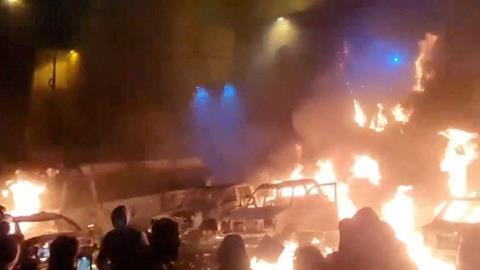
The latest wave of civil unrest began on 28 December, and despite limited media coverage, is still in full flow. Last night, they appeared to reach a climax. In response to a call from the exiled Crown Prince Reza Pahlavi, protesters took to the streets at 8pm last night. They will do so again this evening. The remarkable response saw huge crowds in major cities, such as the capital Tehran, Iran’s second largest city, Mashhad (home of Iran’s Supreme Leader) and Khomein, the birthplace of the founding father of the Islamic Republic, Ayatollah Ruhollah Khomeini.
Extraordinary, historic scenes from #IranProtests this evening: Young protestors in Khomein, hometown of Ayatollah Khomeini, founder of the 1979 revolution that toppled the king, are chanting 'Long Live The King' ... 47 years later.
— Siavash Ardalan (@BBCArdalan) January 8, 2026
Source: @Vahid pic.twitter.com/kTAX1ykLyZ
This morning, Iran’s Supreme Leader, Ali Khamenei, sought to downplay their significance, referring to those who took part as “vandals” who damaged their own country simply to “please” the American president. Protestors were reportedly killed and an Internet blackout imposed across the country, a familiar response to protests in recent years.
At the time of writing, many Iranians in the diaspora have posted on social media to say they have not been able to reach their loved ones inside Iran for hours, and are growing increasingly concerned.
The Islamic Republic have shown themselves to be very capable of clinging on to power, even as it would seem that the vast majority of their people are desperate for them to go.
Change or stick?
For Christians in Iran, there may be a variety of responses to the protests. Some may wish to join the protests in the hope of securing greater religious freedom, including being able to go to church - a freedom denied to the vast majority of Christians in Iran today, as the Armenian and Assyrian churches remain shut to converts.
Others may disagree with the idea of protesting, believing it their duty to “submit to the authorities”, however repressive they may be. During past protests, Christians have offered support to protesters by handing out food or caring for the injured.
But above all, these protests are not about any one faith. They are about a longing for change that has been growing steadily for decades. Pahlavi has promised to lead a democratic transition rather than rule the country himself, and has spoken on numerous occasions about how a future Iran would have a place for all, including religious minorities.
Iranians will know all too well that it is one thing to promise something and another to deliver, but there can be no doubt now that the vast majority of Iranians are more than willing to take the chance in order to free themselves from the iron grip of their current oppressors.
Article 18 is a partner of Open Doors, a Christian charity that advocates on behalf of persecuted Christians





















No comments yet