


The Russian opposition leader who was reportedly killed with frog poison, was memorising Jesus’s Sermon on the Mount in four languages before his death. Rev Peter Crumpler shares how extensively Navalny wrote about his Christian faith and how it sustained him through imprisonment and opposition politics
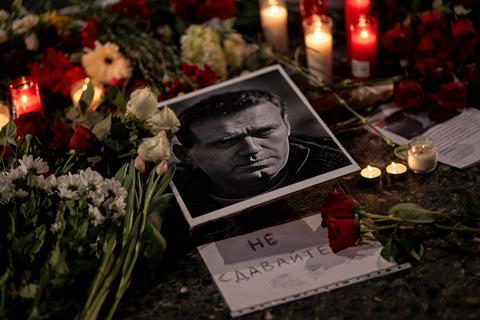
Alexei Navalny, the Russian opposition leader who the UK government and European allies have said was killed with frog poison, was trying to memorise the Sermon on the Mount in four languages before his death in a Siberian penal colony.
On Saturday, Britain, Sweden, France, Germany and the Netherlands issued a joint statement saying that Navalny had been killed in February 2024 using a poison developed from a dart frog toxin.
Only the Russian government had the “means, motive and opportunity” to carry out the assassination, said the European governments. UK foreign secretary Yvette Cooper has called for action to be taken against Russia.
To many, Navalny will be seen as a modern-day Christian martyr – with the evidence confirmed by the weekend’s announcement.
Opposition politics with the prince of peace
In his autobiography, Patriot, – published shortly after his death – Navalny writes poignantly of his Christian faith, saying: “I have always thought, and said openly, that being a believer makes it easier to live your life and, to an even greater extent, engage in opposition politics. Faith makes life simpler.”
Navalny wrote, “My job is to seek the Kingdom of God and his righteousness and leave Jesus to deal with everything else”
While in prison, Navalny launched a project to memorise the 111 verses of the Sermon on the Mount – in Russian, English, French and Latin. He recalls, “After an intricate covert operation extending over two months, I managed to acquire 111 cards that my press secretary, Kira, had made for me. Each has on one side the number of the verse, and the other the text in four languages.”
Navalny challenges his readers, “Are you a disciple of the religion whose founder sacrificed himself for others, paying the price for their sins? Do you believe in the immortality of the soul and the rest of the cool stuff? If you can honestly answer yes, what is there left for you to worry about?”
In the final words of his autobiography, Navalny writes, “My job is to seek the Kingdom of God and his righteousness and leave it to Jesus and the rest of his family to deal with everything else. They won’t let me down and will sort out all my headaches. As they say in prison here: they will take my punches for me.”
An enduring legacy
Following Navalny’s death, his widow Yulia released photographs of his cell. It was scarcely larger than a cupboard, with its only contents a table, a mug, a notebook, mittens, a scarf and a Bible. It was there that Navalny collapsed after a walk around a snow-covered courtyard.
Alexei Navalny has been called the most prominent face of Russian opposition to President Vladimir Putin. He had survived poisoning attacks and years in some of Russia’s most notorious jails. He and his supporters had exposed corruption in many parts of the Russian state, involving President Putin.
Navalny had returned to Russia in January 2021, despite knowing that he would face arrest. He was immediately detained on accusations of violating parole conditions while hospitalised in Germany after being severely poisoned with a Novichok nerve agent.
Prime Minister Sir Keir Starmer has praised Alexei Navalny, saying his “determination to expose the truth has left an enduring legacy.”
Yvette Cooper met Yulia Navalnaya at the European Security Conference in Munich, on Saturday. Navalnaya continues her husband’s opposition to Vladimir Putin, refusing to call him ‘President,’ because she does not accept the legitimacy of his election.













No comments yet