










Bethel Church has stopped selling The Passion Translation of the Bible amid concerns over alleged plagiarism. One of the translation’s leading critics David Fish explains why he believes The Passion falls so dangerously short of the standards Christians should expect
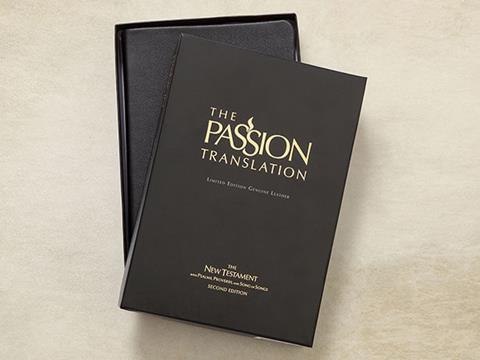
I would like to thank Dr David Instone-Brewer for his willingness to address the recent controversy surrounding the Passion Translation (TPT) which has led to Bethel pulling the product. However, after reading David’s article, I felt it may be helpful to offer a more critical perspective.
In early June, my colleague JonMark Baker and I began a series on the ‘Minor Prophets’ podcast in which we document extensive evidence against TPT’s legitimacy. We are pastors, not scholars. However, we have drawn upon the work of numerous scholars to confirm our conclusions. Based on this work, here is why I believe TPT should be avoided:
1. The translator doesn’t have the required background in biblical languages. In my opinion, Brian Simmons misled the public regarding his credentials and background in Bible translation, as evidenced by an official communication from Wycliffe denying his formal involvement in the Paya-Kuna translation project. He would later admit that he had “minimal background in Biblical languages” when he started the TPT project. YouTuber Mike Winger has documented these facts in his videos.
Simmons referred to himself as “Dr.” in early versions of TPT despite receiving a doctorate from a non-academic institution in a subject entirely unrelated to biblical scholarship. Despite this, he has referred to himself as a “scholar” on multiple occasions.
2. Accusations of plaigarism are credible. On hundreds of occasions, Simmons lifted “Aramaic” (Syriac) renderings from the website of an amateur filmmaker named Victor Alexander while claiming to be “translating directly from original Aramaic texts.”
Alexander’s “translation” is dubious. He claimed to be translating from a secret manuscript that only he possessed and which he refused to show anyone when asked.
Simmons was caught in this practice by Oxford-based researcher Andrew Chapman in 2017. Chapman emailed the publisher of TPT that “his translations are fraudulent and should not be sold.”
Simmons claims that he places “revelations” and “secrets” from God into the footnotes of TPT. In reality, he routinely lifted material from various sources, including works by fringe “Aramaic” primacists Andrew Roth and David Bauscher, neither of whom (from what I can tell) possess scholarly credentials. In several places, TPT copies spelling errors from these sources. Furthermore, some of the “insights” lifted from these works are themselves fabricated.
The TPT website states emphatically that TPT is fit “for use from the pulpit,” suitable for “serious study,” and a “dynamic equivalent” translation comparable to the NIV rather than a paraphrase. This is misleading in the extreme, especially given the fact that TPT seems to copy English paraphrases like Kennth Taylor’s The Living Bible nearly verbatim on many occasions.
3. Simmons brazenly inserts his sectarian theology into the text. For example, he essentially inserted his own poem into Psalm 81:10 to introduce the popular hyper-charismatic doctrine of “making decrees.” The TPT website claims TPT uses italics whenever words are inserted. Despite containing 45% more words than the corresponding ESV rendering, no italics are used in Psalm 81:10.
Simmons also falsely teaches that “Christ is no longer a person, He is now a Body” (i.e. the Church). He inserts this doctrine directly into his “translation” of Colossians 2:17.
4. The translation was never reviewed properly. In my opinion, claims of a “rigorous review” process by credentialed scholars are misleading. Dr. Rick Wadholm Jr., one of only two PhD scholars listed on the TPT website as being attached to this “review” process has denounced the project. He has stated that many of his critical comments were ignored and that Simmons’ notes are “deceitful.”
Many organisations and churches, upon looking at the evidence, have withdrawn their support from TPT, including BibleGateway. Harbor Light Content Group, the original publisher of TPT, has retracted its support for the work and will not allow its published authors to reference it.
The Church deserves better
Simmons proudly claimed in 2020 that millions of copies of TPT had been sold. BroadStreet celebrated more than a million copies sold since 2020. Tens of millions have read TPT via Bible apps like YouVersion. Simmons has stated that he plans to have the full Bible completed by 2028. If this is true, Simmons will have succeeded in selling millions of copies of this deeply problematic Bible version for 16 years, all while claiming that the contents of that version were the result of direct, supernatural revelation from Jesus.
I believe the Church deserves skill, integrity, and transparency from her Bible translators. For these reasons, I believe TPT should be avoided.
Premier Christianity has invited Brian Simmons to respond to the claims made in this article but has not received a response






















1 Reader's comment