











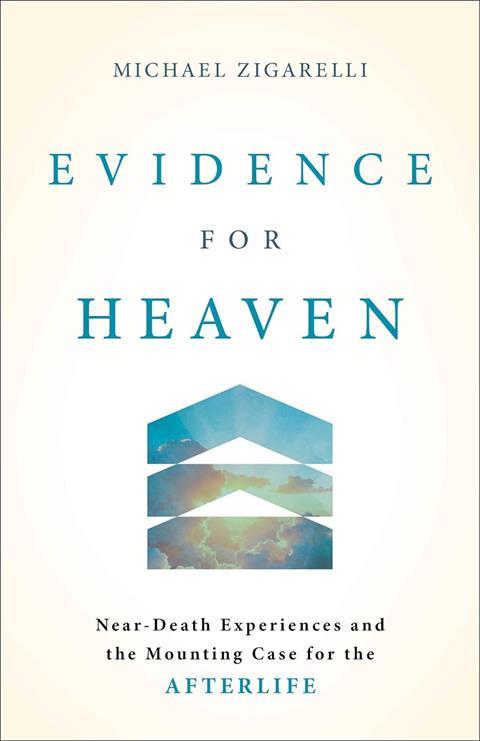
Michael Zigarelli presents near-death experiences as compelling evidence for an afterlife. But an overreliance on anecdotes, unanswered sceptical objections and an uncertain link to Christianity leave his case less convincing than the title promises, says our reviewer

Can convincing evidence for heaven be presented in 136 pages?
In Evidence for Heaven, Zigarelli presents near-death experiences (NDEs) as evidence for an afterlife. The book is easy and accessible, but it isn’t clear who the intended audience is - unless you take a careful read of the acknowledgements. It’s easy to miss, but Zigarelli writes that he wrote the book for “anyone who will die someday”—in other words, everyone. This broad scope may be one reason the book falls short.
The book did not particularly strengthen my faith. Neither did it offer anything useful for evangelism. The book includes some compelling anecdotes that I did not personally feel sceptical about, but I am not sure I could challenge someone else’s scepticism if I shared them.
Zigarelli addresses this towards the end, discussing whether NDEs can be used to share the Christian faith, seemingly anticipating that Christians like myself may have approached the book with this hope. While he argues that they potentially can, I was not convinced by his reasoning. His argument largely rests on the fact that science cannot currently explain NDEs, which he presents as evidence for God. I think a sceptic could simply argue that science has not yet explained NDEs, just as there are many things science has eventually been able to explain.
Zigarelli succeeds in presenting a substantial body of evidence and encouraging readers to investigate it for themselves, regardless of their faith tradition. He provides plenty of accessible anecdotes, alongside around 40 pages of additional resources.
Interestingly, Zigarelli does not mention Christianity much until the end of the book. This aligns with his broad audience and will likely make the book more accessible to non-Christian readers. However, it also makes the final section feel somewhat abrupt, leaving the reader questioning his overall aim. While Zigarelli urges readers to scrutinise the evidence for themselves, he also seems convinced that NDEs are concrete evidence for heaven. Yet evidence for heaven is not necessarily proof of the Christian faith. Although he acknowledges this to some extent, his conclusions are not entirely satisfying. He seems to present NDEs as compelling evidence for both heaven and the Christian faith, while simultaneously admitting that they may not be enough.
The penultimate section, which answers common questions, is useful, as it anticipates some of the key challenges readers may have after being presented with the evidence. However, if the book had been more detailed and less focused on different types of NDEs, this section may not have been necessary.
Zigarelli’s aim seems to be to present accessible anecdotes from different types of NDEs. But the book does not fully achieve what it sets out to do. There are other ways readers might explore evidence for heaven and the Christian faith more broadly, rather than focusing so heavily on near-death experiences.























No comments yet