




Could scientific research into what happens between the edges of life and death prove that Jesus is real? One researcher thinks it may be possible. From atheists finding faith to Muslims encountering Christ, he explains why the evidence for near death experiences might just be the greatest Christian apologetic ever
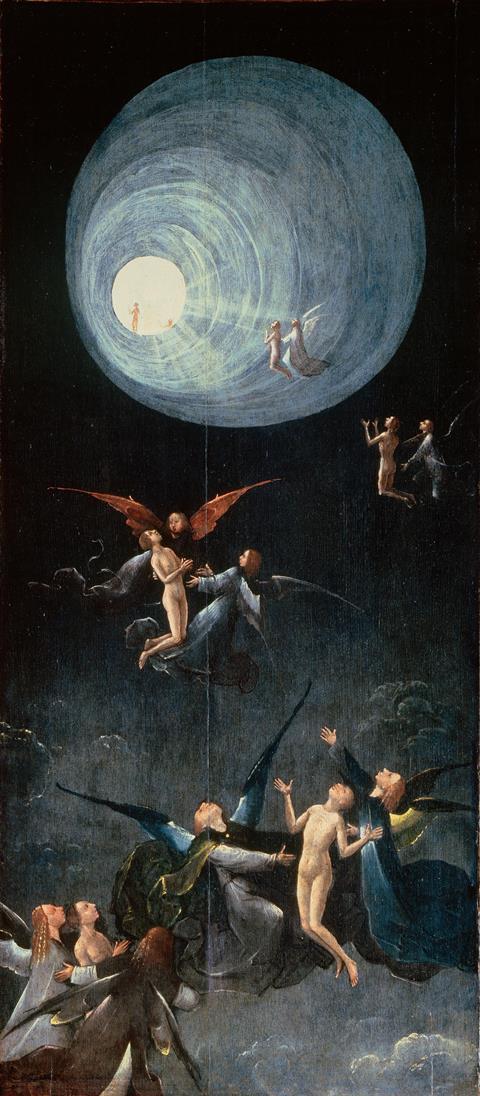
Take a look at this painting by Dutch artist Hieronymus Bosch, which currently hangs in the Gallerie dell’Accademia in Venice.
Bosch, it seems, is capturing how people describe their “near-death experiences” (NDEs). There’s the iconic tunnel leading to a brilliant light, possibly the light of God. There are angels, or at least some kind of spiritual beings, assisting the new arrivals into the tunnel. And there’s a clear willingness on the part of the arrivals to make the transition. Bosch entitled it Ascent of the Blessed.
Now, considering the title of this article, we might respond sceptically: “OK, it’s a rendition of what people claim they saw when they were in some grey zone between life and death. But a painting reveals nothing about whether NDEs are real.”
Except for one thing: Hieronymus Bosch painted this more than 500 years ago. Centuries before I published my book, Evidence for Heaven (Baker), a Renaissance artist painted what could have been my cover. The themes and details of what people experience during NDEs seem to be consistent over long stretches of time. What are we to make of that?
Prevalence and pattern
One logical inference is that NDEs are historical phenomena, not merely modern ones. In fact, there have been NDE-like reports across societies for millennia, and current surveys estimate that between 4% and 9% of people claim to have had such an experience. That translates into millions of people in the UK alone - and hundreds of millions around the world.
Another inference is that some features of NDEs transcend time. There’s a degree of consistency to the testimony. What people claim to see today (tunnels, light, spiritual beings), others have claimed in the past. And well beyond the Bosch painting, ethnohistorians have uncovered some of these same features across ancient civilisations - people groups that had no contact with one another.
That doesn’t prove life after death, of course, but it does give us good reason to look closer.
Transformed lives
2025 marked half a century of empirical research into this phenomenon, some of it by investigators from elite universities and by physicians publishing in A-list journals. I’ve spent years as a social scientist collecting that evidence, scrutinising its credibility and then juxtaposing it with the many brain-based explanations from neuroscience and other fields.
Here’s what we know. There are now several lines of evidence for an afterlife, based on thousands of NDE reports worldwide. The prevalence and pattern establish the preliminary case. Building on that are the transformed lives of those who come back after an NDE.
The research shows that people tend to return from a NDE less concerned about prestige, power, accumulation or reputation. They’re less anxious and more altruistic. Plus, most no longer fear death, confident that they know what’s coming next.
There are also stories of inexplicable life changes: atheists becoming pastors, a mafia boss becoming a social worker, people giving up careers as lawyers or executives to enter the helping professions.
Why? Because they have a new meta-narrative informing their life. They now firmly believe that death is not the end, which allows them to live and love differently. They stop chasing worldly goals because they’re now more otherworldly minded.
It all culminates in this conclusion from Bruce Greyson, the most prolific NDE researcher in the field, based at University of Virginia School of Medicine: “The wide ranging and long-lasting effects of NDEs on people’s lives have been the most surprising and yet the most consistent aspect of these experiences.”
The details check out
Still, transformed lives, no matter how “wide ranging” or “consistent,” are merely circumstantial evidence for NDEs and postmortem survival. Where the afterlife evidence gets more probative is with the corroborated or “veridical” NDE cases - reports that include claims later independently verified.
A few examples. One woman said she had floated near the ceiling during her surgery and memorised a long serial number that was atop a respirator. Another patient saw a red sticker on the top side of a ceiling fan. One claimed to see a red shoe on the hospital roof as she drifted toward the sky. In a report from France, a woman woke after surgery describing in detail the amputation performed simultaneously in the adjacent room.
The staff checked each of these claims. They found the serial number exactly as the woman had recited it, all 12 digits. They found the red sticker on the fan and the red shoe on the roof. The amputation account was accurate down to the colour of the bag that the amputated leg was placed in.
These people were unconscious at the time, but somehow came back with specific, verifiable information.
In another case, a patient reported that, during surgery, his consciousness travelled upward one floor into an empty hospital wing. He claimed he saw mannequins in the hospital beds, some with IVs attached to them. “What a strange vision,” he told the staff when he came off his ventilator. The team exchanged incredulous glances. There was a restricted-access training center one floor above, replete with medical mannequins.
There are also stories of inexplicable life changes: atheists becoming pastors, a mafia boss becoming a social worker
Then there are the classic cases: the “Maria’s tennis shoe” case, the “Pam Reynolds” case, the “dentures in the resuscitation trolley” case - that one was documented in The Lancet, among the top medical journals in the world. I’ve unpacked them in the book, but they’re worth looking up for yourself.
Beyond all that, there are accounts of young children waking from a close call with death, talking about tunnels and insisting they met deceased siblings they never knew. This is what researchers mean by “independent confirmation” and there are now hundreds of these stories, a cumulative case that’s increasingly difficult to dismiss.
Even so, there are thoughtful objections to all of this. Let’s consider three of the most common.
Is it all in our head?
Some of the smartest people in the world are working on this mystery of NDEs - people with neuroscience doctorates from preeminent medical schools. They propose that NDE phenomena, such as an out-of-body sensation, tunnel effect, ineffable light or extreme tranquility are the natural result of oxygen deprivation, REM intrusion, endorphin release, residual brain activity, or other aspects of conventional neuroscience.
Equally credentialed experts challenge those claims, contending the brain-based theories are conjectural rather than correlated with actual NDEs. They also question the exclusionary epistemology of those whose scientific starting point is rejection of the supernatural - a built-in bias that is, ironically, philosophical instead of scientific.
Most problematic for the physiological hypotheses may be the veridical NDE cases. It’s one thing to theorise about NDE elements being all in our head; it’s quite another to explain how people can return with information they simply shouldn’t have. The totality of these independently verified accounts currently tips the scales toward consciousness continuing outside the body.
Leading NDE researcher Gary Habermas of Liberty University puts it this way: “No matter what subjective internal states the critics wish to discuss, by their very nature they cannot explain the existence of objective, externally corroborated NDEs…The available evidence for NDEs seems clearly to be more than enough to establish their evidential reality.”
A projection of culture
The idea that people tend to see religious figures from their own tradition is a pervasive objection, and it’s partially valid.
First, though, we should be clear that many people do see what they did not expect to see in an NDE. Atheists see something - often something divine or demonic - when they expected nothing at all (check out the story of Howard Storm).
Some Jews and Muslims meet Jesus. When Heidi Barr was 16 years old she had a NDE following a horse accident. Despite being raised Jewish and taught by her father that Jesus was the greatest hoax perpetrated on humankind, she claimed to have been escorted through the heavenly realm by Christ, before returning involuntarily to her body though desperate to stay with Him. Decades later she remains a Jewish follower of Jesus.
With a critical mass of experiencers claiming to have met Jesus, NDEs could become the ultimate apologetic
Having said that, many NDE reports do indeed align with one’s belief system and culture. Gregory Shushan, formerly of Oxford University and a leading ethnohistorian, isn’t surprised. Shushan says we recount information “in socially, religiously and linguistically idiosyncratic ways [that] clearly reflect established local beliefs.”
So, a Hindu may call the light Yama (the deity of death), a Christian might call it Jesus, and an atheist might call it cosmic energy, but they may all be witnessing the same phenomenon. An ancient Greek in Plato’s Republic called it a column of light; a Chinese bureaucrat centuries ago called it a mighty emperor.
Without question, there is cultural overlay in these stories. But researchers like Shushan conclude that’s inevitable. We interpret and communicate through a cultural lens which, he says, makes it appear in NDE reports that people see what they expect to see.
Does it align with Christian doctrine?
A pastor friend of mine occasionally asks me to step in for him on Sunday mornings. Most recently, after I shared the NDE evidence with his congregation, he had to do some damage control. Emails, phone calls, impromptu visits to his office. Some were livid he gave a platform to “heretical” ideas.
But not only does this point of view undervalue the mounting evidence for NDEs, it squanders their apologetic potential. These accounts support much of Christian theology: the existence of a supernatural realm, a supreme being whose essence is light and unconditional love, and an afterlife with more than one destination.
There’s even emerging support for Jesus as a divine intermediary, with a critical mass of experiencers claiming to have met him. As a result, NDEs could become the ultimate apologetic, providing empirical evidence for those who consider the Bible to be inadmissible evidence.
Yet many followers of Jesus reflexively dismiss NDEs. When people from diverse worldviews report the same blissful afterlife, that’s deeply - even “heretically” - incongruent with how restrictivists understand the scope of salvation.
It’s a legitimate concern and a complex conversation, one that I’ve fleshed out in Christian Scholar’s Review. The bottom line? The NDE evidence supports many pillars of Christianity while standing in tension with some others, including just how wide the “narrow gate” may be (Matthew 7:13-14).
Not scripture, but a signpost
So, what do NDEs actually reveal?
My conclusion is they do not yet prove an afterlife beyond a reasonable doubt. The phenomenon requires more scientific analysis, and there are indeed credible scientists approaching the question not with a laugh but with a lab coat.
At the same time, the cumulative case is strong enough to shift the burden of proof. On the balance of probabilities, it has become more rational to believe in life after death than to disbelieve.
No, NDEs are not scripture, but they appear to be signposts. Let’s have the wisdom and courage to keep reading those signs.
Read more in Michael’s new book, Evidence for Heaven: Near-death experiences and the mounting case for the afterlife (Baker)


















4 Readers' comments