









Calling the Church to rediscover its role in caring for the sick, Preserving the Penultimate is an ambitious and timely challenge – even if its theological foundations sometimes leave the reader unsettled, says our reviewer

Acknowledging the state of the world and the state of our hearts has always made God’s people ask questions.
In the time of the prophet Ezekiel, the question was “how then can we live?” because a sinful society under divine judgement could only breed despair. The answer, of course, came hundreds of years later, in the person and work of Jesus Christ – our saviour, redeemer and living hope.
Later, in theologian Francis Schaeffer’s time, it was: “how should we then live?” because this Gospel – the good news and eternal truth of God, delivered once for all time, has implications for every domain of our lives. In thought, in speech, and in deed.
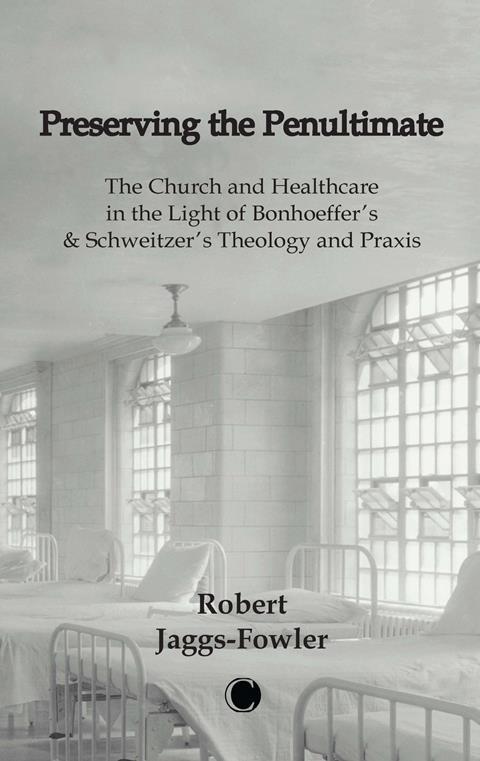
Today, Dr Robert M. Jaggs-Fowler, author of Preserving the Penultimate: The Church and Healthcare in the Light of Bonhoeffer’s and Schweitzer’s Theology and Praxis, prompts Christians to ask: “how should we then serve?”. And in 300+ pages of in-depth theological and philosophical discussion, the author’s suggested answer is bold: the Church, as an institution, should be as hands-on in healthcare provision as it is in education.
The Anglican priest and retired GP has written a book that is equal parts treatise and call-to-action to take up the mantle of “healing the sick” as an essential part of the Great Commission.
The book explores at length the ideas of 20th century intellectual heavyweights Dietrich Bonhoeffer and Albert Schweitzer concerning the role and relevance of the Church in the modern world. Using Bonhoeffer’s language of the ‘ultimate’ (eternal things to come) and the ‘penultimate’ (our present reality), combined with Schweitzer’s emphasis on ethical piety as a demonstration of ‘reverence for life’, the book seeks to make a case for treating healthcare as essential missional work of the Church wherever God’s people can be found. That implies that medical missions begin at home, and the Church ought to be readily available and prepared to fill in the gaps left by state structures. In this instance, the Church of England should mobilise to help rescue the NHS in the name of Jesus.
The book seeks to make a case for treating healthcare as essential missional work of the Church
For those of us whose bread and butter is social impact work, this is a heartwarming clarion call to the rest of the body of Christ to live like it. Imitating the character of Jesus before a weary, watching and waiting world is not negotiable.
And yet, notwithstanding how compelling a conclusion this is, some of the steps taken to get there in the book are brow-raising. At the outset, characterising the Church’s neglect to play a central role in healthcare provision in terms of hindering, delaying or even halting the Kingdom of God (‘the ultimate’) is theologically uncomfortable, to put it mildly.
Of all the things Jesus himself said must take place before “the end will come”, the global proclamation of the Gospel of the kingdom seems to be the prime indicator of the progression of events in God’s timeline (Matthew 24:14). At the same time, we are told that “the end will not come” without a widespread rejection of the truth, and people turning away from Jesus in great numbers (2 Thessalonians 2:3). Lastly, even where there is neglect of service, care and hospitality to “the least of these” (Matthew 25:40), such as of the nature as the author would have the Church perform – the contextual passage of this phrase is about Christ in his judgement seat, rebuking and banishing the disobedient for their failure to perform said duties. That is, the end, or the ultimate, has already come despite a ‘dead’ profession of faith (James 2:26) void of good works. In short, scripture suggests that, paradoxically, while the Kingdom of God will be ushered in through the Church’s obedience (by preaching the Gospel), it will not be hindered for the Church’s disobedience.
What might seem to be pressing the point too finely here should, rather, be considered as indicative of wider problems from the theological influence of Schweitzer, a detailed discussion of which is beyond the scope of this review. However, when someone whose beliefs about Jesus are said to imply that Jesus was a false prophet, it is unsurprising that he would thus also disregard what Jesus said concerning “the last days”. Even more so that Schweitzer would feel so strongly about “preserving” life as we know it while he hesitated to speak on what comes after.
Despite being the more orthodox and properly Christocentric of the two thinkers, Bonhoeffer’s ideas in parts also raise concern, particularly the suggestion that Christians ought to live before God as if God does not exist. That is, Christians should be intentional and proactive at ministering to the needs of suffering people, not shirking responsibility elsewhere. Like Schweitzer, Bonhoeffer’s good intentions create unnecessary stumbling blocks where it would suffice to call Christ’s sheep to sacrifice and service without complicating rather simple commands or diminishing the sovereignty of God in it all. A good example of this can be seen in the then-Bishop of London’s Faith, Place and Health report.
Overall, the author sets out on an honourable journey to call the Church to action on behalf of the sick and the suffering. However, several theological potholes along the way, in such a dense book, can leave even the most conscientious reader exhausted and confused. This is unfortunate given the outcome hoped for was inspiration for resolute action, not further time spent hypothesising. Nevertheless, the question of “how should we then serve?” remains relevant, and perhaps best answered with: “in whatever way Jesus told you to with whatever resources God has given you.”






















No comments yet