












With much anticipation surrounding how the new Archbishop of Canterbury’s tenure will unfold, Andrew Atherstone suggests one thing can be expected from Sarah Mullally: a primacy defined by a steadfast commitment to compassion
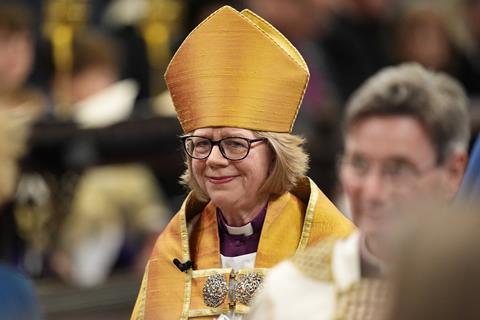
Compassion and kindness are at the heart of Sarah Mullally’s Christian vision. The new Archbishop of Canterbury places a strong emphasis on these virtues in many of her public statements and they drive her policy agenda.
When Justin Welby began as Archbishop, he summarised his three-pronged strategy as promoting prayer, reconciliation, and evangelism. All his many initiatives and reforms during the high-speed rollercoaster ride of his primacy were shaped by those priorities.
Mullally’s strategy, by contrast, focuses not on shaking up the Church but on enabling the Church to be kinder. It is a less dramatic, but no less potent, vision. In her inaugural address to the General Synod last month, she promised to act with calmness, consistency, and compassion. That note of compassion is particularly prominent in her theology and recurs everywhere. For example, for her installation service this week she has specially chosen the hymn ‘Praise My Soul the King of Heaven’, based on Psalm 103, because it speaks of “God’s love and compassion for all”.
Her nurturing nature
Mullally’s focus on compassion can be traced all the way back to her teenage years. Sarah Bowser, as she was then, came to Christian faith in 1978, at the age of 16, through the youth ministry of a lively Anglican evangelical church in Woking, a town in suburban Surrey. Her transformational conversion experience was critical in her decision to embrace a career as a nurse.
She later told Nursing Times of her newfound desire “to care for people”, which in turn was “driven by a faith in a caring God”. In a sermon in 2020 to mark the bicentenary of Florence Nightingale’s birth, she explained that her Christian faith was “my motivation to become a nurse”, and that “I saw my actions as demonstrating those of a loving God.”
She trained in the early 1980s at the Nightingale School of Nursing, at St Thomas’s Hospital in Lambeth, just a stone’s throw from Lambeth Palace, her new home as Archbishop. In a recent address at the Nightingale Nurse Awards, Mullally proclaimed: “My training as a Nightingale has shaped who I am…You can take the nurse out of nursing but never nursing out of the nurse.” In particular, those years “enlarged my capacity to be with people, to stay with them when it would be easier to walk away.”
Compassion and kindness are emphases which Mullally has carried from the hospital into the Church. They are her foundational priorities. “I am the bishop I am today,” she declared in her maiden speech in the House of Lords, “because of that first vocation to nursing, and compassion and healing are constants at the heart of who I am.”
She often draws comparisons between nursing and Christian leadership. In an interview for Nursing Standard, she likened Anglican clergy to “ward sisters” in hospitals. “There are many similarities between nursing and being a priest,” she declared elsewhere, “not least that I find myself in strange uniforms! But they are both about people, compassion and service.”
Compassion at the core
In Mullally’s preaching, Christian compassion is always a keynote. For example, reciting the apostle Paul, she exhorts her hearers to leave a legacy “shaped by compassion, kindness, humility, gentleness and patience, forgiveness and love” (Colossians 3). She often gravitates towards Gospel narratives which reveal the compassion of Jesus for people in need. Jesus never offered “an academic response”, she explains. “He didn’t discuss the theology of the event or reason about the best form of action – he was stirred and motived to act”.
In the same way, Mullally urges Christians to demonstrate compassion in costly ways, “in response to God’s generosity of love in the incarnation”. Preaching on the parable of the good Samaritan (Luke 10), she argues that love for God should naturally overflow into love for one’s neighbour, which means not just the person who “believes what we believe” but “anyone lying in need in a ditch encountered along the road of life”.
I am the bishop I am today because of that first vocation to nursing, and compassion and healing are constants at the heart of who I am.
Christian compassion is not an abstract idea. It has many practical implications, driving Mullally towards social activism. When making moral and political judgments, her usual question is: “What is the kindest response in this situation?” That explains her approach to the Church of England’s controversial Prayers of Love and Faith, which offer blessings to same-sex couples.
She understands the new prayers as a form of pastoral provision, an act of compassion. It also shapes Mullally’s attitude to other hot-button topics like abortion, for which she interrupted her pilgrimage to Canterbury last week to engage in debate in the House of Lords. She affirms the Church of England’s “principled opposition” to abortion, but also insists that “women facing unwanted pregnancies require compassion and care” and must be supported as they face hard choices.
The duty of care
Christian compassion and kindness are the theological engine room for Mullally’s social justice campaigns, witnessed by her desire to embrace the outsider and the marginalised. She argues that “it is a sign of a compassionate community to welcome the stranger”. Faced by a spiralling refugee crisis, for example, she insists that Britain as a society must “continue to grow our ability to be compassionate – to see the need, to be moved and to respond with generosity.”
She is not afraid to chastise government policies or media commentaries that tend to dehumanise people. However, she admits that a more caring community can never be created by parliamentary legislation alone.
Mullally believes it is the role of the local church to model compassion and kindness to the rest of the world. “Compassion is more than a passing feeling of pity,” she says. ”It can be gut-wrenching…Compassion lies at the heart of what it means to be a follower of Jesus Christ.”
Under Mullally’s tenure, there are unlikely to be many flamboyant new initiatives from Lambeth Palace which grab newspaper headlines. Yet in her quiet and determined way, enabling local churches to demonstrate and foster cultures built on compassion will be a central priority over the next five years. “Kindness is one of the most underrated virtues in today’s world.”
Mullally told the congregation at St Paul’s Cathedral at a service to mark the silver jubilee of Christians Against Poverty. Kindness is not “bland or soft or feeble or weak”, she insists. On the contrary, it can be costly and “very demanding”. The Archbishop of Canterbury aims to be the Archbishop of Compassion.






















1 Reader's comment