




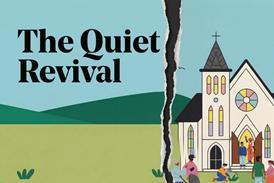







When a government trial restricted teenagers’ access to social media, some reported anxiety and a sense of isolation. Derek Hughes argues the findings reveal something deeper than screen addiction: a generation in fear of silence, and a Church that has forgotten how to inhabit it

I tried everything to stop scrolling.
Deleted the apps. Charged my phone in the kitchen. Set screen time limits — then overrode them at 11pm because I needed to check one thing.
Every tactic lasted a week. Some lasted a day. At some point you have to stop calling it a lack of discipline. Bad habits don’t employ thousands of engineers to stop you leaving.
In the end, the only thing that worked was a small piece of hardware that physically locks the phone. You can’t override it. You can’t negotiate with it. It turns a smartphone into a brick unless you manually unlock it.
That’s what it took.
I tell people this expecting sympathy.
What I get is recognition.
What happens when the phone goes dark
In March, the UK government launched a six-week trial with 300 teenagers across four groups: some had selected apps blocked, some faced an hour cap on Instagram, TikTok and Snapchat, some a 9pm curfew, one carried on as normal.
The stated aim is evidence. The unstated experiment is something stranger: a government trial in enforced stillness.
There’s a difference between a habit you can drop and one that, when it’s gone, takes you with it.
Some participants found the first week disorienting, then tolerable, then almost reluctant to go back. But the detail that stays with me is this: some experienced increased anxiety when cut off from social platforms. A sense of social isolation from peers. The silence didn’t feel like relief. It felt like threat.
That’s not a footnote. That’s the finding.
We’ve spent a decade diagnosing teenagers’ phone use as a bad habit. Something that needs correcting, capping, curfewing. What we haven’t named is what it means when removing the phone produces not peace but panic. There’s a difference between a habit you can drop and one that, when it’s gone, takes you with it. These teenagers weren’t being dramatic. They’d lost the signal that told them they existed. We’ve built an entire generation’s sense of self on rented ground — and then expressed surprise when the landlord calls.
The church should have something to say about this. I’m not sure we do.
We’ve moved at the same pace for so long that any programme we’d offer would carry the faint smell of irony. Youth workers who’ve not sat in silence for a year encouraging teenagers to put their phones down. Church leaders — and I am one — who check notifications between songs in worship and tell themselves it might be urgent.
I bought a Brick because I ran out of softer options. But the deeper problem wasn’t the apps. It was what surfaced when they were gone: a restlessness I’d been feeding for so long I’d stopped noticing it had a name.
The wisdom we forgot
The Christian tradition has been here before. Not as something we’ve moved past, as something we’ve forgotten we have. The contemplatives didn’t pursue stillness as discipline. They pursued it as the condition for encounter. The Desert Fathers didn’t flee the city because stillness came easily. They fled because they knew how hard the fight was. They wanted better odds. Theophan the Recluse wrote that you cannot descend into your own heart if you are always moving on the surface.
Distraction isn’t a modern invention. But the weapons have changed.
What the contemplatives faced was the wandering mind. What we face is an industry that has industrialised the wandering mind and put it in our pocket. They were people who took seriously what everyone else half-believed: that something is there, in the silence, that can’t be found anywhere else.
A generation that panics in silence is watching to see if the adults in the room have found anything there worth staying for.
That is not a fringe position in Christian theology. It is close to the centre of it.
But you can’t offer what you haven’t found. And I’m not sure the church, as a community, has found it recently. We’ve been too busy, too anxious about relevance to model the thing we’re theoretically best placed to teach. Which means when a teenager sits down in a suddenly silent house and feels something close to panic, the church’s response may sound like directions to a place nobody on staff has recently been.
The trial will report in summer. Politicians will argue about bans. Parents will read the headlines and feel either vindicated or exasperated. And most of us will keep checking our phones in moments of mild boredom, picking it up before we’ve decided to.
I still use the Brick. Not because I’ve found what I’m looking for. Because I know I won’t look without it.
Maybe that’s the more honest starting point. Just the admission that stillness, for most of us, doesn’t come naturally anymore. That silence now has to be enforced before it can be inhabited. A generation that panics in silence is watching to see if the adults in the room have found anything there worth staying for.
I needed a Brick. I’m not sure what that says about me but I’m fairly sure it says something about all of us.

























No comments yet