










As Katie Taylor prepares for her farewell fight at Croke Park, AJ Gomez reflects on the Christian faith that shaped her impossible dream, carried her through boxing history and now gives her peace as she prepares to leave the ring
At the turn of the millennium, two young boys appear set to square off at an amateur boxing show in Bray, Ireland. On the board displaying the fighters’ names is ‘K. Taylor’. Underneath the headgear concealing the features of one, however, is a young girl, hair tucked away, first name withheld – and she is beating the boys up.
Katie Taylor had her heart set on boxing at a time when women’s boxing was not even sanctioned in Ireland. That meant on a couple of occasions, if she desired to compete, she was required to disguise herself as a boy.
“When I won and took the headgear off there would be uproar. All the officials went crazy,” she later recalled.
Then, on 31 October 2001, hiding was no longer necessary. Aged 15, Taylor faced fellow teenager Alanna Audley at Dublin’s National Stadium in the first officially sanctioned women’s bout in Ireland – and won.
But Taylor’s ambitions stretched considerably further. Before women were even permitted to box at an Olympic Games, she would rise early before school and train, visualising the gold medal she was sure would one day fall from her neck.
“The thing I was dreaming about didn’t even exist. It was an impossible dream. I believe that was a God-given dream.”
The God who rescued her mam
Taylor first encountered the God she believed had placed that improbable dream in her heart through a transformation much closer to home.
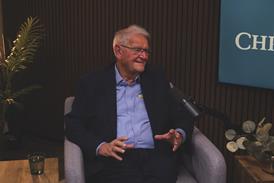
Speaking to Eddie Hobbs on Counterpoint, Taylor described her childhood on a council estate in the Irish coastal town of Bray as “very, very chaotic”. Her mother, Bridget, in Katie’s words was “a heavy drinker and a heavy smoker”, while her father’s legal troubles further contributed to an unstable home life.
Katie summarised her earliest years in Bray as largely absent of structure, shaped by “two broken young people trying to raise four young kids the best they knew how”.
But when a tragic house fire a few doors away claimed the lives of a neighbouring family, the deaths deeply affected Bridget. Taylor said the tragedy pushed her already questioning mother to confront the biggest ones surrounding life. “Where do we go after we die? What is the point of this life? Why is there so much suffering?”
The next day, Bridget went on a walk and encountered a Christian couple in a local coffee shop. Their “unconditional kindness” led to Bible studies, church and eventually Christian faith. Taylor remembers the transformation at home: her mother stopped drinking and smoking, she began to speak life into her family and a household previously characterised by chaos found what Taylor described as “peace” and “hope”.
“That’s when the God who rescued my mam basically became my God.”
Boxing isn’t short of post-fight interviews in which a victorious fighter attributes glory and thanks to their “Lord and Saviour Jesus Christ”. Rarer, perhaps, is hearing a boxer articulate a faith that appears to be not merely an expression of gratitude after victory, but the firm foundation from which everything else flows. Even more uncommon is when the fruits can be observed for yourself.
During her conversation with Hobbs, Taylor was asked how she navigates the moral conflicts that are born from operating within professional boxing. Her answer was explicit.
“I am able to walk in that environment precisely because Christ has formed a character in me.”
Taylor pointed to the biblical story of Daniel, a young Jewish noble forced to navigate life in Babylon while remaining faithful to godly convictions that ran counter to the culture around him. His faith, she explained, carried consequences but his integrity remained intact.
“And sometimes I feel the same way as Daniel,” Taylor said. “Sometimes I felt my career was in jeopardy, and my finances were even in jeopardy. I had to refuse so many sponsorships from gambling companies and alcoholic companies because of conviction. But in the end, God helped me navigate that and He’s brought my career to higher heights than I ever could have imagined.”
And so, as the impossible dream slowly became possible, her faith remained inseparable from it.
A possible Olympic dream
Women’s boxing was finally added to the Olympic programme for London 2012. Taylor arrived not merely as an Irish medal hope but as a woman who had spent much of her life relentlessly petitioning for women to be given entry into this space. She won gold.
The victory transformed Taylor into a national hero, but when reporters attempted to understand the source of her extraordinary self-belief, she repeatedly pointed upwards.
“I just wouldn’t be able to step into the ring without God in my life,” she said after her Olympic success. “Nothing is impossible with God at the end of the day.”
That understanding has been written, almost literally, into her boxing career. Taylor has long carried her favourite scripture, Psalm 18, on her fight gear. The psalm she reads before every bout, rather fittingly, speaks of God arming the writer with strength, making his feet like those of a deer and training his hands for battle.
Taylor remembers first encountering it as a 17-year-old.
“I first read that psalm…with tears rolling down my face,” she told Ward. “It just really resonated with me that God can stoop down to my level to make me great.”
And make her great He has.
The thing I was dreaming about didn’t even exist. It was an impossible dream. I believe that was a God-given dream.
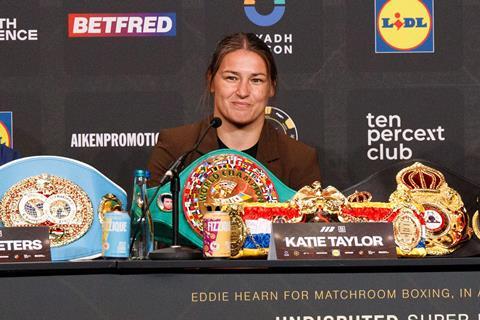
Taylor can now claim Olympic champion, five-time amateur world champion, six-time amateur European champion and two-weight undisputed world champion.
Ask a cohort of boxing enthusiasts who they hold to be the greatest female fighter of all time, the consensus is likely to be Katie Taylor. Ask her, however, and she is likely to redirect that title elsewhere.
“[My faith] is the most important thing to me — not just in my fights. It helps me with everything. It helps me make sense of the world. I view the world through the lens that God is real, that Jesus is a real historical figure who lived, breathed, died and rose again. I believe He’s the greatest of all time.”
The title Taylor reserves for herself is considerably simpler: Daughter of the Most High.
When the gloves come off
For the third and final fight of her historic trilogy against Amanda Serrano, Taylor chose Bethel Music’s ‘Even though I walk’ to be the soundtrack for her goosebump-inducing walk towards the Madison Square Garden ring.
As 80,000 are expected to fill Croke Park this Saturday for her farewell against France’s Flora Pili, Katie Taylor is concluding her career with a peace seldom seen among fighters.
Earlier this year, Taylor sat opposite Andre Ward – a fellow Christian boxing legend whose own nickname, S.O.G., stood for ‘son of God’ – and contemplated something fighters often find considerably harder than getting into the ring: knowing when to leave it.
Boxing is particularly unforgiving in this respect. A fighter spends decades reducing life to camps, opponents, weigh-ins and fight nights. To reach the sport’s summit requires such a radical devotion that, in the process, the profession can become almost indistinguishable from the person.
Taylor believes Christianity has given her an answer to that problem.
“I am a daughter of the Most High, the King of kings, the Lord of lords. I am His kid. That is my identity.”
























No comments yet