









Kemi Badenoch has pledged to restore church buildings, declaring Britain a ‘Christian nation’. But as Christians face prosecution for silent prayer and society strays further from Christian principles, Lois McLatchie Miller argues it is all in vain if the deeper crisis of abandoned Christian values goes unaddressed
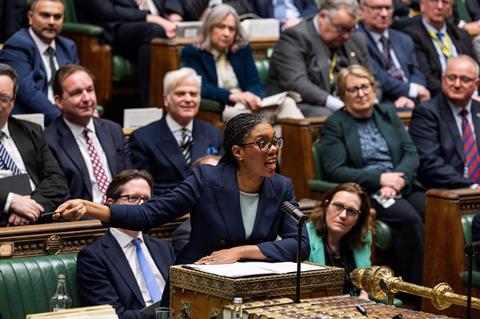
On Easter Sunday, Christ is risen – and so too, apparently, was the Conservative Party’s interest in Christianity.
In a message aimed squarely at Christian voters, Kemi Badenoch pledged to revive funding for the Listed Places of Worship Grant Scheme, restoring support for the repair of church buildings across the country. Britain, she said, is a “Christian nation” – and its churches must be preserved in honour of that historic identity.
Britain is a Christian country.
— Kemi Badenoch (@KemiBadenoch) April 4, 2026
The Conservative Party will always celebrate our Christian heritage with deeds, not just words.
This Easter, we want to ensure local churches are properly maintained and repaired so we’re announcing a plan to restore funding for the Listed Places…
She is not alone in thinking this way. Reform UK has advanced a strikingly similar vision: automatic listed status for all churches, tighter restrictions on their alteration or conversion, and a determination to preserve them as fixtures of Britain’s historic identity.
A convenient Christianity
Across the Right, then, a consensus is emerging. Christianity is to be conserved architecturally. This is well-intended, and may well be a more generous offer than anything from left-leaning parties at present; but it is nevertheless a profound category error. Faith is not about buildings. The early Christians, meeting in borrowed upper rooms and under threat of persecution, would be astonished to learn that the survival of their faith apparently now depends on VAT relief schemes and heritage protections. Church buildings are not the foundation of Christianity, but its byproduct.
Of course, these buildings are beautiful and their restoration is welcome. But such actions mean nothing if Christians themselves are not free to live out, speak, and shape public life according to Christian truth. On this measure, Britain is failing.
In recent years, we have seen numerous Christians arrested for preaching in public spaces, or even prosecuted for praying silently near abortion clinics. One such individual was Adam Smith-Connor, the army veteran and father of two who was convicted in 2024 after he stopped and prayed, just for a few minutes, across the road from an abortion facility in Bournemouth. He didn’t obstruct; he didn’t protest; he just stood quietly, his back to the clinic entrance, praying silently about a child he had lost to an abortion some twenty years ago. He was ordered to pay thousands of pounds for his “crime”.
Whatever one’s view on the surrounding issues, this should give us pause. Once the state begins to police silent prayer – one’s own thoughts, offered to God – we have crossed a line that no amount of church restoration funding can hope to mend.
Church buildings are not the foundation of Christianity, but its byproduct.
If the Conservatives, or Reform, or indeed any party is serious about winning back disillusioned Christian voters, they should start here: with a clear commitment to repeal laws that criminalise the peaceful expression of faith in public life.
But while protecting religious expression is the start, it’s far from the end if the goal is to restore Britain to being a thriving “Christian” nation. The crisis facing Britain is not merely legal, but cultural – and the impact of our nation throwing away Christian values for generations is being keenly felt in the social fabric today.
A cultural unravelling
Our grandparents’ generation began the great untethering. The sexual revolution threw aside Christian virtues relating to sexuality; recasting “freedom” as “liberation from restraint”, severing sex from commitment, marriage from permanence, and family from its central place in public life.
Our parents’ generation continued the project, this time intellectually. The New Atheism movement did not merely question belief in God; it sought to render it irrational, embarrassing, even dangerous. Faith was pushed to the margins, tolerated at best, derided at worst.
The consequences of those apparent “liberations” have come back to bite us hard. In 2026 Britain, family breakdown has become commonplace, leaving many children without the stability once considered essential. Almost half of British children don’t grow up with married biological parents. Divorce has skyrocketed. The birth rate has plummeted. Loneliness is endemic. A third of households are now single-occupant. Depression and anxiety have surged, particularly among the young.
Drug and alcohol abuse continue to hollow out communities stripped of shared meaning. Suicide rates have risen, even as material prosperity has increased. Perhaps this isn’t surprising, as copious research links religion to being of the greatest protecting factors against taking one’s own life.
And in response to this despair, our political class increasingly offers not hope, but death. “Assisted dying” is presented as compassion. One in three British babies are aborted, and plans are in place to decriminalise the procedure up to birth.
These are not isolated developments. They are the logical outworking of a society that has abandoned the belief that human life possesses intrinsic, God-given dignity.
Christianity once supplied that moral architecture. It taught that every person is made in the image of God; that life has meaning beyond circumstance; that our duties to one another are real and binding. But we have replaced that framework with a new religious framework that replaces God with one’s self – a calculus of autonomy, productivity, and preference, in which the most vulnerable struggle to justify their worth. The responsibility of being our own God has crushed us.
It’s no wonder that many young people are beginning to push back. In a culture marked by confusion, instability and despair, there are signs of a renewed openness to faith, meaning and moral clarity. A generation raised without God is starting to ask whether that absence might explain the emptiness it feels.
The architectural measures that the Conservatives and Reform has offered, then, are outdated. This is not the time for aesthetic conservatism: preserving buildings, celebrating heritage, invoking language. It’s a time for deeper matters of belief, morality and truth.
If politicians want to rebuild Christian Britain, it must be willing to do more than maintain old symbols. It must defend the substance. If we want a Christian country again, we will need more than repaired churches: a renewed moral vision.

























1 Reader's comment