










When Derek Hughes’ job as a church leader required him to tell his congregation that his wife was leaving, he expected judgement and the loss of his job. Instead, he says, the exposure he feared became the doorway to a kind of care he would never again turn away from

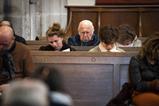
I looked up from my notes and the church building was full. Every seat. Twenty-four hours’ notice and they had all come. My hands were shaking so badly the paper was moving.
Three paragraphs and a church that stayed
Three paragraphs. That was all I’d written. Three paragraphs to tell a church that my wife was leaving. I’ve preached for 30 minutes without notes and enjoyed it. But I couldn’t get through these three paragraphs.
And underneath the reading, I was doing sums about the house. I expected to lose my job. How can you lead a church if you can’t hold your family together? I’d taken harsh emails over a single line in a sermon. So I knew what this would bring. I didn’t even think that was unfair. I had failed. Whatever they decided, I’d let them down, and had no argument ready for anybody who wanted to say so.
I stopped halfway down the second paragraph. Nobody moved. Nobody rescued me. They stayed.
No other job would have asked this of me. When a marriage ends in an accountancy firm the partners find out slowly, over months, and the work carries on. Mine required a statement to a crowd at a day’s notice.
I planned to leave straight afterwards and hand the rest of the meeting to the elders. When the moment came I struggled to walk. So I sat down on the front row instead, with my back to everyone, and listened. The elder said something. Then prayed. I was waiting for it to be over so I could go and hide.
When it finished I got up to go and faced a queue.
A long one.
People whose weddings I’d taken. People whose parents I’d buried. Two I’d never had a real conversation with, who had no particular reason to be standing there. Most of them said nothing worth writing down, and it didn’t matter, because they had come to put their arms around me. That was the entire content of their message. Some were crying. Nobody asked me a single question.
The exposure that risked my job was the exposure that got me cared for.
It took a long time to get out of the building.
The line I wouldn’t have moved
There’s no version of that evening where I keep my private life private and still get held like that. Friends told me it was unfair I had to go through that. The exposure that risked my job was the exposure that got me cared for.
The Church has had a brutal few years as a public story. Abuse cases. Controlling leaders. I’ve heard that one recent independent audit around safeguarding is being resisted by senior figures who hide behind tradition and procedure. All of it true. None of it should be softened.
But nothing gets reported when somebody drops in on Jean on a Wednesday and they have the same conversation about her husband’s allotment they had last Wednesday. Or when a man who spends his whole week being wanted by people eats on a Tuesday at a table where nobody needs anything from him. Or when a 19-year-old gets told the truth about whether to drop out of his course by somebody with no stake in the answer.
They don’t make good headlines. That’s the trouble with the record: the harm gets documented, the rest doesn’t, and we’ve started mistaking the documentation for the thing itself.
There’s no version of that evening where I keep my private life private and still get held like that.
I’m not sure how I’d be functioning now without that hour. I’ve gone over it enough to know what the other version would have done: the same room, the same three paragraphs, every seat full of people deciding what to make of me. Being judged in that moment can’t be unheard – it sets.
Most people reading this will never have to stand at the front of anything. But you will have worked out by now how much of yourself a church can be trusted with. And you will have set the line somewhere. I set mine, and then had it taken off me at a day’s notice. I would never have moved it voluntarily.
I cannot tell you it is safe on the other side. It’s not always, and I know people who found that out the hard way. I can only tell you that I have not once wished the line back where it was.