




New figures suggest fewer than half of adults in England and Wales are now in an opposite-sex marriage. The Church must be bolder in defending and celebrating marriage, says Dr Tony Rucinski
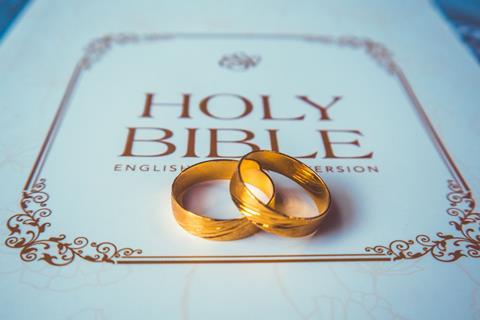
Fewer than half of the adults in England and Wales are now in a man-woman marriage. The Office for National Statistics (ONS) published the figures last month and once you separate out civil partnerships and same-sex marriages, man-woman marriage stands at 49.8% of adults. The ONS didn’t publish that arithmetic itself but it is a finding that should reach every pulpit in the land because of what lies underneath it.
Using the ONS’s online service, you can build the tables the state has never published – marriage status crossed with faith. And when you do that, the figures show something very plainly: marriage in Britain now lives where belief lives.
The faith divide
Every named faith group in the latest census is more than half married – Hindus at 67.6%, Sikhs at 63%, Muslims at 57.7%, Jews at 55.2%, Christians at 52.7%. And the adults with no religion – 17.4 million of them right now – are barely a third married, at 35.8%. Most of them, 52%, have never married at all.
Even if immigration numbers are removed, British-born Christians are 53.1% married – still, in their majority, a married people. The British-born with no religion are 35.6% married, and as with their immigrant counterparts, most have never married at all. Same country, same generation gaps, same housing market, same cost of living. The difference is belief.
And the number of children being born follows the marriage pattern. Births in England and Wales fell again last year, to a provisional 1.39 children per woman – the lowest yet recorded. A country that stops marrying stops having children. We can see it happening before our eyes.
A nation with a birth rate of 1.39 is not merely making a lifestyle choice, it is turning its back on the first thing God instructed us to do.
And it isn’t only that fewer children are born. It’s that fewer of them get to keep both parents. Children do best when the two people who made them are married to each other and stay that way.
That isn’t sentiment; it is what the evidence says. Research by Marriage Foundation found that cohabiting parents were 3.4 times more likely to split up in any given year than married parents – 6.5% against 1.9% – with the gap holding at every income level. And the poorest married parents stay together slightly better than the richest cohabiting ones. Stability is crucial to a child’s wellbeing and a home falling apart isn’t a statistic to that child.
The first commision
This brings me to the thing the church seems too embarrassed to say. The very first thing God ever said to a man and a woman He had made wasn’t about worship, or the sabbath, or even the tree. He blessed them, and He said unto them, “Be fruitful, and multiply, and replenish the earth, and subdue it” (Genesis 1:28).
This was spoken to a married couple, before any law was given and before anything had gone wrong. Marriage and children were not an afterthought bolted onto creation, they were mankind’s first commission. A nation with a birth rate of 1.39 is not merely making a lifestyle choice, it is turning its back on the first thing God instructed us to do.
For a generation, the Church was told that biblical marriage is a private preference, that the country has moved on, and that we should keep our convictions to ourselves. We were told it by the culture, by our leaders and even from our own pulpits. And too much of the church has believed that. The last census has returned its verdict on the country. A majority of its unbelieving adults have never married, and its cradles are empty. Meanwhile, the households still built on the man-woman covenant for life are largely the ones raising the children who will be Britain’s next generation.
But our own numbers are the ones falling. In the ten years to 2021, Christians in England and Wales fell from 33.3 million to 27.5 million – from 59.3% of the population to 46.2% – the first census in which we were no longer the majority. Those with no religion rose from 14.1 million to 22.2 million.
A home falling apart isn’t a statistic to that child.
So the largest group in Britain that still marries in its majority is shrinking by nearly six million a decade, while the group least likely to marry at all grows by eight million. Every year we say nothing, there are fewer of us to say it – and fewer children raised to hear it and pass it on.
This is not something the church ought to be quiet about. Nobody else is going to say it. Turns out you are the salt of the earth – meant to stop the rate of decay.
Right now, ministers are consulting on two fronts: first, on reforms to weddings law in England and Wales that will remove any premise of life or faithfullness through Tying the knot; and second, on extending legal protections to cohabiting couples through A fairer end to relationships.
The direction of travel is clear; anyone who believes marriage is still worth defending should respond and say so. It is very clear that neither the state nor most of its institutions are genuinely interested in promoting marriage. That now falls to the faithful – as perhaps it always has.
It’s up to us. Preach marriage – not as nostalgia but as the gold standard for children, which the data shows it to be. Prepare young couples for it, celebrate it, promote it, and honour it in front of a generation that sees it as increasingly rare. I can keep supplying the figures – built from the state’s own sources, since the state will not. But the church must supply what no statistician can: the cultural lead, and the faith that underpins it.




















No comments yet