












The Pentagon’s UFO website has garnered a record-breaking 1 billion hits in less than a month. Dr Michael Tang says it’s time for the Christians to stop arguing about what aliens are or whether they exist, and focus on why so many people are searching the sky. The human desire for something other-worldly can only truly be satisfied in Jesus
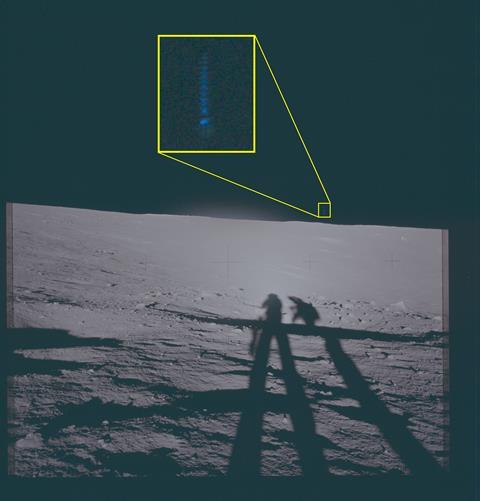
There is a small unfocused light hovering above the lunar horizon in one photograph. Three smaller points in triangular formation. The American astronauts who took the pictures half a century ago described what they saw as “streaks” and “flashes” in the night sky.
In an unprecedented disclosure of previously-classified documents, the Pentagon has just released records of dozens of other “anomalies” recorded by US military aircraft and intelligence officers in more recent years. Browse the website where the 222 files are hosted, and the first thing that strikes you is how strange it is that any of this is happening at all.
The strangest part may not be the photographs, videos or first person accounts of things we cannot explain. It may be us.
In the weeks since the disclosure portal opened, it has recorded more than one billion hits worldwide. That is not a typo. The traffic has been record-breaking. In the first 12 hours alone, 340 million hits were registered.
It would be easy to read all this as a story about credulity. The Mulder and Scully X-Files generation. Conspiracy theorists displaying an inexhaustible appetite for the unexplainable. But one billion hits in 14 days is not a Mulder-generation number. It is a generation-and-a-half number.
It includes people who were not looking, but who clicked anyway. And I cannot stop thinking about what they were really looking for.
Awe and wonder
In 1917, German theologian, Rudolf Otto, wrote a book called The Idea of the Holy. Its central claim was very simple. Religion, at its root, is not about ethics, doctrine or what we believe. It is about an encounter with something that exceeds us.
Otto called it the mysterium tremendum: the mystery that both terrifies us and pulls us in. He called it, more directly, “the wholly other”. He noticed that when human beings encounter the wholly other, however briefly, they always respond in a similar way.
They go quiet. Unable to find words. Otto had a term for this too: stupor. Not stupidity, but “blank wonder, an astonishment that strikes us dumb.”
The Christian tradition has its own answer to the human longing for the wholly other
One intelligence officer, whose account appears in the new tranche of documents, described his 2025 encounter as leaving him “virtually speechless” after his observations. That is not the language of scientific analysis. It is the language Otto was describing more than 100 years ago.
Modern science cannot hold what older traditions called ‘holy’. We have lost the word and called it ‘anomaly’ instead.
What is most striking about those billion clicks is not the credulity, but the hunger.
Generation Z is, by almost any measure, the loneliest and most spiritually adrift cohort in modern memory. They have been told by the institutions who raised them that the cosmos is empty and the categories are settled.
They have grown up inside a story that has no room for mysterium tremendum. And they appear to be quietly unconvinced. Many have stopped going to church. But they have not stopped looking at the sky.
The Church of Christ
The Church ought to find this sobering rather than comforting. We hold the most developed vocabulary for what these clicks are really about.
We have a liturgy structured around the dread and pull of the holy. We have psalms that name disorientation. We have a Christ who turns up on the road, is not recognised, breaks bread and then vanishes again. It is a holy mystery.
And yet, over the last half-century, we have largely traded those resources for a vocabulary of warmth and intimacy: the approachable God, Jesus our best friend, cosy worship moments.
Perhaps we got some things right. But perhaps we also gave away some of what this generation is reaching for, however inarticulately, handing them over to a search engine instead.
A generation looking up because no one has taught them how to look to the cross
In response to the disclosure, one cluster of Christian voices have argued the files document fallen angels or Nephilim, demonic incursion into the visible spectrum.
On the other, a chorus of careful evangelical voices have insisted the Church does not need a new word from the sky.
Both responses miss the point. The interesting question is not what UFOs are. It is what the billion clicks mean.
The Christian tradition has, of course, its own answer to the human longing for the wholly other. And it is far more unsettling than anything on the war.gov website.
Christians believe that the wholly other has already come near. Not as a light above the moon but as a carpenter from Galilee. Not as spectacle, but as offence. The God who exceeds our categories made himself small enough to be misunderstood, executed and missed.
The encounter the Church holds in trust is not three lights, blinking, above Apollo 12. It is a wounded man on a road, asking the people who walk beside him a question about who they think he is.
That encounter is more demanding than disclosure. It asks something of a person. It cannot be archived or redacted. It can only be received.
A billion hits in two weeks. A generation looking up because no one has taught them how to look to the cross. The Church might consider what it is failing to offer them.
























2 Readers' comments