







Church leaders in Jerusalem have called Christian Zionism a “damaging ideology”. But Elijah Dobner notes their letter fails to define the term, or take account for the diverse range of viewpoints which exist among Christians in the holy land
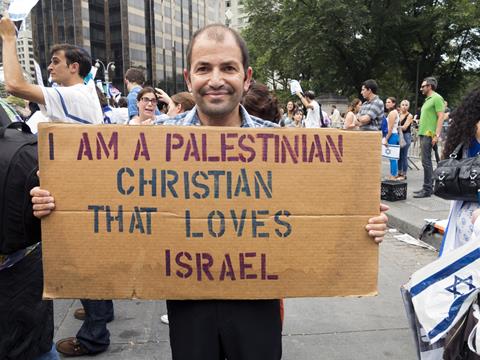
The Council of Patriarchs and Heads of Churches in Jerusalem have issued a short statement condemning Christian Zionism.
They wrote, ”Recent activities undertaken by local individuals who advance damaging ideologies, such as Christian Zionism, mislead the public, sow confusion, and harm the unity of our flock. These undertakings have found favour among certain political actors in Israel and beyond who seek to push a political agenda which may harm the Christian presence in the Holy Land and the wider Middle East.”
There are two problems with their words. Firstly, it’s not clear what they are condemning. This is because their rather terse statement doesn’t bother to define Christian Zionism, nor is it willing to differentiate between less and more extreme forms of the view.
This means readers are left guessing as to what exactly is being criticised. Is it the right of the Jews to a homeland? Or the view that Jews have returned to the land in recent years as a fulfilment of biblical prophecy? Or is it a theology that is used to uncritically support the Israeli government? We don’t know.
I would posit that put simply, Christian Zionism is the support for a Jewish national homeland for mostly theological reasons. It should also be noted that some Christians are pro-Israel while refusing the label.
Critics often like to portray Christian Zionists as an archetypal American evangelical who uncritically supports every action of the Israeli government due to some blinkered dispensational eschatological conviction. But in my experience, pro-Israel Christians come in all shapes and sizes - and from all nations, UK included - and their view of what it means to support a Jewish state also differs wildly.
Additionally, many of them actually reject dispensationalism, and a lot of them actually hail from historic denominations.
Who do they speak for?
The second major problem with the statement is the representatives of these churches (Armenian and Greek Orthodox) are effectively claiming the right to speak for the Christians of the Holy Land, and their comments have been widely interpreted as such. But this is unfair and reveals a misunderstanding of the complex nature of Christianity in the holy land.
Currently the document only appears on the website of the Greek and Armenian Orthodox Patriarchates, although the council actually consists of several church bodies, including the Latin Patriarchate, and the Anglican and Lutheran churches of Jerusalem.
The letter suggests it’s only the “apostolic” churches who are legitimately entitled to speak on behalf of the entire Israeli Christian minority. But this logic excludes the opinions of many evangelical Protestants in Israel (including as many as 30,000 Messianic Jews). It is true that the overwhelming majority of Christians in the Holy Land are Orthodox or Catholic, but they are not so alone that they can speak on behalf of the entire body of Christ in Israel. If the Anglican House of Bishops were to make comprehensive statements in the name of every believing Christian in the United Kingdom, many of us would feel rather annoyed.
Why now?
One wonders why the Council has chosen this particular moment to take a stand. Christian Zionism is typically supportive of Jewish people, and one could argue this is badly needed given the widespread increase in antisemitic attacks recently, not least the Bondi Beach massacre in Australia and the Manchester synagogue murders in the UK. All of this has happened against a backdrop of Holocaust denial, which is enjoying a renaissance through the work of popular podcasters and online personalities such as Nick Fuentes and Candace Owens.
I can think of two reasons why these church leaders are choosing to speak now.
Firstly, in the wake of the horrific massacre of 7 October 2023, which claimed around 1,200 lives, a real sense of frustration and anger took hold of certain Jewish communities in the holy land. Harassment and vandalism become more frequent towards Palestinians in the West Bank - mostly perpetrated by ultra-orthodox settlers. These episodes obviously made the lives of locals, including Christians, harder. The authors of the open letter may fear that proponents of Christian Zionism are legitimizing such attacks against Palestinian Christians.
The second reason is rarely discussed, but the truth is many Arab Christians feel it constitutes ethnic betrayal to speak openly about the treatment they receive from their Muslim compatriots. This means they openly discuss every unpleasant situation and injustice they have experienced at the hands of the IDF or Jewish settlers, but remain silent as the grave when it comes to tragedies that befell their families at the hands of other Palestinians.
Muslim intimidation and attacks do pose a daily risk to many Palestinian and even Israeli Christians (you can read about the sad case of the Israeli town Nazareth here). But any legitimization of Israel feels like betrayal of the tribe. Could this be why these church leaders are able to issue a statement critical of supporters of Israel, but are unable to criticise wrongdoing when it comes from Palestinian Muslims?
We should also note that Israel treats its Christian minority significantly better than virtually any sovereign Muslim country. For example, when Bethlehem in the West Bank was under full Israeli control, it was overwhelmingly Christian (80%). But now, under the civil and security control of the Palestinian Authority, it is around 85-90% Muslim. I first heard about this from an Arab Christian friend born and raised in Bethlehem who had to flee to the West because her life was threatened after she spoke out about what is happening to Christians in her hometown. The same trend holds true for the entire Arab world. In the first half of the 20th century, nearly one-fifth of the Middle East’s population was Christian. Today, that figure has dropped below 3%.
Meanwhile, Israel proper’s Christian population has grown from about 35,000 in 1948 to 180-190,000 today. It should be acknowledged that it is much easier to be a Christian in Israel under Jewish rule than it would be under Muslim rule.
All of this means the situation is not nearly as black and white as the church leaders’ statement would make it seem. Many Arab Christians in Israel love their country, will serve in the IDF and would even consider themselves Zionists. But we never hear about that.
Ultimate hope
We must pray for revival both in the Muslim world and among the Jewish people.
It is enough to look at the rapid growth of the Christian minority in Iran to understand that no situation is completely hopeless for the one we serve.
The only legitimate ruler of the Holy Land is the same King of the Jews that was crucified there, on the edge of Jerusalem, 2000 years ago.
Jesus the King, the only begotten Son of God, the true hope of every last wandering soul, be they Jew or Muslim.




















1 Reader's comment