










During the second world war, CS Lewis housed children evacuated from London and served as a chaplain to the Royal Air Force. Ahead of Remembrance Sunday, Bruce R Johnson explains how his experiences paved the way for his extraordinary career as a public apologist and inspired The Chronicles of Narnia
The day before the United Kingdom’s formal declaration of war against Germany, the first group of evacuee children arrived at the home of CS Lewis. They were all teenage girls. Soon afterwards, Lewis began writing a story in which four siblings are sent away from the London air raids to the safety of the countryside. The story would become The Lion, The Witch and the Wardrobe. But the imaginary tale was prompted by real danger: the threat of military battles in British skies.
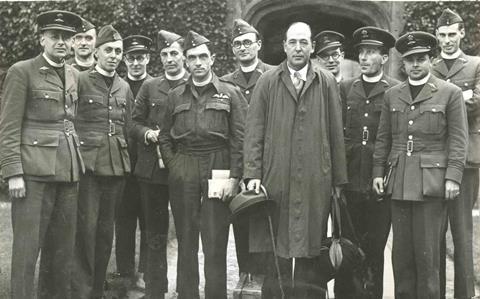
Eighteen months later, the Royal Air Force recruited Lewis to play a small role in that air struggle. The RAF was short of chaplains, so chaplain-in-chief Maurice Edwards asked Lewis to become a part-time lay lecturer. It was an opportunity both to advance the Christian faith among airmen and be an encouragement to other weary chaplains. His first talk at RAF Abingdon did not go well; Lewis called it “a complete failure.” He had little experience in addressing non-academic audiences and still had much to learn about communicating to the masses. But Edwards believed Lewis would find a way.
Across the nation
In July 1941, Lewis began traveling to RAF bases across England, Scotland and Wales. At times, he was not home more than three nights in a row. He visited small camps that were little more than “Nissen huts and loud speakers”, as well as larger RAF stations such as Halton, Cranwell, Hereford and Locking. Chaplain Charles Gilmore said Lewis was “sharp and clear as a diamond with many lights, whether he was speaking to a hundred or to a dozen.”
After one talk, an airman exclaimed: “This is the first time I’ve heard anyone advance a reason for believing the Bible might be true.” At a question-and-answer session, a pilot asked Lewis for a simple explanation of the Holy Trinity. Lewis said: “The question that you have asked us is like asking a slug to explain Einstein.” Then he did his best to explain the inexplicable.
Theology is like a map, he told the airmen. It is meant to guide you safely home
As Lewis became more adept at defending the Christian faith before a live audience, he wondered if he should take it one step further. In August 1942, he asked airmen at RAF Yatesbury to choose to follow Christ. He put this in military terms: “Report for duty. Say your first prayer, wherever you happen to be, at once. Tell Him you want to join.” The live appeal fell flat. After the war, he reflected: “The simple, emotional appeal (‘Come to Jesus’) is still often successful. But those who, like myself, lack the gift for making it, had better not attempt it.” Lewis understood that his role was that of an apologist, not an evangelist.
Stories of good news
On Palm Sunday 1943, Lewis spoke at RAF Feltwell. The squadrons were flying massive night bombing campaigns and experiencing staggering losses. Chaplain Stuart Barton Babbage said each sortie was “into hell and back again”. Lewis used the experiences of these aircrews in his talk, comparing historic Christian doctrines to lines on the maps they used each night. Religious experiences are far more exciting than dry doctrine, as walks along a beach are more pleasant than reading maps, he said. But Lewis then pointed out: “the map is going to be more use…if you want to get to America”.
Theology is like a map, he told the airmen. It is meant to guide you safely home. “Christianity claims to be telling us about another world…You may think the claim false, but if it were true, what it tells us would be bound to be difficult - at least as difficult as modern Physics, and for the same reason”. Many who heard this talk did not make it through the war, but Lewis’s words landed home that day.
His first talk at RAF Abingdon did not go well; Lewis called it “a complete failure”
While Lewis was speaking to the RAF, he was also investing time in successive groups of young evacuees who came to stay with him. He coached some in Latin and Greek as they prepared for university entrance examinations. When the dinner menu was meagre, Lewis sent extra apples to their room. For some, with their parents’ permission, he paid university fees or for professional training in their postwar lives.
One girl later remembered that Lewis “seemed unconcerned with the war”, perhaps reflecting the tendency of adults not to talk about its horrors in front of children. Yet Lewis knew those horrors firsthand. In the first world war, he had been a Second Lieutenant in the army - and an atheist. By the start of the second world war, he carried old shrapnel in his chest and a new faith in his heart.
Lewis learned that the aviators facing death in this new war were sceptical about history, distrustful of ancient texts and almost completely lacking in any sense of sin or guilt, yet he continued to speak with them. As a result, he gained a greater understanding of the mindset of the masses and found his popular voice. Through vivid imagery and clear rhetoric, Lewis laid out a sure pathway for guiding others safely home.




















No comments yet