












Will you be feasting this Christmas? Veronica Zundel explores why Jesus embraced a good meal and how eating together can strengthen our faith, deepen relationships and bring us closer to God
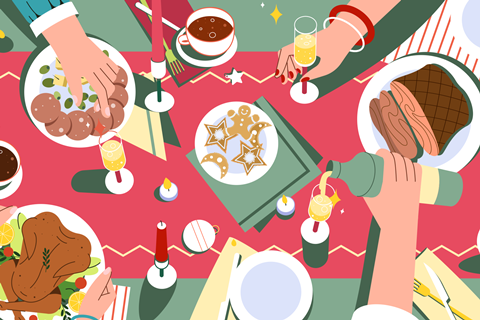
The writer, speaker and songwriter John Bell has a talk called ‘Jesus was a fat man’. In it, he argues that the emaciated, ascetic Jesus we have inherited from medieval art cannot possibly be a fair representation, since, according to the Gospels, Jesus spent much of His time having probably lavish dinners, both with the religious leaders of His time and with outcasts such as Zacchaeus. I don’t think he means Jesus had middle-aged spread (after all, He only lived to His mid-30s), but it’s clear He had no objection to regular feasting.
Feasts and festivals seem to be the focus of most schools’ religious education now. It’s understandable: they are easy to explain, don’t involve complex theological thinking, are common to most faiths and, above all, lend themselves easily to craft activities.
Clearly, faith is not all about feasts and festivals, and some eschew them altogether (my husband’s Christadelphian family boasted of regarding all days as the same). However, it could be that we neglect feasting at our peril. I heard of one church with the slogan ‘No meeting together without eating together’, which was very probably the practice of the early Church, and I’m not talking about a wafer and a sip of wine, or a square of stale bread and a tiny glass of Ribena here. Communion for the first Christians was a proper meal.
When I was with the (now sadly defunct) Wood Green Mennonite Church, we had a bring-and-share lunch once a month and also a monthly ‘members’ communion’, consisting of a simple meal with the taking of bread and wine at its heart, plus plenty of time for sharing and prayer for each other. One member called it “the powerhouse of the church”. Eating together brings people closer in a way almost no other activity can. Isaiah promised the people: “On this mountain the Lord of hosts will make for all peoples a feast of rich food, a feast of well-aged wine, of rich food full of marrow, of aged wine well refined” (Isaiah 25:6). Hardly austerity cooking!
In my family, we have a double Christmas, reflecting the way I was brought up in my Austrian family. On Christmas Eve, the traditional main celebration for most of Europe, we eat a special meal, share our family presents (usually far too many) and often finish off with roast chestnuts and mulled wine. On Christmas Day, we eat the standard British turkey meal and invite guests. All this is helped by the fact that my husband does all the cooking!
Jesus called us to deny ourselves and follow Him. But if we follow His example, He never seems to have called us to a life of privation and dull sobriety. As it says in 1 Corinthians 5:7-8: “Christ, our Passover, is sacrificed for us, therefore let us keep the feast” (KJV).

























No comments yet