












A recent report revealed that an average of 10 crimes are committed at UK churches each day. Claire Walker of the National Churches Trust unpacks the deeper impact crime is having on the nation’s sacred spaces and the communities they serve
Last year, Salvation Chapel International church in Laindon, Essex, was broken into and set on fire. Racist graffiti was also spray-painted inside. On Easter Sunday this year, the church was further vandalised and the congregation left with a £50,000 repair bill. Just a few weeks ago, at St Margaret of Antioch in Barley, Hertfordshire, valuable silverware was stolen, leaving the village heartbroken.
Sadly, these crimes are not uncommon. New data obtained by the Countryside Alliance shows that ten crimes a day are being committed at churches and places of worship across the UK.
The information comes from Freedom of Information Requests to all of the UK’s 45 territorial police forces. 44 police forces responded to their requests, and 37 of them provided figures.
Thefts and burglaries were the most common, with 1,619 incidents recorded. This includes 58 lead and metal thefts. There were also 1,018 incidents of criminal damage, vandalism and arson, and 1,000 cases of violence. The worst-hit areas were London, followed by West Yorkshire and Greater Manchester.
The cost unaccounted for
These crimes have a devastating impact on the congregation and local community. But there’s another problem that doesn’t get as much media attention: paying for repairs following a break-in.
All church repairs are funded by their congregations, so the burden of raising funds to cover these costs falls entirely on local people. And with the cost-of-living crisis, dwindling congregation sizes and ever-increasing inflation, it is a significant challenge to raise the money needed.
Many church buildings already require a litany of repairs. The 2025 National Churches Survey found that one in ten UK churches needed a new roof this year. So, where does the money come from?
There is no UK-wide government scheme that funds repairs to church buildings. A new four-year England-only competitive grant scheme is being set up by the government, but the details for this have not yet been finalised.
There are grants but demand for them often outstrips the money available. For example, at the National Churches Trust we are only able to fund one in four churches that apply to our large grants programme, even though we would love to support more. As a small charity, we can only do so much.
The UK government significantly reduced the budget for the Listed Places of Worship Grant Scheme in 2025 and then ended the scheme entirely this year. This scheme allowed all listed places of worship in the UK to reclaim their VAT costs. Now, repairs are subject to tax, making every repair 20% more expensive.
Church buildings are important – not only as places of worship, but as vital community hubs. They provide at least £55 billion a year in social good, through the support groups they host and run. They are the UK’s hidden safety net. Were the NHS to provide this level of support, they would need to find an extra £8.4 billion every year – the same as employing 230,000 full-time nurses.
You cannot run a food bank or a parent and toddler group if your roof is leaking following a lead theft.
Keeping the doors open
If congregations cannot find the money, we are going to see more church buildings fall into disrepair and close. The burden of repairs should not sit so heavily on the shoulders of local people. We need the UK government, Christian denominations and heritage organisations to work together on a plan that will see these vital buildings properly funded and cared for. This should include removing the burden of paying VAT on repairs.
The added danger following the Countryside Alliance’s report is that people will see locking up their churches as the solution to prevent vandalism. But one of the best ways of preventing crime at churches is to have them open during the day. Professional thieves can easily gain access to a locked church, whereas they will hesitate to enter an unlocked one, as they are very likely to be disturbed. Vandalism has been shown to reduce in both urban and rural areas when churches open their doors during the week.
Keeping churches open helps to engage the local community with the building. By far the biggest asset in keeping a church safe and secure is the many eyes and ears of the local people. If a church is open and welcoming, local people will be alert to what is happening when they go past, or even pop inside to keep an eye on things.
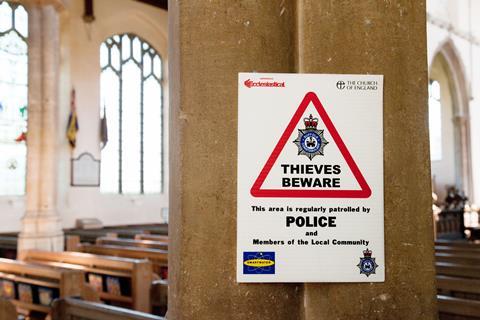
But other measures, such as a roof alarm and using SmartWater should be a must for churches, as these act as a deterrent and are often required by insurers. SmartWater can also help with police investigations, as it means the lead can be traced back to the church in question if it is attempted to be sold.
We also need more data. Not all crimes at churches are recorded as a heritage crime, which limits the data we have and the responses churches receive from the police. If you’re reporting a crime at a church, please do make sure you mention to log it as a heritage crime.
One thing is clear: ten crimes a day is too many. There is work that we can all do to better protect church buildings, so that they can stay open and serving their local communities for many years to come.





















1 Reader's comment