










From women’s sport to prisons and child-issued puberty blockers, this week’s headlines reveal a growing insistence that the body does not matter — one that is placing the vulnerable at risk. Lois McLatchie-Miller explains why she believes Christians must affirm the biological reality
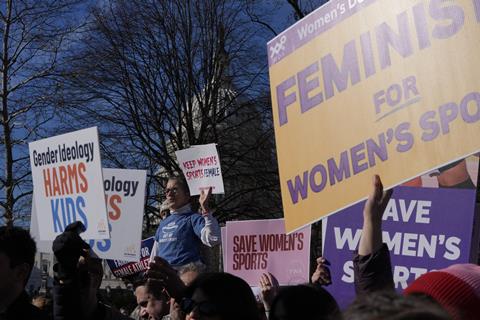
This week, three stories from across the UK and the United States exposed a shared underlying moral confusion.
In Washington, D.C., the US Supreme Court heard arguments as to whether states may protect sporting opportunities for women by preventing males from competing in female-only categories.
In Scotland, Douglas Ross MSP called out the Scottish Government for its determination to continue housing male prisoners in a female prison estate, asking why public money is being spent to defend a policy that places women at risk.
Tomorrow at FMQs, I’ll ask the First Minister why the Scottish Government is going to court to keep housing male prisoners in the female prison estate.
— Douglas Ross MSP (@Douglas4Moray) January 14, 2026
How much will this legal challenge cost Scottish taxpayers and why is it being pursued at all?
Women’s safety must come first. pic.twitter.com/QQVe139iiT
And in England and Wales, a petition to ban the NHS puberty blocker trial has surpassed 100,000 signatures, triggering a debate in Parliament concerning whether vulnerable children should be subjected to medical experimentation in the name of gender ideology.
Different institutions. Different policy areas. One shared question: does the body still matter?
The Christian view of the human body
For Christians, this is not merely a political dispute, but a debate over intrinsic creational truth. At the heart of Christian belief is the doctrine of the imago Dei – that every human being is made in the image of God (Genesis 1:27). We are unified beings, body and soul together, intentionally created.
That means our bodies are not mistakes. They are not problems to be solved or canvases for self-invention. They testify to God’s design. To affirm the body a person is created in is not unkind; it is deeply honouring. It says, “God did not get you wrong.”
In a culture that increasingly treats the body as an obstacle to authenticity, Christianity offers a far more loving message: You are fearfully and wonderfully made. Just the way you are. No dress-up, no pretence, no drugs or scalpels needed.
The consequences of allowing someone to falsely believe they are “born in the wrong body” are damaging beyond their own personal physical, mental and spiritual wellbeing. A cultural insistence that we suspend our belief in reality to accommodate transgender ideology has placed women and girls at risk across several arenas.
Take sports. As the Supreme Court heard this week, women’s sports exist because sex differences are real and meaningful. Male bodies have a higher muscle mass, larger hearts, greater lung capacities, and lower body fat, resulting in 10-30 per cent greater power and speed when it comes to competing. To include them in women’s sports not only jeopardises women’s opportunities for prizes and medals – it also risks their safety in contact sports like boxing, wrestling and rugby.
If male and female bodies were interchangeable, there would have been no need for women’s categories in the first place. The Supreme Court case is therefore not about exclusion; it is about whether female categories are allowed to exist at all. When male bodies enter women’s competitions, women lose fairness, safety, and opportunity.
When ideology trumps safety
In prisons, the stakes are also high. Many female inmates have long histories of being victims of male violence and abuse. Many male convicts have histories of perpetrating those crimes.
To insist that male prisoners be housed in the female estate, simply because they want to be, prizes ideology over basic decency. In Scotland, males have taken residence in female units even despite convictions of rape. Douglas Ross MSP is right to ask why Scottish taxpayers should fund legal battles that put political commitments ahead of women’s dignity and safety.
Children’s safety is also deeply compromised by an insistence that men can become women. In England and Wales, public concern has reached a boiling point over a puberty blocker trial which would allow children, confused about their “gender identity” to be experimented on with drugs which could have a lifelong impact on their development, their bone health, their fertility and more – all in the name of an ideology that tells them they were “born in the wrong body”.
We don’t allow children to consent to sex, or marriage, or alcohol. Why would we allow them to play around with harmful, potentially sterilising chemicals at such a young age?
Over 100,000 people have signed a petition calling for the trial to be banned, ensuring a parliamentary debate. Children do not need drugs to “fix” their perfectly healthy bodies – they need to be loved and affirmed to grow confident in the skin that they’re in.
As this week shows, the victims of the consequences of gender ideology are fast accumulating across almost every sphere of life. Christians are often told that affirming the truth about biological sex is unloving. But Christianity has never separated truth and love.
Love that denies reality is just flimsy sentiment. Love that affirms the truth is substantial. We know that our biology is not a glitch in God’s design but a testimony to it. And for the sake of the men, women and children whose lives are ruined by this fad, we’re called to speak up.

























3 Readers' comments