












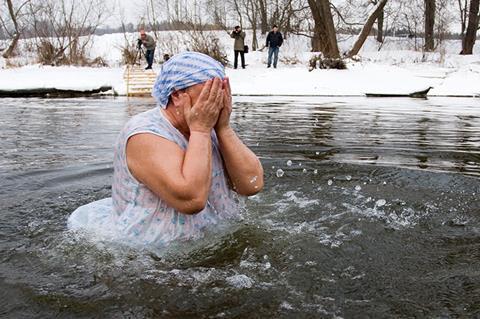
Fancy a dip in a freezing cold lake to start the new year? Karen Miller takes a look at the Christian festival of Epiphany - and how church traditions around the world commemorate the day that Jesus was revealed as the saviour of the world
Have you taken your Christmas tree down yet? Traditionally, festive decorations stay up throughout the twelve days of Christmas, which takes us to 5 January. The following day is known as Epiphany.
The Greek word epiphaneia means “a manifestation or revelation”. But what is being revealed, and to whom? This is something that the Western and Eastern Church each take a different view on.
God revealed
In the Eastern Orthodox Church, 6 January is known as Theophania, the revelation of God. It marks Jesus Christ’s divinity being revealed at his baptism, when the Holy Spirit descended on him in the form of a dove, and God’s voice from heaven proclaimed: “This is my son, whom I love” (Matthew 3:17).
In keeping with this aquatic theme, Orthodox churches mark the event with water-focused events. In Greece, priests bless the sea and other waters. In Istanbul, the Ecumenical Patriarch of Constantinople (very roughly equivalent to the Catholic Pope) throws a small wooden cross into the harbour, launching a swimming race of locals who try to reach it first and kiss it.
In the Western Church, Epiphany marks the baby Jesus being revealed to the gentiles
The Coptic Church celebrates Epiphany on 19 January, since, for them, Christmas falls on 7 January, but the festival still honours Jesus’ baptism. As one of the seven major festivals of the Coptic Church, it involves days of fasting and liturgies in preparation.
In years past, Copts would have taken a dawn or midnight dip in the Nile River to commemorate Jesus’ baptism, but pollution has largely put paid to that. However, they still break their fast with a soup of taro roots, which have to be peeled of their dark skin, symbolising purification, and then soaked, symbolising baptism.
Saviour of the world
In the Western Church, the revelation memorialised by Epiphany is usually the baby Jesus being revealed to the gentiles, in the form of the Magi who came to worship him – the first non-Jews to do so. In many parts of the world, and especially in Latin America, 6 January is known as (Three) Kings’ Day.
In rural Brazil, groups go from house to house playing musical instruments, while in Mexico, a special cake with a mini figurine of the baby Jesus inside is shared. Whoever gets the slice with the figurine has the responsibility of cooking at the next large family gathering!
Europe celebrates Three Kings Day, too. In Prague, people dress up as the magi Kašpar, Melichar and Baltaza, processing through the streets on camels while volunteers collect money for charity. In Spain, there are also processions and families share a brioche cake covered with candied fruit and nuts, again with a prize and a booby prize hidden inside.
In the Eastern Orthodox Church, Theophania marks Jesus Christ’s divinity revealed at his baptism
Special cakes are something of an Epiphany theme, with France serving Galette des Rois, a flaky pastry filled with frangipani, and some German-speaking countries having Dreikönigstorte (three kings’ cake).
Even Britain used to have Twelfth Cake on Twelfth Night, but it fell out of fashion once Christmas cakes became popular. Another tradition that seems to have disappeared is the custom of naming girls born on Epiphany a version of Theophany: Tiffany.
A different take
But if all of these European and Latin American Epiphany traditions sound largely similar, Italy is the outlier. On 6 January, Italian children wait to receive presents from La Befana, a witch-like figure who flies around on a broomstick, leaving gifts for children. The legend goes that when the Wise Men were on their way to Bethlehem, they stopped to ask an old woman for directions and invited her to go with them to worship the baby Jesus.
She was too busy sweeping her house, but she later regretted her decision and raced after them. Unable to find them, she has wandered the world ever since, searching for Jesus, and leaving presents for other children in the hope that one might be him. She also leaves coal for children who have been bad, but these days, it is merely coal-shaped sweets.
If you have some breathing space after the busyness of Christmas, maybe you could enjoy some version of Epiphany cake with your loved ones. But if baking - or even buying - cake seems like too much after the recent festivities (no judgement here), you can just use this time to remind yourself that while the craziness of the Christmas season is over for another year, wise men (and old ladies on brooms) still seek Jesus every day.























No comments yet