











While children in the UK wait for Christmas Day, youngsters in mainland Europe will be receiving presents from St Nicholas this weekend. But how did a fourth-century bishop become the jolly figure we call Santa Claus?
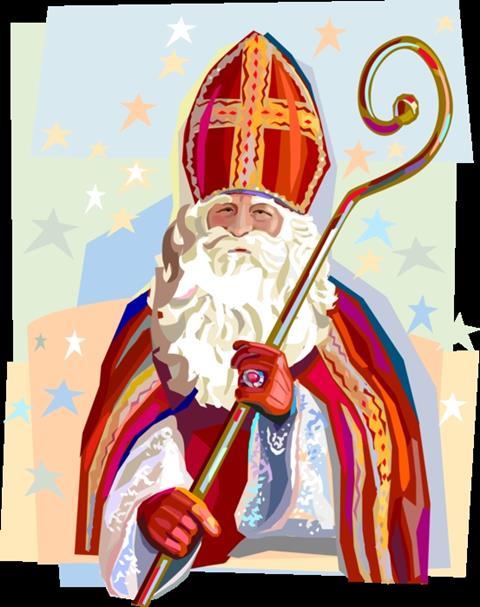
Children in the UK are opening the doors of their advent calendars, impatiently awaiting 25 December, when they will find out what Santa has brought them. But in some parts of Europe, that wait is almost over. In the Netherlands, Belgium and parts of Germany and France, children receive presents in their stockings or shoes on 5 or 6 of December.
The origin of the date is pretty simple to explain: It is the feast day of St Nicholas, the fourth-century AD Bishop of Myra (now modern-day Turkey). Nicholas was imprisoned for his faith during the persecution of Roman Emperor Diocletian, released under Constantine (the first Christian emperor), and attended the Council of Nicaea. We don’t know much else about him, but legends grew up about his miracles and generosity, especially to children, so he was venerated as a saint. His feast day was the anniversary of the day he died – 6 December 343 AD.
From Bishop Nicholas we get Santa Claus, who delivers presents at Christmas, riding a sleigh pulled by flying reindeer. But what has the Bishop of Myra got to do with Christmas? In truth, not much. But if you follow his trail down through the centuries, you can see how a venerable church leader turned into jolly old St Nick.
The birth of St Nick
Saint Nicholas was honoured on his feast day for centuries, but when the Reformation swept Europe, the veneration of saints was looked upon with disapproval. In most parts of Protestant Europe, this date was ignored – except in the Low Countries. In what is now the Netherlands and Belgium, people privately maintained the tradition of filling children’s shoes or stockings with little gifts on St Nicholas’ Eve or St Nicholas’ Day, even if the public veneration of St Nicholas no longer took place. When Dutch settlers travelled to the New World, founding New Amsterdam (New York), they took with them the tales of the kindly bishop Sinterklaas.
In 1821, a poem moved his arrival date from 6 December to Christmas Eve
Meanwhile, in Protestant Europe, there was a vacancy for a generous, gift-delivering old man. The role was filled by personifications of Christmas that were secular and not supposed to represent a real person. They were called things like Father Christmas, Père Noël or Weihnachtsmann. Aimed more at adults than children, this figure was usually portrayed as a laughing, well-lubricated man surrounded by good things to eat and drink, like the Ghost of Christmas Present in Dickens’ A Christmas Carol.
Back in 19th century America, Sinterklaas received a makeover. In 1809, Washington Irving wrote the humorous Knickerbocker’s History of New York. It included old Dutch tales of St Nicholas, by now regarded as the patron saint of New York, who flew over houses dropping presents down chimneys.
In 1821, a poem called Old Santeclaus with Much Delight moved his arrival date from 6 December to Christmas Eve. It also transformed the horse that pulled his sleigh into reindeer. In 1823, Clement Clark Moore wrote A Visit from St Nicholas (the tale that starts “’Twas the night before Christmas”). The transformation into the Santa we know today was complete.
Twinned together
When this Americanised version of Sinterklaas became known in the UK around the 1860s, he was at first treated as being separate from Father Christmas. However, within only a couple of decades these two similar figures were completely identified with one another, as they are today. Santa/Father Christmas has flying reindeer, brings presents down chimneys, and arrives on Christmas Eve.
But what has the Bishop of Myra got to do with Christmas? In truth, not much.
But that is not true everywhere. In Europe, St Nicholas stayed closer to his roots. No flying reindeer for him; he rides a white horse. He is dressed in red, but his clothes are bishop’s robes. Children expect to receive presents from him on the eve of his feast day, not on Christmas Eve. He arrives from Spain, not the North Pole (not that either location makes much sense) and instead of elves he has a human helper who is often called Peter (or Piet or Pierre). Bad children could previously expect not just a piece of coal, but a whipping or, in Austria, even to be abducted by a devil called Krampus – although traumatising children in this way has fallen out of fashion by now!
It’s probably true that the real St Nicholas wouldn’t recognise himself in either portrayal, but perhaps he would be pleased to see that his generosity and love for children have not been totally forgotten. So, this St Nicholas’ Eve, why not raise a glass to the man himself? And maybe check your shoes for presents before you put them on the next morning.





















No comments yet