




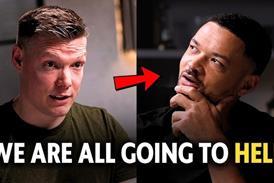







Bryce Crawford and Tristan Tate spent nearly two hours discussing their Christian faith. But after listening to an exchange devoid of curiosity, in which troubling claims went unchallenged, Tim Yearsley was left wondering whether it was a conversation worth having in the first place

What makes for a great conversation?
Whatever your answer, I’ll bet you won’t find it in Bryce Crawford’s recent podcast with Tristan Tate. Why more than 800,000 people would want to spend nearly two hours of their life listening to an exchange so spiritually bankrupt, I do not know.
The fact that both men identify as Christians is facepalm-inducing for me. When the Apostle Paul – no doubt mindful of Jesus’ teaching that his followers are to be “the salt of the earth” – encouraged Christians to “make the most of every opportunity, let[ting their] conversations be full of grace, seasoned with salt” (Colossians 4:6) – he must have been hoping things would be less bland than this.
So why did this podcast have such a deleterious effect on a white English Christian man who also sports a chin-only beard? The answer has less to do with who Crawford and Tate are than what passed – or didn’t pass – between them.
But first, a word on each contributor. Bryce Crawford is a Gen Z evangelist from Georgia, USA, with his own Christian energy drink brand (yes, really). He speaks with candour about Jesus pulling him back from the brink of suicide, fuelling a mission to tell others about the love of God. His sincerity is hard to doubt. And that sincerity makes Crawford all the more endearing when he confesses that his one taste of alcohol was by accident when he ate a champagne chocolate.
Tristan Tate, by contrast, is a more disturbing character. He is brother to king-of-the-manosphere Andrew Tate, and both would face charges including (but not limited to) rape and human trafficking, should they return to the UK.
Tristan’s (re)baptism into Orthodox Christianity seems to have given him enough common ground with Crawford to warrant an appearance on the podcast. As far as I could tell though, Tate’s Orthodox faith serves as a pseudo-spiritual foundation for his sweeping account of Western decline: universities infiltrated by Marxists, mass immigration threatening democracy, Christian values in retreat.
Each man comes across as charismatic and articulate in their own convictions. But like a Big Mac that goes down all too easily, I still regretted it afterwards.
Questions without curiosity
What I want from a great conversation is something that continues to satisfy long after it ends. Something with the kind of flavour-enhancing ‘salt’ that Jesus and Paul describe: curiosity, attentiveness, vulnerability, generosity.
These are the ingredients that turn a bland exchange of opinions into an encounter that leaves people changed. And it’s these ingredients that Crawford and Tate were sorely lacking. Nominally, they have Christian faith in common. In reality, there was more commonality in the fact that each turned up ready to explain the conclusions they already held.
For example, Crawford asks Tate how certain he is that he’d go to heaven if he died right now, on a scale of one to ten. This is a question born from a reductive gospel: heaven-after-death for those who can give the right answers to an imaginary theology exam (can someone introduce the boy to NT Wright?)
But what’s more, when Tate deflects, Crawford uses the opportunity to explain why, in fact, the only acceptable answers to his question are either ‘zero’ or ‘ten’. He does not seem interested in Tate’s lived experience of his faith, the transformation of his character, or what he thinks life in Jesus’ Kingdom looks like.
It’s all the more appalling that Crawford lets Tate’s other answers go unchallenged. Tate claims “Christians have leaned too much on ‘turn the other cheek’” and that they “are weak, and need to wake up a bit”. Crawford only asks what ‘strong’ Christianity looks like, which allows Tate to make his case that Christians should acknowledge their “natural hostility” to those who oppose their nation: immigrants, liberal-progressives, and the mentally unwell.
So much for the weakness of a crucified Christ who displays a “strength stronger than human strength” (1 Corinthians 1:25).
What Jesus did differently
Again and again, the two men declare their points of view, but neither seem interested in understanding how the other arrived there. It could have been so much more. Two Christians sat down to discuss faith, culture and the future of the West. But instead of revelation, there was repetition; instead of encounter, there was presentation; instead of curiosity, there was certainty. It was exchange of conclusions, rather than a genuine conversation, and so unlike the kind of conversation their Saviour enjoyed.
Consider Jesus on the road to Emmaus (Luke 24). He meets two disciples whose hopes lie in ruins. Jesus walks at their pace for a while, allowing them to tell their story in their own words. Then, he challenges their perspective with startling boldness: “How foolish you are, and how slow to believe all that the prophets have spoken!” (Luke 24:25)
Jesus goes on to explain the fullness of the scriptures and their revelation of Himself. And yet, He leaves the disciples wanting more, not less! They beg Him to stay for supper. Only after Jesus is gone do the travellers realise who they’d been walking with – and why their hearts burned while He talked to them on the road.
The best conversations are like that. We are witness to each other’s hopes and hurts; but we are also brave enough to disagree when we see things differently, while never speaking with less than gentleness and respect (1 Peter 3:15). We may not mention Jesus explicitly, but if our hearts are burning, we can be sure His presence is with us.
Most of us will never sit opposite a podcaster with a ring light and 800,000 viewers. Thank goodness. But we will sit opposite plenty of other people: over coffee, in the waiting room, at our desks. Could we see these moments not as opportunities to share our conclusions, but as small roads to Emmaus?
We need conversations seasoned with enough salt that we are interesting and interested, present to people, curious about their stories, and ready with reasons for the hope that we have. After all, Christian witness is at its best not when it platforms controversial figures, but when it leaves people with their hearts burning.























No comments yet