






Tommy Robinson’s latest rally in Central London brought together hundreds of people to sing Christmas carols. Dr William Allchorn went along to find out whether the event was political, religious, or a mixture of the two
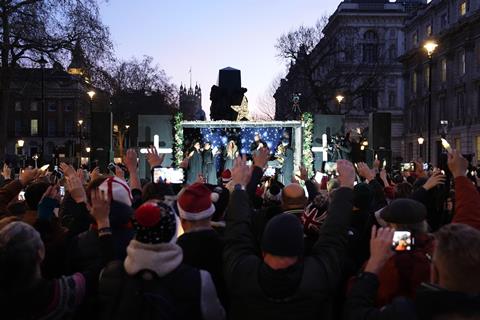
Central London became the stage for a carefully managed but symbolically charged demonstration hosted by Tommy Robinson on Saturday.
The Unite the Kingdom (UTK) Christmas carol service promised to “put Christ back into Christmas.” It took place at the Trafalgar Square end of Whitehall amid a heavy Metropolitan Police presence and strict spatial separation from counter-protests.
A Christmas aesthetic with political undertones
It wasn’t the only protest taking place in Westminster. A Stand Up to Racism demonstration and another unrelated anti-digital ID march also converged on Whitehall. Police barriers, mounted officers, and visible lines of separation defined the physical environment, reflecting a policing strategy shaped by previous clashes and learnings from UTK-linked events.
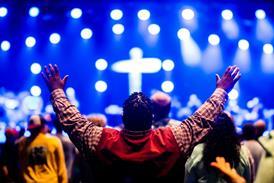
By mid-afternoon, hundreds of people had assembled. The atmosphere was deliberately seasonal: Christmas music played through loudspeakers, participants wore Santa hats and winter coats adorned with Union Jack flags, and carols were interspersed with Bible readings and speeches. Several UTK-aligned priests addressed the crowd, invoking Christian themes and the Nativity narrative.
Organisers and Robinson himself have repeatedly described the event as “non-political”. At the end of the rally, he referenced how he had found faith in prison and that he discovered a Jesus who stood against the establishment, and instead stood with sinners like him.
Christianity as an identity
In speaking to the attendees gathered, I discovered many had concerns over cultural loss, marginalisation, and displacement amid multiculturalism. For these participants, Christianity is a values-based bulwark against more impersonal forces of globalisation, national change and fragmentation.
A woman in her early 40s, describing herself as “not especially religious,” said the rally was “…about tradition and cohesion…You don’t need to go to church every Sunday to see that Britain was shaped by Christian values.”
Others framed their presence as a response to what they perceived as exclusion from public narratives of modern Britain in different ways.
“I get why people say it’s political,” a shopworker in his mid-30s told me, watching from the edge of the crowd. “But for a lot of people here it’s about taking their country back. They feel like the national Church doesn’t include them anymore and that we’ve lost something quite significant.”
One woman from a Pentecostal background said she had attended out of concern about faith being “pushed out of public life,” But she also expressed unease: “I do think faith has been marginalised, but I’m uncomfortable when the message drifts into politics. There’s a line, and it matters.”
Belief in a Christian push back
Despite this, several speakers returned to the language of hope through remembrance, arguing that acknowledging Britain’s Christian heritage could offer social cohesion in a period they characterised as fragmented and uncertain. Christmas, they suggested, provided a rare moment of common reference—capable of bringing people together across political and generational divides.
One speaker told the crowd that hope lay in recovering confidence rather than retreating into resentment, urging attendees to see the carols not as confrontation but as testimony and to attend church the following day.
Another emphasised reconciliation, telling supporters that public expressions of faith should be peaceful, joyful, and unafraid, and explicitly discouraging hostility toward counter-protesters or police.
Among attendees, similar themes emerged in quieter, less rhetorical forms. A middle-aged attendee, describing himself as “culturally Christian,” said: “For me, this is about hope that we can still share something in common. Christmas is one of the few things left that feels bigger than politics.”
Another participant, holding a light from their phone up during the final carol singing, framed the event as a reassurance rather than a demand: “I don’t expect everyone to believe what I believe. I just hope Christianity isn’t treated like something embarrassing or outdated. Being here feels like saying it still matters.”
For some, the hopeful note was personal rather than national. A younger attendee, attending with family members, explained: “It’s easy to feel like the country’s always arguing. Singing carols together—even here—reminds me that people still want meaning, not just noise.”
Even among those aware of the rally’s political associations, there was an expressed desire for peaceful coexistence rather than escalation.
“I hope people on the other side understand that not everyone here is angry,” said a woman in her early 50s. “Some of us are just trying to hold on to something familiar and good.”
In that sense, the rally functioned not only as a site of conflict, but also as a space where speakers and participants—however contested their framing—sought hope and redemption: to articulate optimism about their faith, community, and the future.
Meaning, ownership, and Christmas
Ultimately, then, the UTK Christmas Carol rally was less about the performance of carols than about ownership of meaning. Who gets to define Christmas in public spaces? Is Christianity a shared faith tradition, a cultural inheritance, or a political symbol?
While the day passed without disorder, the deeper conflict over identity, belonging, and the public role of religion remains unresolved. Christians are on both sides of these often fraught and heated debates. For evidence of this, you need only walk up the road to St Paul’s Cathedral where a group of Christian campaigners performed a reimagined nativity featuring the baby Jesus as a refugee.
Was the rally a Christian service, complete with songs and scriptures? Yes, but it was also a microcosm of Britain’s ongoing culture war - identity, loss, and hope staged to the familiar soundtrack of Christmas carols.





















1 Reader's comment