









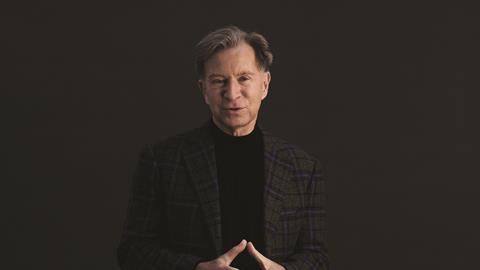

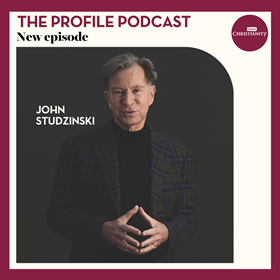
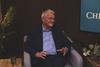
He’s on first-name terms with popes and prime ministers and has given much of his wealth away. But Catholic philanthropist John Studzinski believes generosity isn’t just about money – time and talent matter just as much as treasure.
When I ask the highly influential philanthropist John Studzinski what gets him out of bed in the morning, he takes the question more literally than I intended. I’m soon treated to a rundown of his morning routine, which includes getting up at 4am to pray. He follows this with an (unsuccessful) attempt to convince me he’s not that impressive – he has friends who rise a whole hour earlier to begin their intercessions, he says.
We’re meeting to discuss his new book A Talent for Giving (Bloomsbury). I’m struck by how the former Morgan Stanley and HSBC banker seems more at ease discussing his Catholic faith than he does his finances. When it comes to wealth, the 69-year-old, who has never married and has no children, is matter of fact: the more you earn, the more you can give away. It is thought that ‘Studs’ – as he’s known to his friends – was at one point earning £13m a year.
Studzinski rarely grants interviews. But when he does, he often references Jesus’ words “To whom much is given…much will be required” (Luke 12:48, NKJV). It’s an important sentiment from a man who is unafraid to challenge others to put their wealth to good use, and who reportedly counts among his friends the last four popes, several members of the Royal Family, former prime minister Gordon Brown and Sting. Investing his wealth in good causes seems to bring him genuine joy. You could say it is a ‘calling’, but not in the way the term is perhaps traditionally understood. At one point, he thought he might be called to the priesthood. But his friend, Pope John Paul II, dissuaded him: “You will be much more useful to the Church if you don’t become a priest.”
His generosity origin story begins aged six, when the young Studzinski started volunteering in a Boston soup kitchen. Fast forward to 1980, and he co-founded The Passage, which has since become London’s largest day centre for homeless people. I’m impressed to discover he still volunteers there every Sunday evening as a receptionist. It’s an embodiment of his philosophy that God wants us to be generous with our time and our talents, not just our treasure.
What gets you out of bed in the morning? What drives you?
Well, I get up every morning at four o’clock, although many of my close friends get up at three o’clock. They think that’s the hour to really pray, because it confronts some of the dark forces of the world. But I see 4am-8am as my private time, my prayer time, my contemplative time. It’s time to exercise and walk my dogs and think. Time is the most powerful gift from God. Then I go to Mass every day at eight o’clock.
In May 1987, I was in a car crash in Frankfurt and had a near-death experience. I guess after that I was even more mindful that I had some purpose, and I was much more rigorous about being more God-centric.
What happened?
I was 31 years old, working in investment banking at Morgan Stanley. We were on the autobahn, and there was a torrential downpour. The car in front crashed with a number of other cars and my driver couldn’t brake in time. He did not survive. I broke all my ribs in three places; my left arm was in 62 pieces and I lost a lung.
I was in intensive care for a week. The German orthopaedic surgeon came in one morning when I was on life support, and he said: “I noticed you’ve got very strong faith.” I said: “How do you know that?” He said: “Well, you don’t talk about it, but I watch you meditate.” He took this big leather medicine ball, threw it at me and said: “I want you to pray and meditate and inflate this. If you do, you’ll inflate your remaining lung. Otherwise, you’ll be on an artificial breathing apparatus for the rest of your life.”
Treasure without time or talent withers on the vine very quickly
I was impressed with his astute observations. I sat there, praying and meditating for a good hour with my medicine ball – and I inflated my lung. It was a perfect example of what I call ‘real prayer’. It was not peppered with a lot of flowery language. It was very emotional. You’re entirely embracing God and asking for something in a very powerful, spiritual and soulful way. It saved my life.
Your faith was there from an early age. What are your memories of being raised Catholic?
My mother was a very strong Christian. As a nurse during the second world war, she took care of a lot of people. I was born on St Joseph’s Day (19 March) during a blizzard, and because of her knowledge of the scriptures, she perceived that the birth of a child in a dramatic way on an important saint’s day was very auspicious.
I remember, at the age of five or six, coming home from school and saying to my mother: “I would like to have everybody [in my class] home for supper to meet you.” She said: “No problem.” I said: “Good, because I’ve invited them all for Monday evening.”
That was when we began talking about what we could do to support the homeless and the poor in the town I lived in, because there was a need at that time for a soup kitchen. You would think six-year-olds were clueless, but we were very purpose-driven and we didn’t want to waste time [so we set up a soup kitchen].
It’s funny, you often can’t teach young children about the scriptures, or even about faith. But you can teach them through service. Doing service gives people a much closer proximity to humanity and to the will of God. That’s why I’m a big fan of volunteerism as part of a core curriculum in schools – it’s such a powerful way to teach Christianity.
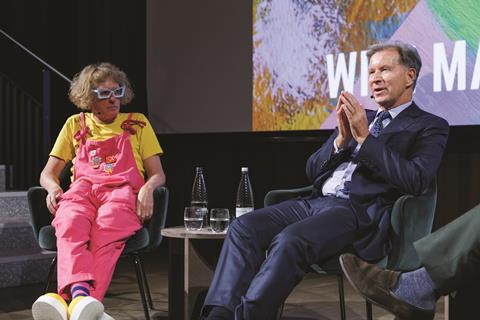
You were six years old when you volunteered in a soup kitchen. I imagine volunteering might look a little bit different for you now?
Well, I still do it. I still work in The Passage on Sunday nights as the receptionist. The thing people have to remember about volunteering is we think we’re giving our time and our insights, or whatever. But when you’re working with people, God holds up a mirror. And I believe strongly that God speaks to us through other people, particularly the marginalised, the poor and the vulnerable.
You’ve had a long career in banking, working with HSBC, Morgan Stanley and Blackstone. Have you experienced any ethical or moral dilemmas? Some might assume there to be a clash between your faith and those corporate environments.
The English are preoccupied with God and mammon. How can someone be interested in God and money? And I just go to the scriptures and say: “Give to Caesar what is Caesar’s and give to God what is God’s” [Mark 12:17].
When people say: “Why do you work with all this money?” I say: “First of all, the more money I make, the more I can give away.”
We’re all given the ability to allocate assets. Your greatest asset is time. Your other great asset is talent. Whether you have time, talent or treasure (money), God wishes you to allocate those things.
I spent a lot of my late teens working with Mother Teresa in Calcutta, in the leper colony. She always nurtured me and said: “Remember, you can only change the world one person at a time.” And she was quite rigorous at taking money from anyone – and I mean anyone. She would always say: “The money comes to me, I bless it and I put it to good use.”
So, it’s not about how much money you have. It’s about how you allocate it?
People think that to have an impact in society, you need to have a lot of money. I actually don’t think that’s right at all. You have to understand your entrepreneurial skills or your talents. Think about the Parable of the Talents, particularly the gentleman who buries his talent. I think we all bury certain talents that have to be unearthed and nurtured and put to good use. But I also think we can do a lot with them if we actually juxtapose our talents with what we’re passionate about.
We’re all given the ability to allocate assets
None of this is very modern. You can find all this in the scriptures: “to whom much has been given, much is expected. And those who have been given much, even more is expected” [see Luke 12:48].
You’ve been unafraid to encourage wealthy people to invest more of their resources in good causes. You previously suggested we should scrap the Sunday Times Rich List and instead publish a list of who has given the most money away. Is that still your view?
I’ve had challenging conversations with some very wealthy people across the world. And many wealthy people do give away a lot of their money through foundations. I think I’ve also reached a point of [thinking]: Who am I to judge? But having said that, I would be more inclined to encourage them to look at partnerships with a broader range of society, where you can encourage more people to engage in giving for the common good.
You believe we can all be generous with our time, talent and treasure. But surely the people who can make the most difference are the millionaires, not the average people who may only have a few pounds to donate to a good cause?
Financial wealth enhances the state of the planet, but it has to be deployed in what I call a stealth bomber way, which comes through the human channel.
There’s so much potential in individuals. You can have a big impact through mentoring – and there’s a domino effect. Look back at your own career and who gave you your first break, who trusted you, who invested in you, who nurtured you, who gave you an apprenticeship. It enhanced your dignity, your self-confidence, your identity as a human being. Chequebook philanthropy doesn’t always do that.
Treasure without time or talent withers on the vine very quickly.
There’s so much need in the world, but you can’t help everyone. How do you decide which causes or projects to back financially?
It’s simpler than it would seem. Everything I do relates to human dignity, whether it’s someone who is homeless (The Passage), or trying to rescue someone out of modern slavery (Talitha Kum) or if you’re a young artist and you’re not from the upper middle class but want to become a composer, actor, painter, poet, photographer or set designer and need your first break (Genesis Foundation). When you give someone a break, you enhance their self-confidence and their dignity.
I’ve been a big supporter of Riding for the Disabled (RDA) in the UK. Everyone thinks the RDA is about horses and the glamorous English countryside, but it is actually about working in the community, and the horse is the tool. It can enhance an individual’s motor skills, their mental acuity and give them a greater sense of self-confidence and dignity.
What’s your opinion of Generation Z? Will a new generation of entrepreneurs rise to your challenge of being generous?
I think the media and the world has Gen Z wrong. Jonathan Haidt’s book [referred to them] as “the anxious generation” tied to social media, but the data suggests they actually are bottoming out on the use of social media and certain types of apps. The data suggests that 15-30-year-olds have an increased likelihood of believing in a higher power. Many more are going back to Christian services in North America and the UK.
The more money I make, the more I can give away
While this generation is seen – to use that terrible word – as high-maintenance ‘snowflakes’, the reality is they’re hypersensitive. And I think we have to be careful here. Hypersensitive people are closer to humanity, closer to the human condition. They have more insights into human dignity, and they’re closer to God. For those reasons, I think they represent a generation of substantial hope.
How has your faith changed over time?
My prayer life has become, in some respects, simpler. It’s become more regular – and potentially more repetitious – and more contemplative, even sitting and staring at the cross for ten-to-20 minutes a day. When someone says to you: “What are you actually praying when you’re staring at the cross?” sometimes the answer is: “I’m not praying anything. I’m just being in the presence of the crucifixion, which is the most powerful thing that we all have witnessed.”
How would you like to be remembered?
I’ll be 70 in March, so I’m entering the last quadrant of my life. I do find myself spending a lot of time with older people as they contemplate death and going home to the Lord. But I’m not big on remembering. I only want to be remembered by the individual people whose lives I’ve touched.
I’m not into vanity building sites or bricks and mortar. I think it’s more a question of: “How many lives have you touched?” and “How many people have you inspired to touch the lives of others?”
Let’s get realistic. Ashes to ashes, dust to dust. It’s profound on Ash Wednesday, but it is a reality. We’re a speck in the universe. You’ve just got to remember it’s more about your behaviour today, and how you enhance the human condition.
To hear the full interview listen to The Profile podcast premier.plus/theprofile
A Talent for Giving (Bloomsbury) by John Studzinski is out now


















No comments yet