










Kingdom Code’s hackathon saw a room of Christian coders come together to tackle the language barrier isolating churchgoers whose first language isn’t English. Mike Ashelby tells the story behind the innovative AI translation tool they created
Christmas is the season of the open door. It is the one time of year when the “stranger” is most likely to walk into our churches — neighbours, international students, and extended family members drawn by the carols and the candlelight.
But for the more than five million people in England and Wales who do not speak English as their main language, that open door often leads to a closed experience. They are physically welcomed, but spiritually isolated. They stand in the crowd, surrounded by the warmth of the community, but the message of the service remains locked behind a language barrier.
The incarnation was the ultimate act of translation. It wasn’t just God speaking to us; it was God becoming human so that we could truly know him. At Breeze Translate, our mission is to help the UK Church reflect that heart. We believe that if someone walks into a church this December, language should not stop them from hearing the most powerful message of all: Emmanuel, God is with us.
From Pizza and Code to a “Digital Pentecost”
This mission didn’t start in a cathedral, but in a room full of coders, snacks, and a tight deadline.
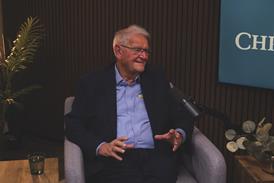
The setting was Kingdom Code, an annual Christian hackathon where technologists gather to ask: How can we use our skills to serve the Kingdom? Tim Moger from NEFC Church stood up and pitched a problem that is becoming increasingly common: our communities are diversifying, but our church services are leaving people out.
For me, this problem wasn’t theoretical; it was sitting in the seat next to me.
Two Iranian asylum seekers had recently joined our congregation. One spoke limited English; his mother-in-law spoke none. I remember the helplessness I felt trying to welcome them into the community. We did what we could — we pasted Persian text onto the projector for the liturgy — but the moment the service moved on, they were cut off.
It wasn’t just the sermon they missed. It was the notices, the updates on community life, the small invitations to belong. After the service, the young man could manage a basic conversation, but the heart of the message — and the invitation to participate in the family of the church — was inaccessible. His mother-in-law sat through the entire service in silence. We were welcoming them into the building, but we lacked the tools to welcome them into the fellowship.
A Romanian woman, who sat silently through services for three years was literally crying with joy the first time she could hear the sermon in her own language.
That weekend, a team formed around Tim’s idea, led on the technical side by Ben Hartman. Ben brought extensive expertise in real-time communications to the table, but perhaps more importantly, he brought a missionary’s heart. Living in Germany and speaking German as a second language, he knew intimately the fatigue of trying to process faith in a non-native tongue.
Over 24 hours, the team built a prototype. Originally, we called it “deBabel” — a reference to the Tower of Babel, seeking to reverse the confusion of languages. But as the project grew, we realised we didn’t just want to tear down a barrier; we wanted to invite the Spirit in.
We renamed it Breeze Translate, a nod to Acts 2. At Pentecost, the Holy Spirit came like a “mighty rushing wind” — a breeze — and suddenly, everyone heard the good news in their own native tongue. That became our hope: to build a tool that clears the way for a similar connection today.
How It Works
Since coming on board to help expand the reach of Breeze, I’ve seen that simplicity is key. We didn’t want to create an app that people had to download (a barrier in itself). Instead, Breeze is browser-based.
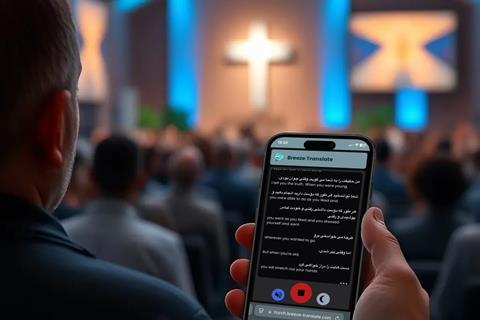
The church connects their sound desk to a computer — or simply places a mobile phone on the lectern — and the system does the rest. The congregation scans a QR code, and their own phone becomes a personal interpreter, providing live, real-time translation in their own language.
Crucially, it works both ways. The system supports a host of different input languages with automated language switching. This means a service can be truly multilingual — a contributor can get up and share a testimony in Farsi or pray in Ukrainian, and the English speakers in the room will see the translation instantly. With hundreds of output languages available, it allows everyone to participate, not just listen.
In Slough Baptist Church, the leadership used Breeze to support an Italian woman who had attended for years, relying on her husband’s faltering whispers to understand. When they switched on Breeze, she told the leadership it was the first time she felt she could truly connect with the service independently.
Similarly, Gareth Ingle from All Nations Church in Fir Vale shared a story that stopped us in our tracks. A Romanian woman, who had sat faithfully but silently through services for three years, used Breeze for the first time. Gareth told us, “She was literally crying with joy the first time she could hear the sermon in her own language.”
That emotion is the difference between being an observer and being a participant.
A Christmas Welcome Initiative
Today, Breeze is used in hundreds of churches, but our vision is for thousands. We see a UK church that looks increasingly like the vision in Revelation 7:9 — a multitude from every nation, tribe, people, and language.
We know that this Christmas, many churches will host guests who don’t speak English. We also know that the fear of technical costs often stifles outreach.
That is why we have launched “The Christmas Welcome Initiative.” We decided to remove the cost barrier entirely. Any church that uses Breeze Translate for their standard services gets all their extra Christmas events — carol services, Crib services, midnight mass — included for free.
The technology behind Breeze is complex, but the goal is simple. It started with a few coders at a hackathon, but it has grown into a movement to ensure that when the church declares “Joy to the World,” the whole world — in every language — can understand the invitation.
For more information visit Breeze Translate



















No comments yet