












When Pope Leo politely declined to pray inside a mosque, he modelled how Christians can show respect for our Muslim friends, while being clear about our theological differences, says Andy Bannister
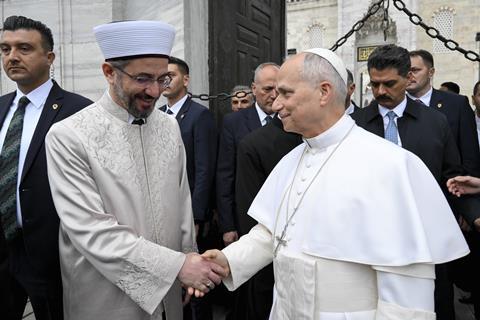
Last week, during a visit to Turkey, Pope Leo visited Istanbul’s famous Blue Mosque. This was Leo’s first visit to a Muslim place of worship and the world’s press was watching. Pope Leo politely removed his shoes as a sign of respect, but declined the Imam’s invitation to pray.
Some might wonder what the issue is. Can’t Christians pray anywhere?
While that’s true, it misses something important: we live in a symbolic age. Most people, seeing a headline or photograph about the Pope praying with Muslims, would automatically read it through the lens of religious pluralism. “Aha,” they’d conclude, “all religions are the same. Muslims and Christians worship the same God.”
By showing politeness and respect while also saying “no” to prayer, the Pope sent a more powerful message. Difference need not divide us - Muslims and Christians can be friends. But we can also be clear that we do not believe the same thing.
“Abrahamic faiths”
It’s common to assume that because Muslims and Christians are both ‘Abrahamic faiths’ they’re very similar. But the ‘Abraham’ of the Qur’an is merely a religious building block that Muhammad borrowed as he built Islam. Believing religions were the cultural glue that made nations, Muhammad wanted to give the Arabs a religion. As he did, Muhammad drew on the religious stories (Jewish, Christian, and Arabian religious traditions) circulating around Arabia. Hence the Qur’an has ended up with names and fragments of stories that Christians recognise, jammed together with things we don’t, and a very different theology behind it all.
genuine friendship requires honesty, not a naive papering over of significant differences
Unlike the relationship between Christianity and Judaism—the first Christians were mainly Jewish, Jesus was a Jew, the New Testament quotes or alludes to the Old Testament thousands of times—the Qur’an was compiled centuries after Jesus, a thousand miles away from the lands of the Bible, and by people who didn’t know it firsthand. Islam is not a sister religion to Judaism and Christianity, but needs careful study in its own right.
The differences
Further confusion comes because our Muslim friends often use the same words as Christians, but mean different things by them. In my book Do Muslims and Christians Worship the Same God? I look at several key areas where this matters, of which the most important concerns the word “God”.
Just because Muslims and Christians believe in one God, doesn’t mean it’s the same God. When you look at the core characteristics of God in the Bible—God is relational, can be known, is love, and has suffered for our salvation—the Qur’an ignores, rejects, or rewrites each category.
Relationship: in the Bible, God often relates directly with humanity, calls his people children, and invites us into relationship in which we can call him Father. In the Qur’an, Allah is utterly transcendent. Humans relate to him as servants to a master. No friendship, no adoption, no intimacy.
Knowability: God in the Bible reveals far more than just commandments, but discloses his character, and reveals himself most fully in Jesus. By contrast, Allah in the Qur’an reveals his laws, but never himself in any deeper way.
Love: The Bible declares “God is love”—love is not just something God does but something God is, flowing from his very nature as triune. The Qur’an, conversely, never uses such language and rarely speaks of Allah’s love which, at best, is more akin to a favour Allah endows on those who earn it.
Suffering: God in the Bible grieves over our sin and out of love stepped into history in Jesus to pay the price we never could so we can be reconciled to him and spend eternity with him. By contrast, Allah in the Qur’an does not “save” anybody—rather humans must carry their own burden, hoping their good deeds outweigh their bad so they can attain Paradise.
These are not minor differences but recognising them does not prevent Christians and Muslims being friends. Indeed, genuine friendship requires honesty, not a naive papering over of significant differences.
Beautifully unique
When you speak to Muslims who have become Christians, they won’t tell you it was “because we realised it was 99% the same”. Rather they discovered that Jesus was beautifully different. One example is my late friend Nabeel Qureshi, whose story is told in Seeking Allah, Finding Jesus. He yearned not just to know about God but to know God—a journey that led him to discover, in Jesus, a God who was far more than he had ever imagined in Islam.
In politely declining to pray, the Pope modelled hospitality and respect, but also clarity and confidence. As Christians we are likewise called to show friendship to the Muslims we meet, but also a conviction in the uniqueness of Christ. And truth shown with love, conviction with grace, is very winsome.

























2 Readers' comments