


The US government’s removal of Venezuelan president Nicolás Maduro brings much uncertainty for the country’s religious leaders, says Anna Lee Stangl
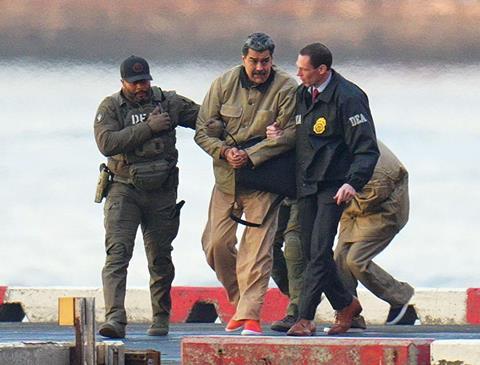
On 3 January, the United States government forcibly ousted Venezuelan president Nicolás Maduro from power, and physically removed him and his wife from the country. This action is unlikely to have a direct impact on freedom of religion or belief (FoRB) in the short term, but it will complicate the already tense relationship between religious leaders and the ruling United Socialist Party of Venezuela (PSUV).
On its own, Maduro’s absence is unlikely to result in serious political instability. The tendency to refer to the government under his leadership as ‘the Maduro regime’ has contributed to a misperception that the system was centered around him as an individual, and that his removal could cause it to crumble.
The US ousting of Maduro could be used to impose even harsher restrictions on religious leaders
On the contrary, the transition from Hugo Chávez, who enjoyed a cult of personality around his rule, to the far less charismatic Maduro was carried out strategically, with the active support of key leaders. It was also in close consultation with the Cuban government, which, since Chávez came to power in the early 2000s, has provided critical support to Venezuela in the form of security, intelligence and military advisors.
Today, most of those key Chavista leaders who helped orchestrate Maduro’s transition to power remain in place. This includes the now acting president, Delcy Rodríguez Gómez and her brother, the president of the National Assembly, Jorge Rodríguez Gómez. Minister of Defense Valdimir Padrino López, and Diosdado Cabello Rondón, who heads the Ministry of the Interior, Justice and Peace control the military, which has been repeatedly purged over the past two decades, eliminating any potential forces unsupportive of the Chavista regime.
Informers unite
More broadly, 23 of Venezuela’s 25 states are led by PSUV governors and around 90 per cent of municipalities are headed by PSUV mayors. Over the past two decades, armed groups of Chavista militants, called colectivos, have been set up across the country. They are present in urban neighborhoods, towns and villages and have already been activated, acting as brute enforcers to ensure that no expressions of support for Maduro’s removal take place. They go door to door interrogating residents and reviewing their devices for any social media statements that could be perceived as disloyal.
Authority figures at every level will now be scrutinising independent civil society leaders – not just those working with human rights and pro-democracy groups, but also religious leaders. The ability of religious leaders to convene and speak to groups of people, as well as the influence that they hold will make them of particular concern.
Uncertainty about what will happen next is likely to make government leaders hypersensitive to any kind of declaration or action that is not plainly supportive of their legitimacy. Religious leaders will feel pressure to speak with caution, both in the public sphere and privately. The Venezuelan government has long encouraged its citizens to inform on one another, most recently promoting a mobile phone app to do so.
Private conversations - and even prayer conducted in the context of a home group, for example - could be vulnerable to informants cooperating with the government, either voluntarily or under pressure. There is a possibility that things could go further, with attempts to maintain neutrality or to stay apolitical interpreted as treason.
Columbia calling
In the western part of the country, the presence of illegal, armed groups from Colombia, such as the National Liberation Army (ELN), a guerrilla group provided with safe haven by Maduro’s government, further complicates the situation for religious leaders.
The ability of religious leaders to speak to groups of people will make them of particular concern
In Colombia, the ELN has a long history of persecuting religious leaders, especially Protestant pastors who they accuse of being agents of imperialism, and restricting FoRB in areas under its control or influence. Over the past decade, the group has demonstrated a similar antipathy to Protestant Christianity in Venezuela. The US ousting of Maduro is only likely to harden its idealogues and could be used as a justification to impose even harsher restrictions on FoRB and threats against religious leaders.
It is extremely difficult to predict what will happen next in Venezuela without knowing what further actions, if any, the US might be contemplating. As long as the Chavistas remain in positions of power at the national, state, and municipal levels, however, the polarisation that already exists within broader civil society will become even more extreme. At some point, this may mean that demands of public political loyalty will be made of religious leaders. Those who are unable or unwilling to pledge their allegiance to Chavismo may find themselves to be targets.









No comments yet