






An ancient Christian tradition is making surprising inroads into the world of alternative rock. From Lacey Sturm’s alt-metal to HolyName’s metalcore, musicians are finding depth, discipline and meaning in Eastern Orthodoxy. Mike Starkey explains what’s behind the trend

In the late 1970s a young English composer, John Tavener, converted to Orthodox Christianity. He started attending St Sophia’s Greek Orthodox Cathedral in London’s Bayswater, and embarked on studies of the early Church Fathers.
The iconography, theology and ancient liturgies of the Orthodox Church became a dominant influence on Tavener. A little over a decade later, his work The Protecting Veil debuted at the BBC Proms and went on to become the best selling classical album in Britan. It was even shortlisted for the Mercury Music Prize (a rare achievement for a classical piece). Tavener had drawn on the traditions of Byzantine chant. His aim was to create an “icon in sound”.
The beliefs and liturgies of the Eastern Orthodox Church have gone on to shape classical music, notably in the work of the Estonian composer Arvo Pärt. But today its influence is as likely to be felt in the edgier worlds of indie rock, alt-metal and metalcore.
The Strange Story of Luxury
Luxury was formed in the early 1990s at a small Christian college in rural Georgia, USA, by brothers Lee and Jamey Bozeman. Their sound was a guitar-based indie rock with plaintive, poetic vocals – in the same neck of the woods as The Smiths and Radiohead. In 1995 the band were driving home from the Cornerstone music festival when their van was involved in a serious road accident. The band members and others travelling with them survived the crash, but some sustained life-changing injuries.
Recovery was slow. During this time some band members started exploring Orthodoxy, eventually converting to the ancient faith. Three of the five band members are now priests in the Orthodox Church in America (OCA).
In a culture of relativism, Orthodoxy believes in absolute truth
Their indie rock sound remains unalloyed by their priestly vocation. The driving, upbeat pop sensibility of their latest album’s lead single, ‘Maker (Wheel Within a Wheel)’ belies its dark origins. Bandmember Lee Bozeman had been hearing sacramental confessions on a teen camp, and was struck by the levels of anxiety and depression he was hearing about, and the high numbers of the teens on medication. The song is a response to this, inviting the troubled hearer to a place of rest.
Lacey Sturm and Kenotic Metanoia
The highest profile rock convert to Orthodoxy is alt-metal vocalist Lacey Sturm, the first solo female artist to top the Billboard Hard Rock Albums chart.
Sturm, then named Lacey Mosley, had first exploded into the world of heavy music as singer of Flyleaf.
She had a troubled adolescence, dominated by drug abuse, depression and suicidal thoughts. When she was aged 10, her three-year-old cousin was beaten to death by his stepfather. She turned her back on any concept of a loving God and became an atheist. An unexpected evangelical conversion at 16 transformed her life, and would later model a hope of healing for the emotional pain shared by many of her fans.
In 2008 she married guitarist Josh Sturm. Together they began to explore the traditions of Eastern Orthodoxy. They read Orthodox writings, including The Orthodox Way by Bishop Kallistos Ware, a British convert to Greek Orthodoxy. By 2020 the couple had converted too. Her powerful 2023 album, Kenotic Metanoia, references her journey to Orthodoxy: Kenotic Metanoia is Greek for self-emptying repentance.
Orthodox Metalcore
The conversions of the Sturms and Luxury to Orthodoxy deeply affected their lives and lyrical content, but didn’t fundamentally change their musical genres. Luxury still sounded like wistful 90s indie. Sturm and Flyleaf still made epic alt-metal.
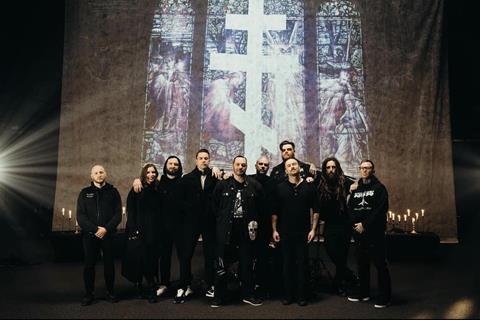
By contrast, HolyName fuses the aesthetics and liturgies of Orthodoxy to push the boundaries of the genre itself. In the case of HolyName, that genre is metalcore – an aggressive fusion of metal and punk that often incorporates harsh vocals. Even in the world of rock, metalcore is at the outer limits and not for the faint of heart.
From 2006 to 2018 Tommy Green was vocalist of Sleeping Giant. He finally called time on the band amid a turbulent period of personal brokenness and spiritual crisis. In 2017 he was received into the Greek Orthodox Church along with his wife and sons.
Green’s new project, HolyName, draws on the content and imagery of his new faith to dramatic effect. The band’s highest profile track, ‘Fall Down on Your Knees’, is a collaboration with Brian ‘Head’ Welch, guitarist of nu-metal band Korn. Their record label describes the project as “a love letter to Christ and a tribute to the history of Eastern Orthodoxy”. In other words, it’s the raucous love-child of John Tavener.
‘Fall Down on Your Knees’ is a worship song to Christ as Lamb of God, focusing on personal surrender. It draws on the imagery of Revelation, a book beloved of the Orthodox churches. It is chanted in an Orthodox extended, repetitive ‘drone’ style, echoing ancient liturgies. The video evokes Orthodox aesthetics and iconography: darkness lit by candles, images of Mary with heart pierced by swords, skulls as a memento mori (reminder of human mortality), the three bar cross of Orthdoxy.
The Appeal of Orthodoxy
At first glance, the collision of avant-garde rock and an ancient Christian tradition that resists change and is indifferent to cultural relevance might seem odd. But on reflection the appeal becomes clear:
• In a shallow consumer culture driven by a restless quest for novelty, Orthodoxy offers ancient tradition and unbroken continuity.
• In a selfie culture, Orthodoxy shifts the focus away from narcissistic introspection, and outwards to the external, embodied and communal.
• In a culture of relativism, Orthodoxy believes in absolute truth and good and evil. It takes biblical accounts of the demonic with utter seriousness.
• In a culture of hedonism, Orthodoxy offers rigorous self-discipline and clear structures for life and worship.
• In a culture of noise, chatter and social media, Orthodoxy invites believers into silence.
• In a modern church culture where so much worship centres on my personal feelings about God, Orthodoxy shifts the focus to sacrament, ritual and time-honoured doctrine. I participate in a drama bigger than my own emotions.
• The aesthetics of Orthodoxy fits well in rock subcultures such as metal. Here skulls, exotic crosses, robes and vestments, candles and icons are already cool.
Cautionary Notes
Has the arrival of Eastern Orthodoxy in rock culture been a good thing? Absolutely. It evidences a hunger for faith, depth, roots, community, structure, discipline and meaning. It offers solid nourishment to the spiritually searching, and a rebuke to the spiritual junk food or thin gruel that sometimes passes for Christianity in the West.
Is it entirely positive? Far be it from me to judge other’s spiritual journeys, or one of the great traditions of world Christianity. But as a sympathetic observer, I’d offer three cautionary notes:
1. Orthodoxy as Style
Orthodox faith offers a healthy antidote to our superficial and identity-obsessed culture. But escaping from the gravitational pull of consumer culture is hard. Orthodoxy itself can become just another lifestyle choice, a cool new set of images for social media. As in any Christian tradition, the real challenge is discipleship.
2. Orthodoxy as Politics
Orthodox churches have roots in specific cultures: Russian, Greek, Syrian, Romanian, and so on. Ethnic churches can import cultural baggage from home cultures, along with with old grudges and enmities. Most notoriously, Patriarch Kyrill of Moscow has supported Vladimir Putin’s bloody incursion into Ukraine.
If charismatic Christianity risks adulterating faith with the values of Western culture, Orthodox Christianity risks adulterating it with a macho political and cultural conservatism from Russia and Eastern Europe. Most recent converts to Orthodoxy in the USA have been young men on the political right, introduced by online influencers. According to Pew Research, 64% of American Orthodoxy is male, and significantly younger than most denominations. They even have a nickname: orthobros.
A recent feature in The New York Times on the revival of Orthodoxy notes the dangers of the faith being identified exclusively with the far-right. Certain corners of the Orthodox internet are not just conservative or traditionalist, but openly racist and antisemitic, with several far-right figures converting in recent years.
3. Cultural Disconnect
There is a bigger question of how Christianity fits into any human culture. This has preoccupied Christian missions down the centuries, as faith is constantly reimagined in new settings. At its best, the Church manages to speak eternal truths in the dialect of its host culture.
The stark disconnect of Orthodoxy from Western culture is clearly part of its current appeal. But I can’t shake off a suspicion that a spirituality based on changeless tradition, from a distant part of the world, will always feel like an exotic import to most in the West, and is likely to remain a minority option.
Nevertheless, whatever they’ve got in that Orthodox holy water, it seems to be refreshing parts other churches can’t reach.




















1 Reader's comment