


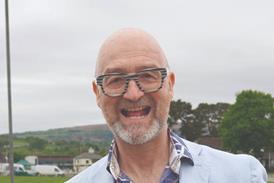




Living with neurofibromatosis, Oliver Bromley has been mistreated his entire life. But he’s still choosing resilience over revenge
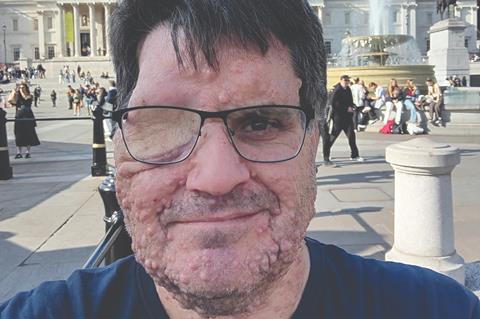
Oliver Bromley has held to one guiding mantra passed down by his grandmother during the most trying years of his life.
“You have to wake up, make your bed, look in the mirror and know who you are,” he says with conviction. It suggests the words were once delivered to him with the same intensity – one woman’s conscious effort to instil a much-needed sense of security in her grandson.
Early life
Bromley was born with neurofibromatosis, a genetic condition caused by a faulty chromosome. It prevents the production of neurofibromin, the protein that regulates cell growth and combats tumours. Primarily, this results in growths along the nerves, appearing as lumps beneath the skin. For Bromley, these first began to emerge in his adolescence.
“I had a big tumour, a plexiform fibroma, that grew in my right optic orbit and caused my eye to sag,” he explains. His symptoms drew cruel attention. Schoolmates branded him “Cyclops” and “one-eyed man”, mocking his impaired vision with jibes about him walking in circles. “I faced a lot of teasing and heartache because of that.”
It was at this point that his grandmother’s words met another anchor. “We were taught memory verses at school and Psalm 139 stuck with me. The part where it says: ‘I praise you, Lord, for I am fearfully and wonderfully made.’ [v14, ESV]” The two worked in cohesion – his grandmother’s encouragement to “know who you are” was cemented by the realisation of how divine that identity truly is.
Choosing resilience
Bromley’s neurofibromatosis has meant multiple hospital visits and operations. Last August, following one of these and weary of hospital food, he walked into a restaurant near King’s College Hospital in Camberwell, London.
He attempted to order a meal but was told it was cash only, so he stepped outside to withdraw money. When he returned, the manager stopped him. “They said: ‘You’re scary-looking. The [customers] are complaining about you. Please leave now.’”
It happened so fast that Bromley barely registered what was happening. “Incredulously, I asked him to repeat himself because I didn’t understand.” The man reiterated that he should leave.
Bromley sat down in nearby Camberwell Green park and broke down. “I bawled. I cried my eyes out, I asked: ‘Why, Lord? I’m at the lowest point in my life. All I wanted was a nice meal. Why has this happened?’”
Hurt, he phoned his wife, Bridget. “It was a Sunday afternoon. She got on a train from Reigate in Surrey and came straight to the hospital,” he recalls. When she arrived, the pair began to formulate a plan of action.
The hospital matrons reported the incident to the restaurant, and Citizens Advice advised Bromley to first give the owner the opportunity to reply. “I always believe that if somebody’s got something against you, you go to them first. You don’t go above them,” he says. “So, we gave them a week to respond, which they never did.”
From there, the matter was escalated to the Metropolitan Police, who classed the incident as a disability hate crime in contravention of the Equality Act 2010. A local newspaper, The Southwark Times, picked up the story. Soon Bromley’s experience was making national and international headlines.
But despite his experiences, Bromley opted not to take legal action against the restaurant or name them publicly. He “didn’t want to make it about revenge,” he explains. “The Lord says, ‘Vengeance is mine’ [Romans 12:19, ESV]. I wanted to use it as a teaching moment, to raise awareness of neurofibromatosis.”
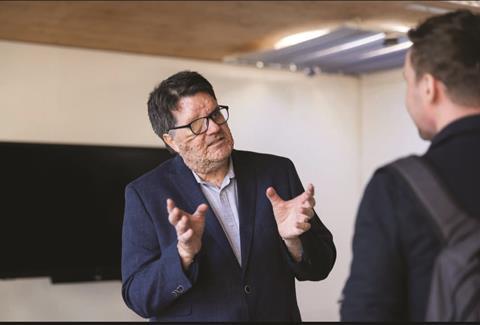
Thanks to the increased media attention, Bromley quickly became a prominent advocate for all those living with disabilities who are discriminated against on a daily basis.
A strong foundation
Bromley insists that God’s love has sustained him throughout all of the hard-heartedness he’s encountered during his life. “We grew up in a family that prioritised faith. We went to church every Sunday. My parents were born-again Christians, so they encouraged my brother and I to put our faith in Christ.” He made a personal commitment to Jesus while watching Billy Graham on TV, before later joining a Brethren church in his young adulthood.
Yet, every day for Bromley requires intentionality. A conscious standing on who God says he is, against lies from the enemy that come dressed as stares, double takes and inappropriate questions informed by ignorance about his condition.
“Romans [12:2] tells us to be ‘transformed by the renewing of your mind’. We have to capture those thoughts and reframe them.
“I think there’s something to be said for telling yourself every day that you are a child of God, that you’re ‘fearfully and wonderfully made’. What other people think about you is none of your business. And I can honestly say I no longer care what people think about me.”
For Bromley, resilience isn’t a place at which you arrive, but must choose to dwell again and again.
“You have to keep reminding yourself to lean on Christ. It’s a battle – ‘not against flesh and blood, but against…the spiritual forces…in the heavenly realms’ [Ephesians 6:12]. I’m having to face this battle every day.”





















No comments yet