









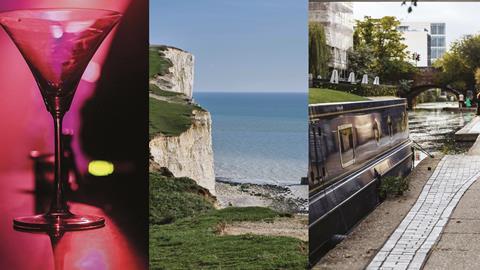
From strip clubs to racecourses: meet the Christians taking God’s presence into places others fear to tread.
Strip club
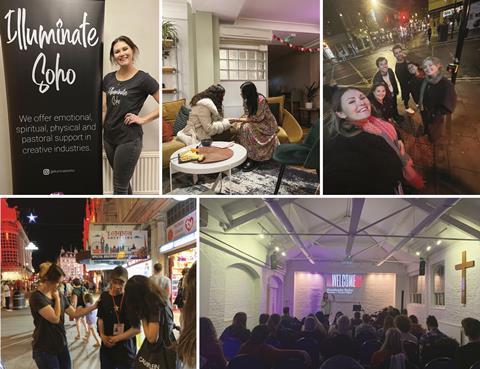
Madison Kinsley is strip club chaplaincy coordinator for Illuminate Soho in London
When I tell people what I do, it definitely leads to the room going quiet for a second!
We have a couple of clubs that we go into each week. We always go in pairs and we have at least two people outside praying the whole time. At the end of the night, we gather together to pray, because it’s a dark environment we’re in.
On the whole, the girls really love us. But it wasn’t always like that. Some are more suspicious. We take cakes, cookies – anything sweet, really! We bring gifts for their birthday. We really want to bless anybody that is in that space. We offer wellbeing and mental health checks – or just a listening ear. I often say: “If you need to laugh, I’ll laugh with you. And if you need to cry, I’ll cry with you. I’m here to be with you in whatever moment you’re in.”
We’re Christians, so obviously we also offer prayer – and we pray for the managers too. We get into conversations about faith quite often. When the girls ask why we’re there, we explain that we’re Christians and we just want to show them a side of God that they’ve perhaps never seen before.
The conversations are sometimes about really high stress situations. Some girls need money to pay their bills and so they have found themselves in this environment. Sometimes it’s relationship issues, friendship issues with other girls in the club or family problems. Quite often, they’re battling anxiety or depression.
Two or three times a year, we run worship nights, where we gather in Soho to pray over the sex industry as a whole, lifting it up to God. We also run events and mentorship. At the moment, I’m meeting around five girls each week, supporting them with mental health or personal issues, helping them with housing situations or to find jobs.
Once, I was in a club when a girl was auditioning. She was so afraid, she was shaking like a leaf. She really didn’t want to be there. We asked if we could pray for her. She said she’d recently started going to church and was planning to get baptised that weekend. She’d previously worked in the industry and said: “I just felt like I needed to get this out of my system before I fully gave my life to the Lord.” We talked with her and she was just weeping. She said: “I feel like this is a sign from God that I’m not supposed to be here.” We were able to talk to the manager and walk out of there with her.
People ask why strip clubs let Christian chaplains in. The women who pioneered this ministry prayed for 18 months outside the clubs before they ever went in and met the managers. So never discount the power of prayer. God is the one who opens the doors.
For more information and to support Illuminate Soho, visit thirdspaceministries.co.uk
Beachy head
Gus Pickett is team supervisor at Beachy Head chaplaincy in Sussex
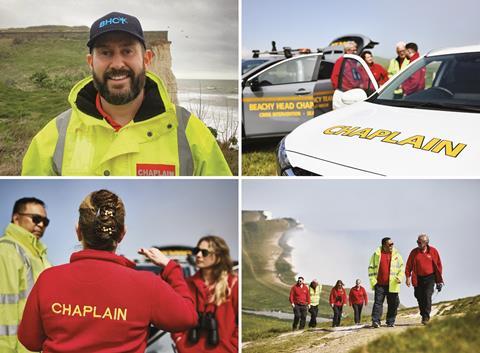
There’s been a chaplaincy presence at Beachy Head for over 20 years and at the moment we are a team of 24. From our base, we patrol 365 days a year, looking for anyone who is in distress or might be suicidal. We support around 400 people every year.
We try to engage people long before it becomes a cliff-edge negotiation – people who are upset, in their vehicle or walking through the area – but about a third of our interventions will be at the cliff itself. The good news is that in the vast majority of cases, if we’re able to talk with someone, they will come back with us. We’re there to demonstrate Jesus’ love, to offer people a path back from the edge and encourage them to take it. Ultimately, the decision is theirs, but we will stay with someone and keep trying to bring them back, however long it takes.
When somebody does choose to end their life, it’s very difficult, but we still did the job that God had us there to do. We were there, speaking words of encouragement, caring about them and loving them in the final moments of their life. It’s very painful, but it’s also a privilege.
Being a Beachy Head chaplain is a calling. People often think we’re solely trying to stop suicide – and that’s a large part of it – but we’re there to help anyone who is suffering or feeling overwhelmed. We work closely with mental health services, HM coastguard and Sussex Police, who often call us about missing people. Sometimes a person needs to go to a psychiatric hospital immediately. More often, they’ll leave us with referrals in place for further support to help start their recovery. The likelihood that they’ll survive is a lot higher when services, family and friends become aware of their situation.
My church pastor told me that God was going to send me to call people back from the edge. At the time, I thought he meant people on the fringes of the church. I forgot about it until I applied to become a volunteer at the Beachy Head chaplaincy team. One day, I was calling a girl back from the edge and I remembered his word. I used to work in the corporate world, so it was a financial step down to take this job, but I’ve never felt more at peace. It’s like your soul rests when you’re doing what God wants you to do, even when it’s very challenging.
In those crisis moments, we’re not evangelising, because our focus is solely on that person’s safety. But maybe at a later date people will think: Who were those people who helped me on the worst day of my life? What did they believe? A number of people we have helped have later become Christians.
God is very much at the centre of what we do. He’s our reason for being there. If there is someone on the edge, one chaplain will be talking with them, and the other will be escalating to the correct agency and noting things down – but also praying. Before every shift, we hand every detail over to God and just say: “Let us be your hands and feet today. Let us reflect your love to the people we meet.”
For more information and to support Beachy Head Chaplaincy visit bhct.org.uk
Horse racing
Rev Simon Bailey is national chaplain to the horse racing industry in Newmarket

A lot of Christians might see horse racing as being propped up by the gambling industry, and ask: “Why would Christians be involved in that?” I would say: “Why wouldn’t they be? This is where Christ would be.”
I’ve loved sport all my life – and God is up to something in sport. When I was offered the job at Newmarket, which is the world headquarters of horseracing, I thought: Why would I not want to be part of this? I’ve been overwhelmed at how the industry has opened its doors to me.
I’m the only paid member of staff, but we have several volunteer chaplains around the UK. Everybody thinks horse racing is just about the race day – the top hat and tails, betting and bars. But staff have the same kind of issues as anybody else – stuff going on at work or in their home life. It really is birth to death – and all those issues in between.
There are around 80 yards and 3,000 racehorses just in the Newmarket area. We’ve also got the British Racing School, where young people aged 16 to their early 20s come and train for their first jobs in the industry. Often, it’s their first time away from home, and they’ve come to Newmarket with big hopes and dreams. They get homesick, or stuff is going on at home. I’m there once or twice a week to chat with them and offer support.
On race days, I try to be around to chat with trainers, riders and owners. Sometimes the conversation is fantastic. At other times, you feel like a bit of a loose part. But you have to be there just for the day somebody says: “I’m struggling” or needs to talk. It’s worth it just for that one person. You don’t really have to do that much – just listen, let them know that you’re there. It’s care, love and compassion that maybe they don’t see elsewhere in the industry.
You won’t work long in the horse racing industry before you have an injury. There’s a lot of risk, and it’s our job to be there for that too. It takes up a lot of my time. Mental health is also a big thing now. A lot of staff stay in the Newmarket area when they retire. That’s when pastoral care kicks in – home visits, deaths, funerals. People really allow you into their lives. But I get back just as much as I give.
It’s quite easy to share my faith. The world of horse racing is quite opinionated. Everybody has their say, and everybody’s quite thick-skinned. You’re known as ‘the racing rev’ – it’s not something you try to hide. People might have a different faith or no faith, but we leave God to fill in that gap. If Christ came for all, he came for all. The rich and the poor, when life is OK and when it’s not. We’ve got to be in and among all of that.
For more information and to support Racing Welfare, visit racingwelfare.co.uk
Waterways
Dr Corina Priest is a waterways chaplain in Derbyshire
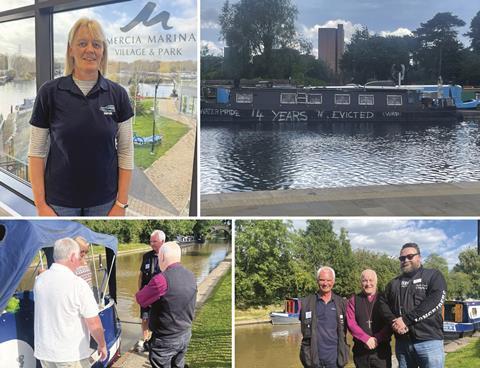
Almost three years ago, I decided to sell up and live on a canal boat. I got a bit obsessed by the idea of living in a tiny house after travelling to New Zealand and watching too much Stacey Solomon’s Sort Your Life Out. My sister suggested I try living on a boat instead!
Last year I qualified as a spiritual director. I was previously a mental health nurse in the military, and I always had a close relationship with the military chaplains. When I found out about waterways chaplains, I could see the organisation had similar values. Earlier this year, I thought it was the right time to get involved.
I’m based at Mercia Marina in Derbyshire. The owner and staff have a real focus on welfare and have welcomed me with open arms. Approximately 500 people live there, so it’s quite a big population. About 80 per cent are over the age of 65. Many have travelled all their lives as continuous cruisers and are now based at the marina because they’ve got health complications or need more help.
Being a waterways chaplain is really rewarding – but it can also be challenging. It’s a voluntary position, and no two weeks look the same. People might die on the marina, receive a terminal health diagnosis or experience bereavement. Supporting those people and their families – whether they have faith or not – is a huge part of the job.
Working collaboratively with others is vital. I can’t provide financial support or sort out people’s debts, but I can encourage them to engage with organisations who can. Many people have had difficult experiences and don’t trust statutory services. If you’re a continuous cruiser, trying to access health services can be really tricky. Sometimes, it is journeying with them and holding their hand to get them there.
I see Jesus in every encounter. It doesn’t matter if a person shares my faith or not. If people want to talk about faith, I am absolutely there for that. But if they don’t, we can show love in a different way. Jesus went to the edges of society. He met with people of other faith backgrounds. I just try to do my best to be there for people at the difficult points in their lives and point them in the right direction.
For more information and to support Waterways Chaplaincy, visit waterwayschaplaincy.org.uk
School
Alex Ewing is director of The Bridge Youth Project in Salisbury. Katie Ollivierre is one of their school chaplains
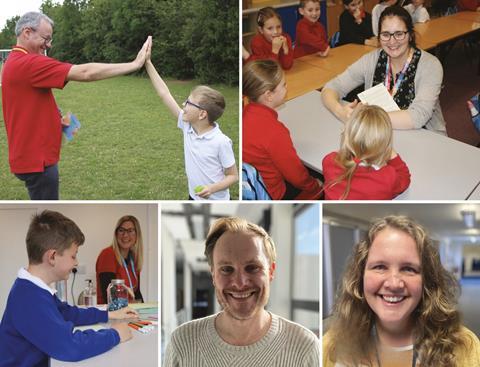
The Bridge has been involved in schools work since 1994, but its chaplaincy journey started in 2012. Today, 13 chaplains serve 23 primary and secondary schools in Wiltshire.
A Bridge chaplain is the only person in the school community who can relate to everyone equally. They can sit with pupils, parents, a governor or a teacher. Whoever it is, they meet them on their level. On one occasion, we met with a headteacher to explain what chaplaincy was. We had barely started the meeting when she broke down in tears, offloading everything she was carrying. That moment of confidential care opened something deep.
Historically, churches have been woven into the fabric of school life. Now many are closing, and volunteers are thinning out. In some areas, the post office has closed, the pub has closed, the church has closed. The school is the only place where the needs of the whole community are seen. Even in church schools, the chaplain is sometimes the only Christian presence people encounter – and where the local church is active, they can enhance and support the great work already happening.
Schools are crying out for chaplaincy, yet many are at breaking point financially. Some have gone into deficit to keep their Bridge chaplain, because they value the role so deeply. It is humbling and challenging. Schools contribute a large part of the cost, and we raise the rest, which means the shortfall grows with every school that asks for support. At the moment, we are having to turn schools away, and that is heartbreaking.
We go in as Christian chaplains, but always with sensitivity and inclusion. In one school, a staff member initially protested: “We don’t need a chaplain here; that’s not who we are.” Six months later, they came back and said: “I was completely wrong about you, and I’m sorry. You make the biggest difference.”
In recent years, we have seen a growing openness and hunger among children, young people and staff. It is exciting to watch. A chaplain might teach a lesson, then be around at break or lunch to continue a conversation. It marks a real shift from being an occasional visitor to becoming a trusted, visible, permanent presence.
One parent wrote to say that her son had been going through an immensely difficult period, and that having someone who genuinely had time for him had been nothing short of life-saving. We hear comments like that often. The simple act of saying: “I have time for you” opens doors, builds trust and changes lives.
For more information and to support The Bridge Youth Project visit the-bridge.org.uk
The chaplains interviewed for this article were speaking to Emma Fowle




















No comments yet